In a postseason defined by star power, rising tension, and shifting narratives across the Western Conference, few storylines have been as unexpectedly transformative as the emergence of Alex Caruso in Oklahoma City’s playoff push. What began as a steady, defense-first role assignment for the veteran guard has evolved into one of the most impactful mid-series surges of the entire postseason, reshaping both the identity and ceiling of the Oklahoma City Thunder as they battle through the Western Conference Finals.
For the Oklahoma City Thunder, Caruso’s arrival in this moment was never framed as a headline acquisition meant to carry scoring load or dominate usage. He was brought in for stability, for defensive tone-setting, for connective intelligence on both ends of the floor. Yet as the stakes have escalated in the Western Conference Finals, Caruso has delivered something far more disruptive than expected: production that has flipped from complementary to essential.
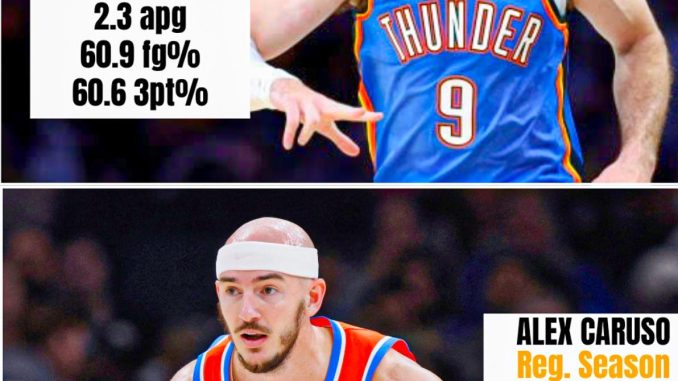
Through the regular season, Caruso’s role was consistent but modest. He averaged 6.2 points per game while shooting 42.3% from the field, anchoring possessions with defensive effort, smart rotations, and secondary playmaking. His value was widely understood within coaching circles and locker rooms, but it rarely demanded attention in box scores or nightly highlight reels. That context makes his current playoff surge not just surprising, but structurally significant to how Oklahoma City is winning games.
In the Western Conference Finals, Caruso has elevated his scoring to 21.0 points per game while shooting an astonishing 60.9% from the field and 60.6% from three-point range. The efficiency alone would be noteworthy for any rotation player, but the volume combined with timing and defensive continuity is what has fundamentally altered the series dynamic. This is not empty production in blowout minutes or late-game stat padding. It is high-leverage execution, delivered in moments when possessions tighten, scouting reports sharpen, and every defensive rotation is magnified.
The transformation has been so pronounced that within Oklahoma City’s internal structure, Caruso’s impact is no longer discussed as a “spark” off the bench or a situational advantage. Instead, he has become a stabilizing force in lineups that previously relied almost exclusively on perimeter creation from primary ball-handlers. When defensive pressure collapses onto Oklahoma City’s lead creators, Caruso has repeatedly punished rotations, attacked closeouts with decisiveness, and converted catch-and-shoot opportunities at a level that has forced opponents to reconsider how far they can help off him.
What makes the surge even more compelling is that it has come without any visible compromise to his defensive identity. Caruso’s reputation has long been built on disruptive perimeter defense, low-error decision-making, and a relentless approach to ball pressure. That identity has not only remained intact during the Western Conference Finals; it has arguably intensified. His on-ball defense has forced uncomfortable initiations from opposing guards, and his off-ball awareness continues to generate deflections, defused actions, and broken sets that rarely show up in traditional box score categories.
Opposing coaches have been forced into uncomfortable adjustments. Leaving Caruso unattended on the perimeter is no longer a viable option, given his current shooting efficiency. At the same time, overcommitting defensive attention to him opens driving lanes for Oklahoma City’s primary creators, producing cascading advantages across the offensive structure. In essence, Caruso has created a strategic dilemma that did not exist during the regular season: he must now be treated as a legitimate scoring threat, not a peripheral concern.
That shift has altered spacing across the Thunder’s offensive sets. High ball screens that once funneled defenses toward predictable rotations now carry additional consequences when Caruso is positioned on the weak side or sliding into corner actions. The threat of his shot has compressed help defense, giving Oklahoma City’s creators cleaner reads and faster decisions. Even when he is not the primary scorer on a possession, his presence is bending the geometry of the floor in ways that ripple through entire offensive sequences.
Within the flow of games, Caruso’s contributions have often arrived at moments that swing momentum. A timely three-pointer after a defensive stop. A transition finish that punishes a missed assignment. A deflection that leads to a fast-break opportunity. These are not isolated incidents but recurring patterns that have become increasingly difficult for opponents to contain over the course of the series.
What separates this stretch from typical playoff hot streaks is sustainability under pressure. Caruso’s shot selection has remained disciplined, avoiding forced attempts even as defensive attention has increased. He is not hunting volume for the sake of maintaining scoring averages. Instead, he is operating within Oklahoma City’s offensive structure, capitalizing on advantages as they arise and punishing defensive breakdowns with efficiency that has bordered on surgical.
The psychological effect on the series cannot be ignored. Playoff basketball often hinges on which non-superstar players can tilt possession quality over time. When role players outperform expectations in high-leverage environments, it forces recalibration across both game planning and in-game adjustments. Caruso’s emergence has done exactly that, shifting how opponents allocate defensive resources and creating uncertainty in matchups that were previously stable.
For Oklahoma City, this development has also deepened trust across lineups. Coaches have been able to extend rotations without sacrificing defensive intensity or offensive coherence. Caruso’s ability to function as both a point-of-attack defender and a secondary initiator has allowed for more flexible combinations, reducing the burden on primary creators and enabling more aggressive defensive schemes on the other end.
There is also a leadership component that extends beyond numbers. Caruso’s communication on the floor, particularly on defense, has been a consistent anchor for Oklahoma City’s younger rotation players. In a series where every possession is dissected and every mistake magnified, his vocal presence and anticipatory guidance have helped stabilize defensive coverages and maintain structure under pressure.
The contrast between his regular season output and his Western Conference Finals performance has become one of the defining statistical jumps of the postseason. A player averaging just over six points per game suddenly operating as a 20-plus point contributor on elite efficiency is not simply a matter of increased opportunity; it reflects a convergence of confidence, fit, and situational readiness. Caruso is not playing outside his identity—he is expanding it within the most important games of the season.
Opponents, meanwhile, are left to reassess how much of this surge can be attributed to variance versus genuine evolution. Playoff sample sizes can distort perception, but the consistency of Caruso’s impact across multiple games suggests something more structural than random shooting variance. His defensive presence has been steady, his decision-making disciplined, and his offensive aggression calibrated rather than reckless.
As the series progresses, the question shifts from whether Caruso can sustain this level to how Oklahoma City continues to maximize it. Opposing defenses will inevitably adjust, likely increasing physicality on closeouts and attempting to disrupt rhythm early in possessions. How Caruso responds to those adjustments may ultimately shape not just the remainder of this series, but the broader trajectory of Oklahoma City’s postseason ambitions.
Still, what is already clear is that his role has fundamentally changed. He is no longer viewed strictly through the lens of a specialist or situational contributor. In the context of this Western Conference Finals battle, Caruso has become a pivot point—someone whose performance directly influences spacing, defensive attention, and late-game execution.
For a team built around emerging stars and dynamic offensive versatility, having a player like Caruso ascend in this way provides a stabilizing counterbalance. Championships are often shaped not only by the brilliance of top-end talent but by the unexpected elevation of players whose contributions shift from supplementary to essential at precisely the right moment. Oklahoma City is experiencing that dynamic in real time.
As the pressure intensifies and every possession grows heavier, Caruso’s emergence stands as one of the defining subplots of the series. What was once a role defined by hustle, defense, and occasional scoring has transformed into something far more consequential. In a Western Conference Finals where margins are thin and execution is everything, Alex Caruso has become one of the most decisive variables on the floor—and Oklahoma City’s push deeper into the West now carries his imprint more than anyone could have reasonably projected just weeks ago.
Be the first to comment