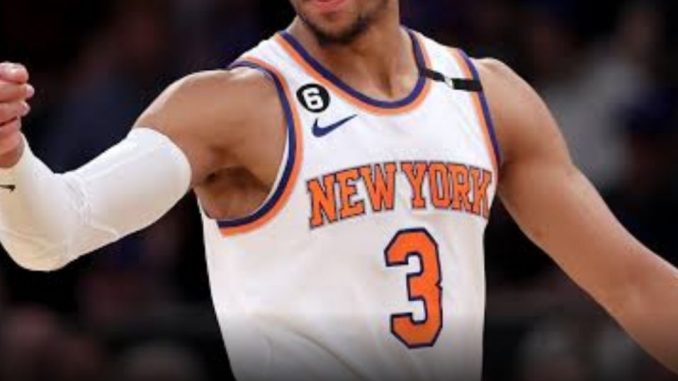
The New York Knicks are two wins away from the Eastern Conference Finals, but if you ask Josh Hart, nothing about the job is close to finished. After delivering what he called a “career night” in a dominant 109–93 Game 2 victory over the Cleveland Cavaliers, the veteran guard-forward immediately shifted attention away from celebration and toward control, urgency, and unfinished business.
At Madison Square Garden, where momentum can turn into mythology in a matter of minutes, Hart’s message cut through the noise: complacency is not an option. “We can’t be happy yet,” he said after the final buzzer, still visibly locked into the intensity that defined his performance. The Knicks now hold a commanding 2–0 lead in the series, but Hart’s warning underscored a locker room mindset shaped by experience, scars, and an understanding of how quickly playoff control can evaporate.
For most players, a night like Game 2 would have been the headline. Hart filled the stat sheet in every imaginable way, impacting the game with the kind of relentless energy that has made him one of the Knicks’ emotional engines throughout the postseason. He attacked the glass, sprinted the floor in transition, defended multiple positions, and made timely offensive plays that consistently broke Cleveland’s rhythm. Whether it was a contested rebound in traffic, a deflection that turned into a fast break, or a crucial finish through contact, Hart’s fingerprints were all over the game’s most decisive sequences.
New York’s 16-point win didn’t come from a single star explosion, but rather from a collective tightening of execution—and Hart was the embodiment of that identity. The Knicks imposed their physicality early, absorbing Cleveland’s opening surge and gradually bending the game toward their tempo. By the second half, Cleveland’s offense—often reliant on rhythm creation from the perimeter and midrange scoring bursts—began to stall under the weight of New York’s defensive pressure.
The Cavaliers, led by Donovan Mitchell and Darius Garland, entered Game 2 knowing they needed a response after dropping the series opener. For stretches, they showed it. Mitchell in particular tried to ignite Cleveland with aggressive scoring bursts, attacking downhill and forcing New York’s perimeter defenders into rotations. But every Cleveland push seemed to meet an answer—often from Hart, who played like a man determined to win every 50–50 moment on the floor.
It wasn’t just the production; it was the timing. Hart’s presence consistently arrived when Cleveland threatened to close gaps. A loose-ball dive here, a strong box-out there, a transition finish when the Cavaliers were trying to stabilize—each moment added up to a psychological edge that the Knicks never surrendered after the first quarter.
The Knicks’ overall execution mirrored Hart’s approach. Jalen Brunson orchestrated the offense with patience, manipulating pick-and-roll coverage and forcing Cleveland’s bigs into uncomfortable decisions. The spacing around him remained disciplined, allowing New York to generate clean looks even when possessions broke down. But it was the Knicks’ defensive identity that ultimately dictated the outcome.
New York’s switching schemes and help rotations forced Cleveland into difficult shot selection for much of the night. The Cavaliers, who had hoped to speed the game up and create chaos in transition, found themselves trapped in half-court possessions that drained rhythm and confidence. Even when Cleveland managed to generate advantages off initial actions, the Knicks’ recovery defense was quick enough to shrink windows before clean looks could materialize.
By the third quarter, the game had tilted decisively. The Knicks’ lead stretched as their physicality wore down Cleveland’s frontcourt. Second-chance opportunities became a major separator, with New York consistently winning the rebounding battle in key stretches. Hart was central to that dominance, crashing the boards with timing and aggression that repeatedly extended possessions or shut them down entirely.
The Cavaliers’ bench attempted to stabilize the game, but the energy gap became increasingly evident. Every Knicks rotation player seemed to enter the game with a defensive mandate, and that continuity created a suffocating environment for Cleveland’s offense. Even when the Cavaliers found small pockets of success, New York responded immediately, preventing any sustained momentum.
Still, despite the comfort of a 2–0 series lead, Hart’s postgame tone reflected a deeper awareness of playoff volatility. He has been part of enough postseason battles to understand that momentum in a series can shift not just game-to-game, but possession-to-possession. His message was not performative—it was rooted in experience.
“We did what we were supposed to do at home,” Hart emphasized, according to team context following the win. “But it’s the playoffs. Nothing carries over if you don’t keep your edge. We can’t relax because we won two games. They’re too good for that.”
That perspective has become increasingly important for the Knicks, a team that has built its identity around toughness, rebounding, and defensive consistency under playoff pressure. The roster’s construction emphasizes grit as much as skill, and Hart represents that philosophy as clearly as anyone. His ability to impact games without requiring plays to be run for him has made him indispensable in this series.
Cleveland, however, is far from a passive opponent. The Cavaliers have shown throughout the season that they can adjust quickly, especially when their core guard tandem finds rhythm. Mitchell’s scoring ability remains a constant threat to tilt games, while Garland’s playmaking can unlock offensive stretches when New York’s pressure loosens. But in Game 2, the Cavaliers never fully found that balance. The Knicks’ defensive attention to detail consistently forced secondary options into primary roles, disrupting Cleveland’s preferred structure.
Jarrett Allen and Evan Mobley also faced a difficult night inside. The Knicks’ physicality around the rim limited clean finishes and forced Cleveland’s bigs into contested decisions. The rebounding battle became a symbolic representation of the game’s broader theme: New York simply imposed its will more consistently.
As the final minutes ticked down and the Knicks maintained control, the Garden crowd sensed both satisfaction and anticipation. A 2–0 lead is significant, but it is not final, and Hart’s voice echoed that reality even as fans began to project ahead. The Knicks understand that the series now shifts in tone, with Cleveland returning home needing to respond with urgency.
For Hart, the focus is already there. His approach reflects a player who has carved out his role through persistence rather than spotlight, thriving in the margins where playoff games are often decided. That mindset has helped stabilize the Knicks in moments where offensive execution fluctuates, and it has given the team an emotional anchor during extended postseason stretches.
What makes Hart’s message resonate is not just the timing, but the credibility behind it. This is a player who does not separate effort from expectation. In his view, a strong game is not a reason to relax—it is a standard to repeat. That mentality has spread throughout the roster, reinforcing the Knicks’ identity as one of the league’s most physically committed teams in high-stakes environments.
As the series moves forward, the pressure now shifts squarely onto Cleveland. The Cavaliers must find ways to counter New York’s rebounding dominance, solve the Knicks’ defensive rotations, and generate more efficient offensive possessions against a defense that has shown no intention of easing up. Adjustments are inevitable, but execution will determine whether this series returns to Cleveland with life or slips further away.
For the Knicks, the challenge is internal. Maintaining focus with a 2–0 lead is often harder than earning it. Hart’s warning serves as both reminder and reinforcement: the job is not defined by control, but by completion.
In playoff basketball, comfort is the first step toward collapse. Josh Hart knows it. The Knicks know it. And even after a dominant 109–93 victory that put them firmly in control of the series, the message inside their locker room remains unchanged—nothing has been achieved yet, and everything still has to be earned.
Be the first to comment