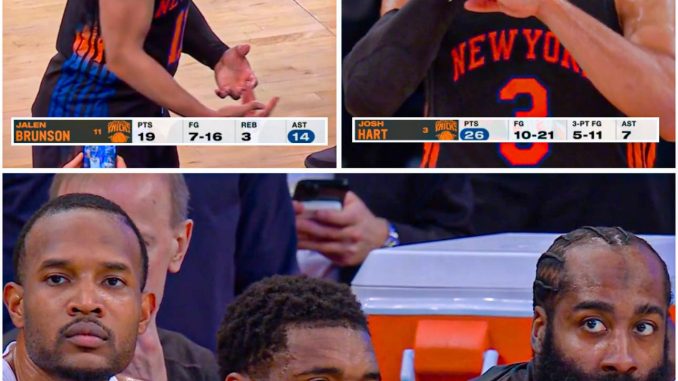
The New York Knicks are no longer simply surviving playoff basketball—they are imposing their identity on it. In a postseason run that continues to reshape expectations around Madison Square Garden, the Knicks delivered yet another emphatic statement on Thursday night, riding a relentless two-way surge from Josh Hart and a masterful orchestration from Jalen Brunson to overwhelm the Cleveland Cavaliers and secure a commanding 2-0 lead in the Eastern Conference Finals. The win extended New York’s remarkable postseason streak to nine straight victories, a run defined by physical defense, late-game composure, and an increasingly confident offensive hierarchy that has left opponents searching for answers.
From the opening tip, the tone was unmistakable. The Knicks played with the kind of controlled aggression that has become their signature this postseason, dictating pace, closing airspace, and forcing Cleveland into hurried decisions on nearly every possession. The Cavaliers, led by a young core still learning to navigate the pressures of deep playoff basketball, found themselves immediately on the back foot as New York turned defense into transition opportunity and half-court execution into a precision exercise.
Josh Hart set the emotional temperature early. Known throughout the league for his relentless motor, Hart elevated his impact into something closer to domination in Game 2. He attacked the glass with purpose, ripped down contested rebounds in traffic, and turned loose balls into momentum swings that rippled through the arena. Every hustle play seemed to compound Cleveland’s frustration. Every second-chance possession felt like another cut into their composure. By the middle of the first quarter, Hart was not just influencing the game—he was bending it toward New York’s rhythm.
What made Hart’s performance especially devastating was the variety of his impact. It was not confined to effort alone. He finished in transition with authority, knocked down timely perimeter shots that stretched Cleveland’s defensive shell, and served as the Knicks’ most reliable connective tissue between possessions. When the Cavaliers attempted to slow the game and reduce possessions, Hart responded by speeding it up. When they tried to match physicality, he met them blow for blow. His presence became a psychological factor as much as a statistical one, embodying the Knicks’ refusal to be outworked on their home floor.
While Hart supplied the emotional force, Brunson supplied the structure. The Knicks’ All-Star guard once again demonstrated why he has become the central figure in New York’s modern playoff identity. Every possession seemed to flow through his decision-making, and every Cavaliers defensive adjustment was met with Brunson’s calm recalibration. Whether navigating traps at the top of the arc or probing mismatches in isolation, he maintained complete control over tempo and spacing.
Brunson’s orchestration was most evident in how he manipulated Cleveland’s defensive coverages. When the Cavaliers switched screens, he patiently dissected mismatches, drawing help defenders before spraying precise passes to open shooters. When they dropped coverage, he punished the space with mid-range efficiency that has become his playoff trademark. And when they attempted to pressure him high above the arc, he countered with footwork that created just enough separation to keep New York’s offense flowing without interruption.
The chemistry between Brunson and Hart became the defining dynamic of the night. One dictated the structure; the other supplied the chaos that broke Cleveland’s defensive rhythm. Together, they formed a balance that the Cavaliers simply could not stabilize. Every time Cleveland appeared to build defensive discipline, Hart’s energy would crack it open. Every time they threatened to generate stops, Brunson would slow the game to his preferred cadence and reassert control.
The Cavaliers entered Game 2 with adjustments aimed at slowing New York’s transition game and forcing the Knicks into more deliberate half-court possessions. Early signs suggested partial success, as Cleveland briefly managed to limit fast-break opportunities and force several contested mid-range attempts. But sustaining that level of defensive focus proved impossible under the weight of New York’s physicality and shot-making discipline.
By the second quarter, the Knicks had already begun to reestablish dominance on the boards, where Hart’s relentless pursuit and the frontcourt’s collective effort created second-chance opportunities that tilted the possession battle decisively. Those extra possessions proved critical. Even when Cleveland managed to secure stops, they often found themselves defending again within seconds, unable to fully reset or control tempo.
Offensively, the Cavaliers showed flashes of resilience, particularly through stretches where their perimeter shooting briefly connected and their spacing forced New York’s defense to extend beyond its comfort zone. But those moments were isolated rather than sustained. Each time Cleveland threatened to build momentum, the Knicks responded with either a defensive stand or a transition burst that halted any meaningful run.
The third quarter proved to be the turning point, not through a single explosive sequence but through cumulative pressure. The Knicks gradually expanded their lead through disciplined execution and unrelenting physicality. Brunson continued to orchestrate with surgical precision, identifying mismatches and exploiting them with patience. Hart continued to energize every possession, diving for loose balls and turning defensive rebounds into immediate offensive advantages. The Cavaliers, meanwhile, began to show visible signs of fatigue, both mental and physical, as possessions grew more difficult to generate and even harder to finish cleanly.
One of the defining elements of New York’s current playoff run has been its defensive identity, and Game 2 was another showcase of that foundation. The Knicks’ rotations were crisp, their closeouts disciplined, and their interior protection suffocating at key moments. Cleveland’s driving lanes were consistently crowded, forcing the Cavaliers into contested floaters and late-clock jumpers that rarely found the mark. Even when Cleveland managed to break through initial pressure, help defenders were waiting at the rim, altering shots and forcing uncomfortable releases.
As the game entered its final phase, the outcome felt increasingly inevitable. The Knicks’ lead, built gradually through consistency rather than volatility, had reached a point where Cleveland needed near-perfect execution to mount a comeback. But perfection was not available. Every Cavaliers possession seemed to run into another layer of resistance, another rebound secured by New York, another transition opportunity fueled by Hart’s relentless energy or initiated by Brunson’s steady command.
The closing minutes became a celebration of control. The Knicks managed the clock intelligently, avoided unnecessary risks, and maintained defensive pressure without overcommitting. Brunson remained composed, directing traffic and ensuring that each possession ended on New York’s terms. Hart continued to play with full intensity, as if the game were still hanging in the balance, a reflection of the culture the Knicks have built throughout this postseason: no possessions wasted, no effort conserved.
By the final buzzer, the Knicks had not only secured a victory but reinforced a growing narrative that they are among the most complete teams in the playoffs. Nine consecutive postseason wins now stand as evidence of sustained excellence rather than a fleeting surge. Each victory has carried a slightly different texture, but the underlying formula remains consistent—elite guard play from Brunson, relentless energy from Hart, and a collective defensive identity that refuses to bend under pressure.
For Cleveland, the series now shifts into a precarious position. Falling into a 2-0 deficit in a conference finals setting is not just a tactical problem but a psychological one. The Cavaliers have shown stretches of competitiveness, but sustaining that level for full games against a team as disciplined as New York has proven difficult. Adjustments will be necessary, particularly in rebounding, perimeter containment, and late-clock execution, but the margin for error has already narrowed significantly.
For the Knicks, however, the focus remains on continuation rather than reflection. This is a team that has embraced incremental dominance, treating each game not as a statement of arrival but as a step toward something larger. The chemistry between Brunson and Hart encapsulates that mindset—one player controlling the chessboard, the other disrupting it entirely. Around them, a supporting cast has found clarity in defined roles, amplifying the effectiveness of the stars without overextending themselves.
As the series prepares to shift back into action, the Knicks carry not just momentum but identity. They are playing with conviction, depth, and a level of cohesion that has become increasingly difficult for opponents to counter over four quarters. The Cavaliers, now staring at a must-adjust scenario, will need to find answers quickly or risk watching this series slip further out of reach.
For now, though, the story belongs to New York. A ninth straight playoff win. A 2-0 series lead. And a performance defined once again by the perfect combination of Josh Hart’s eruption and Jalen Brunson’s orchestration—two forces working in tandem to push the Knicks one step closer to something they have not experienced in decades, but are now beginning to believe is within reach.
Be the first to comment