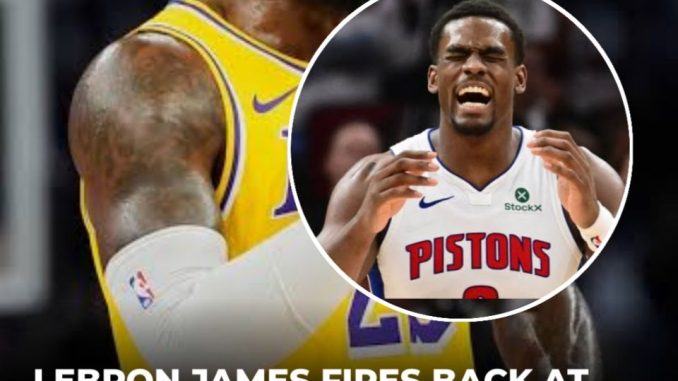
The postgame scene in Cleveland carried the weight of a series that had just closed the door on the Detroit Pistons’ season, but the loudest voice in the room didn’t belong to a Cavalier, a coach, or even a member of the advancing team’s front office. It belonged to LeBron James, who chose the moment not to celebrate the Cleveland Cavaliers’ emphatic 125–94 Game 7 victory over the Pistons, but instead to redirect attention toward a 21-year-old center whose future is suddenly as uncertain as it is promising.
Jalen Duren, the Detroit Pistons’ young interior anchor, walked off the floor after a physically demanding series that exposed both the limits of Detroit’s current roster and the growing pains of a franchise still trying to find its post-rebuild identity. Duren’s stat line in the decisive Game 7 was quiet—just 8 points and 7 rebounds in a game where Cleveland controlled the paint, tempo, and physical tone from the opening tip—but what lingered afterward was not the box score. It was the conversation surrounding his next contract extension and whether the Pistons should commit long-term money to a player still searching for consistency on the playoff stage.
That conversation, however, was quickly reframed when LeBron James stepped in with a perspective that carried both authority and nuance.
“People forget how young he is,” LeBron said following the game, choosing his words carefully as cameras gathered. “He’s a big-time talent. Big men don’t just show up in the playoffs and dominate on command. It takes time. It takes reps. You can’t rush that process just because everybody wants instant results.”
The comment immediately rippled through the NBA ecosystem, not just because of who said it, but because of what it challenged. In a postseason defined by urgency, roster evaluations, and front offices already preparing for offseason decisions, LeBron’s defense of Duren felt almost like a pause button on a league that rarely allows one.
For the Detroit Pistons, the series against Cleveland was supposed to be a measuring stick for progress. Instead, it became a reminder of how far the gap remains between development and contention. Cleveland’s frontcourt rotation dictated nearly every physical matchup of the series, and Duren—despite flashes of rim protection and rebounding dominance in earlier games—was increasingly neutralized as the series stretched into its final chapters.
By Game 7, the Cavaliers had fully committed to collapsing the paint, forcing Duren into contested catches, rushed decisions, and a level of defensive pressure that exposed his still-developing post moves and passing reads. Cleveland’s game plan was simple but effective: deny early positioning, crowd the lane, and force Detroit’s guards to beat them from the perimeter.
It worked.
The Cavaliers outscored Detroit by a wide margin in the paint, controlled second-chance opportunities, and turned what was expected to be a competitive elimination game into a controlled closeout performance. The Pistons never led after the first quarter.
Still, the spotlight didn’t just belong to Cleveland’s execution. It also belonged to Detroit’s internal question: what exactly is Jalen Duren right now, and what will he become?
That question is complicated by timing. Duren is extension-eligible, and while his raw production over the season has shown steady growth—double-digit rebounding nights, efficient finishing around the rim, and improved defensive positioning—his playoff performance has introduced hesitation into conversations that once felt straightforward. Front offices often say they pay for trajectory, not just production, but postseason performance tends to accelerate those evaluations in ways the regular season never does.
LeBron James, however, pushed back against that instinct.
“I’ve seen guys take years before it clicks in the playoffs,” he said. “Centers especially. The game speeds up, everything is more physical, every mistake is magnified. People forget how steep that learning curve is.”
It is not the first time LeBron has publicly advocated patience for younger players, but the timing of his comments—coming immediately after eliminating Duren’s team—added unusual weight. In a league where competitive lines are rarely crossed in post-elimination commentary, his remarks read less like sympathy and more like an intentional reframing of how Duren’s performance should be evaluated.
Inside the Pistons organization, the challenge is less philosophical and more financial. Detroit’s rebuild has already consumed multiple seasons, multiple draft cycles, and multiple resets of expectations. Duren was supposed to represent one of the foundational pieces of a new identity built around physicality, rebounding, and defensive toughness. That promise has not disappeared, but it has become more complicated.
Across the series against Cleveland, Duren averaged modest numbers by his regular-season standards, and more importantly, struggled to consistently impose himself against a Cavaliers front line that varied coverages and punished his positioning errors. At times, he looked dominant in spurts—snatching offensive rebounds and finishing through contact—but those moments were too infrequent to shift the momentum of games.
That inconsistency is exactly what makes his situation so difficult to evaluate. Players who show flashes of dominance in playoff environments are often the ones franchises struggle most to value correctly. Pay too early, and you risk locking into potential that has not yet stabilized. Wait too long, and you risk losing a cornerstone of your rebuild.
LeBron’s message seemed aimed directly at that tension.
“The league is full of examples of bigs who didn’t look the same until year three, year four in the playoffs,” he said. “You can’t shortcut experience.”
The irony, of course, is that LeBron James himself has spent two decades being the standard for immediate impact, durability, and postseason readiness. Yet even he acknowledged that the expectations placed on players like Duren are often unrealistic when stripped of context.
For Cleveland, the focus remained on advancement and execution. The Cavaliers’ Game 7 performance was a showcase of discipline and depth, with their guards controlling tempo and their interior defense suffocating Detroit’s second-chance hopes. The 125–94 final score reflected not just talent, but maturity—a team that understood exactly how to close a series without allowing doubt to creep in.
But as Cleveland prepares for the next round, the conversation around the series is already drifting elsewhere.
It has shifted toward Detroit’s offseason decisions and, more specifically, the question of whether Jalen Duren’s long-term future should be secured now or reassessed later. Front offices across the league have increasingly leaned toward early extensions for young players they believe in, but the new collective bargaining environment has also made teams more cautious about projecting development too far into the future.
Duren sits at the intersection of those philosophies. He is productive enough to justify belief, but still inconsistent enough to justify hesitation. That is the exact type of player organizations either build around for a decade—or move on from before the second contract ever fully materializes.
LeBron’s public stance may not change Detroit’s internal calculus, but it does reshape the external narrative. When one of the most accomplished players in basketball history argues for patience, it forces a broader audience to reconsider how quickly judgments are made in real time.
“He’s going to be fine,” LeBron added before leaving the podium. “But fine doesn’t happen overnight in this league. Especially not for bigs. You’ve got to let it breathe.”
For Duren, the offseason now becomes less about recovery and more about definition. The Pistons will need to decide not only what they believe he is today, but what they believe he can become within a system that still lacks a clear hierarchy. Improvement in conditioning, defensive reads, and offensive versatility will all be part of that evaluation, but so will the larger question of whether Detroit can afford patience in a conference that continues to accelerate around them.
As for Cleveland, their focus shifts forward, but the imprint of Game 7 remains as much about what was said after the buzzer as what happened during the 48 minutes on the court. They advanced, decisively. Detroit did not. Yet the most resonant voice in the aftermath did not belong to either locker room.
It belonged to LeBron James, who turned an elimination night into a broader reflection on development, expectation, and the uncomfortable speed at which the NBA demands answers from its youngest players.
And in doing so, he ensured that Jalen Duren’s name would not be remembered solely for a playoff exit—but for the debate that followed it.
Be the first to comment