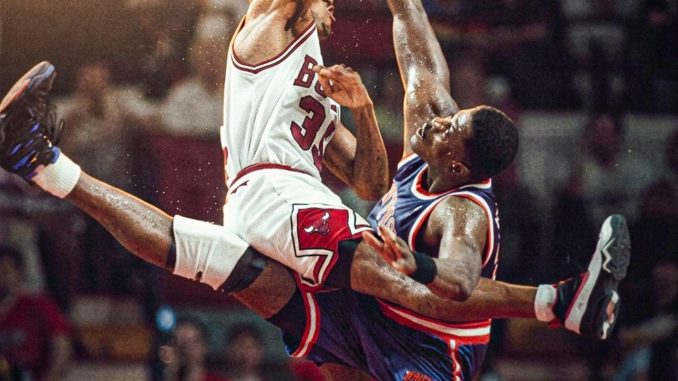
Thirty-two years ago, inside the deafening atmosphere of Chicago Stadium, Scottie Pippen delivered a playoff moment so vicious, so unforgettable, that it instantly became one of the defining images of 1990s basketball. In a rivalry built on hate, toughness, and physical punishment, the towering forward of the Chicago Bulls rose above Patrick Ewing and detonated one of the most ruthless poster dunks the NBA postseason has ever seen, leaving the crowd in absolute chaos and the New York Knicks stunned in disbelief.
Even after three decades, the image still carries the same electricity.
The Bulls and Knicks rivalry during the early 1990s was basketball warfare disguised as a playoff series. Every possession felt personal. Every drive into the lane came with elbows, forearms, and bodies crashing to the hardwood. There was no friendship between those teams, only bitterness and survival. At the center of it all stood Pippen and Ewing, two superstars representing two franchises battling for Eastern Conference supremacy during the height of the NBA’s golden era.
Chicago Stadium was already shaking before the play even unfolded. Fans understood the stakes. The Bulls were fighting to continue their dynasty while the Knicks wanted desperately to knock them off their throne. The tension in the building was suffocating. Every defensive stop sounded like thunder. Every fast break felt like a potential riot.
Then came the sequence that would live forever.
The Bulls pushed the ball in transition, catching New York scrambling defensively. Pippen saw an opening and attacked without hesitation, accelerating toward the paint with the kind of fearless aggression that defined his prime years. Standing between him and the rim was Ewing, the intimidating Knicks center who had built a reputation as one of basketball’s premier shot blockers and interior enforcers.
Most players would have pulled the ball out or avoided contact altogether.
Pippen did the opposite.
He exploded directly at Ewing, elevated violently through contact, and hammered home a dunk that instantly froze the arena for a split second before unleashing absolute pandemonium. The collision itself was shocking enough, but it was what happened afterward that transformed the moment into NBA mythology.
Pippen stood over Ewing afterward, glaring down at the fallen Knicks superstar in one of the coldest acts of playoff intimidation ever witnessed. The message was unmistakable. This was Chicago’s building. This was Chicago’s era. And nobody — not even Patrick Ewing — was safe.
The crowd erupted into pure insanity.
Fans screamed, players jumped off the bench, and Chicago Stadium shook with a roar that felt almost volcanic. The moment instantly became more than just a dunk. It became symbolic of the Bulls’ relentless swagger during their championship reign. It represented the emotional warfare that defined playoff basketball in the 1990s, when rivalries were fueled by genuine hatred and stars weren’t afraid to embarrass opponents on the biggest stage imaginable.
For many basketball fans, it remains the greatest poster dunk in playoff history.
What made the play so iconic wasn’t simply the athleticism. Plenty of great players have thrown down powerful dunks over defenders. What separated Pippen’s slam was the combination of context, rivalry, timing, and raw disrespect. Doing it against Ewing in the postseason elevated the moment to another level entirely. Ewing was not some helpless defender caught out of position. He was one of the NBA’s toughest competitors and most feared rim protectors. Attacking him head-on in a playoff game required extraordinary confidence.
Pippen had that confidence in abundance.
By 1994, he was no longer viewed merely as Michael Jordan’s sidekick. Jordan had temporarily stepped away from basketball, and Pippen was carrying the Bulls with the burden of superstardom resting fully on his shoulders. Critics wondered whether Chicago could remain elite without Jordan. Pippen answered those questions all season long with MVP-level performances, elite defense, and some of the best all-around basketball of his career.
The dunk over Ewing became a perfect snapshot of that transformation.
It showcased Pippen as a fearless leader capable of commanding the sport’s biggest moments entirely on his own. He wasn’t simply complementing greatness anymore — he was creating legendary moments himself.
The rivalry between Chicago and New York amplified everything. During that era, the Knicks embodied toughness and physical intimidation under coach Pat Riley. Their strategy against Chicago centered on turning games into street fights. Hard fouls were common. Tempers constantly flared. There was genuine animosity between the rosters, and every playoff meeting carried an atmosphere bordering on hostility.
That environment made Pippen’s dunk feel almost rebellious.
He didn’t just score two points. He attacked the emotional identity of the Knicks themselves. New York prided itself on bullying opponents physically, but in that instant, Pippen became the aggressor and humiliated the franchise’s cornerstone player in front of a roaring national audience.
The visual aftermath remains unforgettable.
Ewing crashing backward.
Pippen standing over him.
The crowd losing control.
Those few seconds became immortalized across highlight reels, magazines, documentaries, and NBA history specials for decades afterward. Younger generations who never watched the Bulls-Knicks rivalry in real time still recognize the play instantly because it represents everything fans romanticize about 1990s basketball: intensity, physicality, superstar swagger, and postseason drama.
Ironically, the moment also revealed the complicated duality of Pippen’s legacy.
Throughout his career, Pippen often existed in the shadow of Jordan despite being one of the greatest two-way players the league has ever seen. He was a seven-time All-NBA selection, an elite defender capable of guarding every position on the floor, and arguably the most versatile forward of his era. Yet conversations about the Bulls dynasty naturally revolved around Jordan’s greatness.
But moments like the dunk on Ewing reminded the basketball world that Pippen possessed his own brand of greatness.
He could dominate games defensively. He could orchestrate the offense. He could rebound, facilitate, and lead fast breaks like a point guard trapped inside a forward’s body. And when the moment demanded violence at the rim, he could deliver that too.
Many former players have since reflected on how difficult it was to challenge Ewing near the basket during that era. The Knicks center stood as one of the league’s premier interior defenders, using his strength, timing, and shot-blocking instincts to intimidate attackers. Most guards and forwards avoided direct collisions with him.
Pippen chose confrontation instead.
That fearlessness became one of the defining characteristics of the Bulls dynasty. Chicago’s stars thrived under pressure and embraced moments capable of breaking opponents psychologically. The dunk over Ewing wasn’t merely a highlight — it was psychological warfare unfolding live in front of millions.
Even today, modern NBA fans continue debating where the play ranks among the greatest posters ever recorded. Some argue Vince Carter’s Olympic dunk over Frederic Weis belongs at the top. Others point toward iconic slams from LeBron James, Kobe Bryant, or Shaquille O’Neal.
But Pippen’s dunk carries a unique level of emotional weight because of the rivalry and postseason setting attached to it.
Playoff basketball magnifies everything. Mistakes become larger. Big shots become eternal. And humiliations linger forever. Ewing, despite enjoying a legendary career, could never fully escape that moment. Every replay reopened the wound. Every anniversary resurrected the image of Pippen towering above him inside Chicago Stadium.
To Ewing’s credit, he continued battling relentlessly throughout the series and throughout his Hall of Fame career. His greatness was never diminished by one play, even if the highlight became one of the most replayed moments involving him. Ewing remained one of the defining centers of his generation and the unquestioned face of Knicks basketball during the 1990s.
Still, that single moment belonged entirely to Pippen.
The play also symbolized a broader cultural shift happening in basketball during that decade. The NBA in the 1990s embraced personality, intimidation, and emotional expression in ways the league had never fully seen before. Stars wanted moments that could crush opponents mentally as much as physically. Pippen’s reaction after the dunk captured that perfectly.
There was no apology.
No helping hand.
Only dominance.
Chicago Stadium itself added another layer of mythology to the moment. Long before the modern luxury arenas of today’s NBA, Chicago Stadium was famous for its deafening noise and hostile atmosphere. Players often described it as one of the loudest buildings in professional sports. When Pippen dunked on Ewing, the arena’s eruption became part of the highlight itself.
You can almost hear it just by watching the replay.
The crowd’s roar crashes in like an avalanche as Pippen hangs momentarily in triumph. It feels less like a basketball highlight and more like a gladiator conquering an arena.
For Bulls fans, it became one of the franchise’s most treasured memories outside of championship-clinching moments. While Jordan naturally authored many of Chicago’s signature plays, Pippen’s poster over Ewing stood among the rare highlights that felt equally legendary.
It validated his superstar status.
It validated his toughness.
And it permanently etched his name deeper into NBA playoff lore.
Thirty-two years later, the clip still spreads across social media every postseason. Younger fans discovering the rivalry for the first time react with the same shock older fans experienced live in 1994. That’s the mark of a truly timeless sports moment. It transcends generations.
Basketball evolves constantly. The pace changes. Rules change. Playing styles shift. But some moments remain untouchable because emotion never ages. Pippen’s dunk over Ewing still feels raw, violent, and breathtaking because the intensity behind it was completely genuine.
There was nothing manufactured about that rivalry.
Nothing soft about that era.
And nothing ordinary about that dunk.
On that unforgettable night inside Chicago Stadium, Scottie Pippen didn’t merely complete a fast break. He created one of the most savage playoff highlights the sport has ever witnessed, a moment forever burned into NBA history as the night he soared over Patrick Ewing and sent an entire arena into basketball immortality.
Be the first to comment