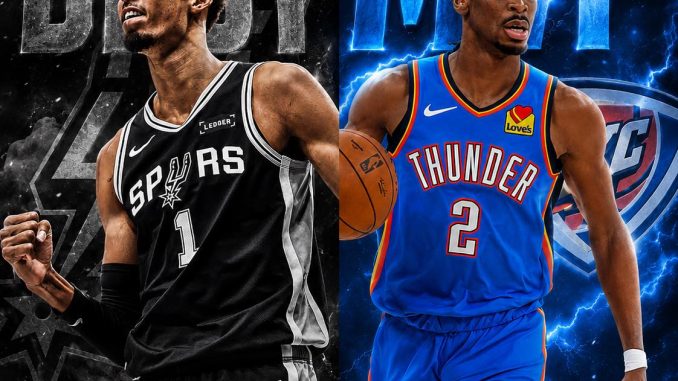
The stakes were already sky-high before tipoff, but Game 1 of this heavyweight playoff clash quickly evolved into something larger than anyone in the building expected. It wasn’t just a series opener; it felt like a collision course between eras, philosophies, and individual brilliance at its absolute peak. On one side stood the Defensive Player of the Year standard embodied by Victor Wembanyama, the towering force redefining what it means to protect the rim in the modern NBA. On the other, the reigning MVP-level engine in Shai Gilgeous-Alexander, a guard whose control of tempo, footwork, and late-game poise has turned him into one of the league’s most relentless offensive pressures.
What unfolded over four quarters was not simply a basketball game. It was a playoff war in its purest form—violent in pace, surgical in execution, and emotionally charged from the opening possession to the final whistle. Every run was met with resistance. Every adjustment triggered a counterpunch. And every possession felt like it carried the weight of an entire series.
From the start, Oklahoma City made its intentions clear. Gilgeous-Alexander set the tone early, probing the defense with patient dribbles, testing angles, and drawing early fouls that forced San Antonio’s defensive shell to shift its structure. He didn’t rush into shot-making. Instead, he dissected coverages, pulling bigs into space and forcing rotations that slowly revealed cracks in the Spurs’ perimeter discipline. His midrange rhythm, often described as inevitable, arrived quickly—soft pull-ups from the elbow, lean-in floaters over extended arms, and a calm that seemed unaffected by the playoff atmosphere.
But every time Oklahoma City found a pocket of rhythm, Wembanyama answered with something that disrupted the very idea of rhythm itself.
At 7-foot-4 with a wingspan that seems to erase geometry, Wembanyama altered shots without even fully committing to jumps. Drives that looked clean suddenly turned hesitant as players felt his presence looming a step earlier than expected. Lobs that seemed available disappeared mid-flight. Even open shooters found themselves rushing releases, aware that a contest might arrive from angles that shouldn’t exist in conventional scouting reports.
The first true turning point came midway through the first quarter when Oklahoma City attempted to attack the paint in consecutive possessions. Gilgeous-Alexander carved into the lane, drawing help from the weak side. The pass seemed destined for a cutting big man—until Wembanyama rotated from what looked like an impossible distance and swatted the attempt into the third row with a timing that drew an audible reaction from the arena. On the very next possession, he met a second drive at the summit, sending the ball back with such force that it ignited a fast break the other way.
Those sequences didn’t just shift momentum; they changed how Oklahoma City approached the rim entirely.
Still, elite offenses adapt. Gilgeous-Alexander began to manipulate Wembanyama’s positioning rather than challenge it directly. He used hesitation dribbles to freeze help defenders, then slipped into short midrange windows before the Spurs’ back line could fully rotate. When San Antonio adjusted by pulling Wembanyama closer to the restricted area, Oklahoma City responded by stretching him outward, dragging him into space where his reach was still disruptive but less immediately game-breaking.
The chess match had begun in earnest.
By the second quarter, the game had settled into a brutal equilibrium. Neither team could sustain separation. San Antonio leaned on Wembanyama’s defensive gravity and a series of opportunistic transition bursts. Oklahoma City leaned on Gilgeous-Alexander’s isolation mastery and disciplined half-court spacing that forced the Spurs into constant decision-making stress.
What made the matchup so compelling was not just the individual brilliance, but the way each star forced systemic recalibration from the opponent. Every possession became a referendum on strategy.
When Wembanyama sat, San Antonio’s interior protection visibly softened. Oklahoma City attacked immediately, probing the paint with renewed aggression. When Gilgeous-Alexander rested, the Thunder offense lost its composure, settling for perimeter jumpers that failed to replicate his downhill pressure. Both teams understood the same truth: the series hinged not just on depth, but on the unavoidable dominance of its central figures.
The third quarter delivered the game’s most chaotic stretch.
It began with Gilgeous-Alexander orchestrating a personal scoring burst that blended patience with inevitability. He hit consecutive midrange jumpers, each one slightly more contested than the last, as if he were gradually increasing the difficulty of his own performance. Then came the drive that broke the defensive setup entirely—an acceleration from the top of the key that split two defenders and forced Wembanyama into a help position he rarely has to occupy. Even then, the contest arrived late. The finish was soft, high off glass, untouched.
But Wembanyama responded not with offense, but with control.
On the ensuing possession, he anchored the paint so effectively that Oklahoma City abandoned a drive mid-air, kicking the ball out into a rushed perimeter shot that missed badly. He then transitioned into offense, where his mere presence altered the Thunder’s spacing. A lob that would have been routine against any other defense became a contested decision, and the hesitation led to a turnover. Two possessions later, he blocked another attempt at the rim and initiated a fast break himself, dribbling the ball upcourt like a point center, collapsing defenders before finding a cutting teammate for an easy finish.
The crowd had shifted from watching a game to witnessing a duel.
By the fourth quarter, fatigue began to creep into execution, but not into intensity. Gilgeous-Alexander continued to operate with surgical precision, drawing fouls, stepping into clutch pull-ups, and controlling tempo as if the clock were an extension of his own decision-making. Every dribble was deliberate. Every pause carried intention.
Wembanyama, meanwhile, became more aggressive in his deterrence. He stopped waiting for shots to reach him and began eliminating options earlier in the possession. He hedged higher, rotated faster, and closed passing lanes that seemed open half a second before they were taken away. Even when not directly involved in a play, his presence distorted Oklahoma City’s spacing, forcing them into longer possessions and more contested attempts.
With under five minutes remaining, the game reached its most dramatic sequence.
Gilgeous-Alexander isolated at the top, facing a set defense designed specifically to slow him. He hesitated, drove left, spun back right, and created just enough separation to rise into a contested jumper that seemed to hang in the air longer than regulation physics should allow. It fell.
On the other end, Wembanyama answered immediately. A defensive stop led to a transition opportunity where he sprinted the floor, received the ball near the arc, and took one dribble before finishing over multiple defenders at the rim. The sequence wasn’t just athletic; it was symbolic. The Defensive Player of the Year anchor showing he could also tilt momentum on offense when the moment demanded it.
The final two minutes became a grind of half-court possessions, timeouts, and defensive substitutions. Every possession was deliberate. Every mistake felt potentially decisive. Gilgeous-Alexander continued to generate clean looks out of nothing, while Wembanyama erased them at the rim or forced adjustments that led to second-chance defensive stops.
In the closing possession, Oklahoma City had the ball with a chance to either take Game 1 or force overtime depending on execution. Gilgeous-Alexander controlled the ball at the top, surveying a defense fully set, Wembanyama stationed near the paint like a final checkpoint. The guard made his move—one hard dribble, a shift of pace, a drive into the lane.
And then the moment everyone would remember: Wembanyama stepped into help at precisely the right angle, forcing a midair adjustment. The shot went up under duress, altered just enough to miss cleanly. The rebound was secured, the buzzer sounded, and the arena exhaled after a game that never truly allowed anyone to breathe.
What Game 1 ultimately revealed was not a winner in a series, but the architecture of a rivalry that may define this postseason. Gilgeous-Alexander controlled stretches of the game with the composure of a player fully aware of his offensive responsibility. Wembanyama, meanwhile, reshaped the geometry of the court itself, turning what should have been open opportunities into calculated risks.
It was MVP versus DPOY in its most literal form—creation against denial, rhythm against disruption, inevitability against interruption.
And if Game 1 was any indication, this series is far from a battle of adjustments. It is a sustained collision between two forces that do not merely compete, but redefine the conditions of competition itself.
Be the first to comment