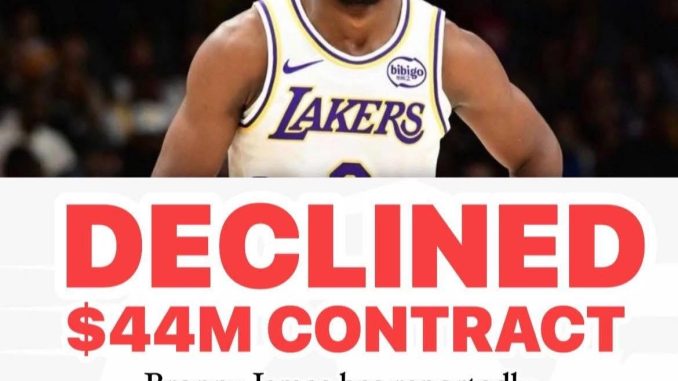
Bronny James’ future with the Los Angeles Lakers has suddenly become one of the most talked-about storylines in the NBA after reports emerged that the young guard declined a four-year, $44 million contract extension offer from the franchise. The development has sent shockwaves throughout the league, not only because of Bronny’s connection to his father, LeBron James, but also because it raises significant questions about the Lakers’ long-term plans and the direction Bronny wants his career to take.
For an organization that has spent the better part of the past two years building around the historic father-son pairing, the reported rejection represents an unexpected twist. The Lakers entered this offseason hoping to establish stability around their young talent while simultaneously preparing for the eventual transition into a new era. Bronny was widely viewed as one of the central pieces of that vision. Now, uncertainty surrounds what comes next.
League executives and analysts immediately began speculating about the motivations behind the decision. A four-year deal worth $44 million would have provided financial security and demonstrated the Lakers’ confidence in Bronny’s potential. For many young players, such an offer would be difficult to pass up. Yet declining the extension suggests Bronny and his representatives believe there may be greater opportunities ahead, whether financially, competitively, or both.
The decision comes during a pivotal period in Bronny’s professional development. Since entering the NBA, he has faced scrutiny unlike almost any young player in league history. Every performance has been dissected, every statistic analyzed, and every career move compared to the legacy of his father. While most rookies are afforded time to grow away from the spotlight, Bronny has had to develop under constant national attention.
That pressure has often overshadowed his progress on the court. Coaches and teammates have repeatedly praised his work ethic, defensive instincts, and willingness to embrace a team-oriented role. While he has not yet emerged as a star, there have been encouraging signs that his game continues to evolve. The Lakers’ reported willingness to commit $44 million over four years reflects the organization’s belief that he can become a valuable contributor in the years ahead.
From the Lakers’ perspective, the extension proposal appeared to make sense on several levels. First, it would have secured a young player whom the franchise believes still possesses considerable upside. Second, it would have strengthened continuity within the roster. Third, it would have maintained one of the most compelling narratives in professional sports—the opportunity for LeBron and Bronny to continue sharing the court together.
The father-son partnership has generated enormous interest across the basketball world. Every game featuring the duo has attracted significant media attention, and merchandise sales associated with the historic pairing have been strong. Beyond business considerations, the arrangement has represented a unique chapter in NBA history. Never before had a player of LeBron’s stature been able to compete alongside his son at the highest level.
Because of that context, Bronny’s reported rejection of the extension carries implications far beyond a standard contract negotiation. It introduces questions about whether he envisions his future remaining in Los Angeles. It also creates speculation regarding whether he wants to establish his own identity away from the franchise where his father became one of the league’s defining figures.
Around the NBA, players often decline extensions for strategic reasons. In some cases, they believe their market value will increase with continued development. In others, they seek greater flexibility to explore future opportunities. Sometimes a player simply wants to evaluate the direction of an organization before making a long-term commitment.
For Bronny, any of those factors could be in play.
The Lakers have undergone significant changes in recent years, balancing the pursuit of championships with the challenge of preparing for life after LeBron. The franchise remains one of the most recognizable brands in sports, but roster construction decisions over the next several seasons will be crucial. Young players considering long-term commitments naturally want assurance that the organization’s vision aligns with their own aspirations.
If Bronny believes his role could expand elsewhere, declining the extension might be viewed as a calculated gamble. A larger opportunity to handle the ball, create offense, and showcase his full skill set could ultimately lead to a more lucrative contract in the future. Many players have bet on themselves in similar situations, choosing short-term uncertainty in pursuit of long-term rewards.
At the same time, turning down a guaranteed $44 million is not without risk.
The NBA is an unforgiving league where circumstances can change rapidly. Injuries, roster moves, coaching changes, and fluctuations in performance all influence a player’s market value. Accepting an extension often provides protection against those uncertainties. By reportedly declining the offer, Bronny signals considerable confidence in his trajectory.
That confidence may stem from internal evaluations of his growth. Sources around the league have frequently noted that Bronny possesses qualities that do not always appear in traditional box scores. His defensive effort, basketball IQ, and understanding of team concepts have earned respect from coaches. Those attributes often become increasingly valuable as players mature and gain experience.
The Lakers’ willingness to present a substantial extension indicates they likely see more than just a developmental prospect. Organizations do not commit significant salary-cap resources without believing a player can contribute meaningfully to winning basketball. The offer itself serves as evidence that Los Angeles views Bronny as part of its future.
Now the challenge for the Lakers will be determining their next move.
Front offices typically approach these situations with patience. Contract negotiations often involve multiple rounds of discussions, and an initial rejection does not necessarily mean both sides are headed toward a split. Teams and players regularly revisit talks as circumstances evolve.
The Lakers could choose to continue conversations throughout the offseason, hoping to find common ground on contract structure, incentives, or future role expectations. Alternatively, they may decide to let the situation play out and reassess at a later date.
For LeBron, the reported development adds another layer to an already fascinating stage of his legendary career. The four-time NBA champion has accomplished virtually everything possible in basketball, but sharing the court with his son remains one of the most meaningful achievements of his journey. While there is no indication that Bronny’s decision directly impacts LeBron’s plans, observers throughout the league will inevitably wonder how the situation influences the family dynamic and future decisions.
LeBron has consistently emphasized his desire for Bronny to make choices that benefit his own career. Throughout the years, he has publicly supported his son’s independence and growth as a player. If Bronny believes declining the extension positions him for greater success, it would not be surprising to see LeBron support that approach.
The broader NBA landscape also makes the story particularly intriguing. Teams across the league are constantly searching for young guards who can defend multiple positions, make smart decisions, and fit within modern systems. If Bronny continues to improve, he could attract significant interest from organizations seeking depth and long-term upside.
That possibility undoubtedly factors into any negotiation strategy. Players and agents often assess league-wide demand when considering extension offers. If there is a belief that multiple franchises would pursue a player in the future, rejecting an early extension becomes a more realistic option.
Still, Los Angeles remains one of the most attractive destinations in professional sports. The Lakers offer a global platform, championship expectations, and unmatched visibility. Many players dream of spending their careers in purple and gold. Walking away from a long-term offer from such a franchise is a decision that naturally attracts attention.
Fans have already begun debating the implications of the reported move. Some view it as a sign of confidence and ambition, arguing that Bronny wants to prove he can succeed on his own terms. Others believe the security of a four-year agreement should have been enough to secure his future. Such discussions are likely to continue as more information emerges.
What remains undeniable is that Bronny’s career path has never followed a conventional script. From his high school years through college and into the NBA, he has operated under extraordinary circumstances. Every decision carries amplified significance because of his family name and the expectations attached to it.
Yet moments like this also highlight his determination to chart his own course. Declining a substantial extension, if the reports are accurate, represents a willingness to embrace uncertainty in pursuit of a vision he believes is best for his future.
For the Lakers, the coming months will be critical. Maintaining a strong relationship with Bronny while continuing to support his development will remain a priority. Organizations often emphasize patience when working with young players, and there is no reason to believe that approach will change.
The franchise has invested considerable resources into building a competitive roster while cultivating emerging talent. Losing a player they view as part of their future would not be ideal. Therefore, efforts to keep negotiations alive are likely to continue.
As the offseason unfolds, league executives, agents, players, and fans will closely monitor every development. Contract negotiations can evolve quickly, and situations that appear uncertain one week can be resolved the next. Until a final decision is reached, speculation will remain a major part of the conversation.
For now, the reported rejection of a four-year, $44 million extension stands as one of the most surprising developments of the NBA offseason. It underscores Bronny James’ belief in his potential, introduces new questions about the Lakers’ future plans, and adds another compelling chapter to one of basketball’s most closely followed stories.
Whether this ultimately leads to a new agreement with the Lakers or sets the stage for a different path remains to be seen. What is certain is that Bronny James has once again become a central figure in the NBA spotlight, and the basketball world will be watching closely to see what comes next.
Be the first to comment