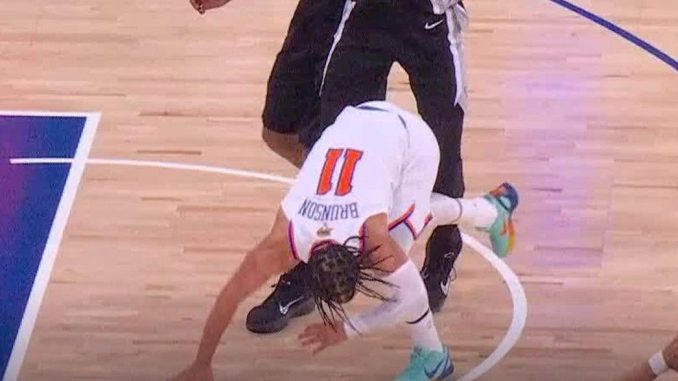
The NBA has officially closed the door on one of the most hotly debated moments of Game 3 in the NBA Finals, confirming that the on-court shove involving Victor Wembanyama and Jalen Brunson will remain classified as a common foul, with no upgrade to a flagrant and no additional disciplinary action coming from the league office. The ruling, delivered after a postgame review of the sequence, effectively clears the San Antonio Spurs star of further punishment and preserves his availability for the remainder of the series against the New York Knicks.
The decision arrives at a critical juncture in the NBA Finals, where emotions, physicality, and scrutiny over officiating have already defined much of the narrative between the Spurs and Knicks. Game 3, a tightly contested battle that swung in San Antonio’s favor, intensified those tensions when Wembanyama made contact with Brunson during a heated possession in the second half. The play drew immediate reaction on the floor, from the benches, and across social media, with arguments splitting between those who viewed it as playoff-intensity basketball and others who believed it crossed into unnecessary contact worthy of a flagrant upgrade.
After a full review process, the league office ultimately sided with the on-court ruling. According to NBA standards, the contact did not meet the threshold for unnecessary or excessive force, nor did it include the kind of wind-up, follow-through, or high-risk targeting that typically triggers a Flagrant 1 or Flagrant 2 classification. Instead, officials determined the shove fell within the spectrum of normal playoff physicality—especially in a series where both teams have leaned heavily into aggressive defensive schemes and controlled contact.
For the Spurs, the decision is a significant relief. Wembanyama has been the centerpiece of San Antonio’s championship push, and any risk of suspension or escalating disciplinary points would have dramatically altered the team’s approach heading into the crucial stretch of the Finals. With the series hanging in the balance and momentum shifting after San Antonio’s Game 3 victory, the franchise now retains its full core rotation intact as they prepare for Game 4 in New York.
The context surrounding the incident is just as important as the ruling itself. Game 3 was physical from the opening tip, with both teams battling for space in the paint, fighting through screens, and contesting every possession as if it were a late-game defensive stand. In that environment, marginal contact often becomes magnified, and borderline plays can quickly escalate into flashpoints. The Wembanyama-Brunson sequence was no exception, occurring during a possession where both players were jockeying for position in transition defense.
From the league’s perspective, consistency in officiating and disciplinary enforcement remains a central priority, especially in the postseason. The NBA has long faced criticism for fluctuating interpretations of what constitutes a flagrant foul in high-stakes games, and this decision reinforces a more conservative threshold for upgrades unless there is clear evidence of dangerous or excessive intent. In this case, the review determined that while the shove was visible and forceful, it did not cross into the category of unnecessary escalation that would alter the competitive fairness of the possession.
For Brunson and the Knicks, the ruling brings closure to a moment that briefly sparked frustration but did not materially change the outcome of the game. New York has already shifted its focus to Game 4, where the urgency is significantly higher given the series momentum. The Knicks understand that in a Finals environment, responses to physical play often matter more than the league’s postgame interpretations, and their attention will now be on execution rather than officiating debate.
Still, the incident has added another layer to an already compelling individual matchup between Wembanyama and Brunson. On one side stands a generational defensive presence whose length, timing, and versatility have reshaped how teams approach the paint. On the other is one of the league’s most efficient and crafty guards, whose ability to manipulate angles and draw contact has made him a consistent playoff force. When those two worlds collide, physicality is almost inevitable, and Game 3 was a reminder of just how thin the line can be between playoff intensity and disciplinary scrutiny.
The league’s decision also indirectly highlights the evolving identity of Wembanyama as a superstar. Throughout the season and into the playoffs, the Spurs phenom has been under constant examination—not only for his generational skill set, but for how he adapts to the emotional and physical demands of postseason basketball. Moments like the shove on Brunson become magnified precisely because of his stature in the league. Every action is reviewed through the lens of a player expected to define the next era of NBA dominance.
Importantly, the NBA’s ruling suggests confidence that Wembanyama is not trending toward reckless or unsportsmanlike behavior. Instead, the interpretation aligns more closely with a young star learning the boundaries of playoff basketball in real time. That distinction matters for both the league and the Spurs organization, which has consistently emphasized development, discipline, and composure as foundational elements of its rebuild into a contender.
From a strategic standpoint, the absence of any disciplinary escalation allows San Antonio to maintain continuity heading into Game 4. Head coach and staff can proceed without adjusting rotations or managing foul-related restrictions tied to cumulative flagrant points. In a Finals series where margins are razor-thin, even minor availability concerns can shift game planning in meaningful ways.
For New York, the focus remains on controlling the tempo and responding to San Antonio’s physical edge without allowing frustration to dictate shot selection or defensive discipline. The Knicks have already experienced how quickly momentum can swing when the Spurs’ interior defense tightens and transition opportunities are limited. Brunson’s leadership will be central in ensuring the team remains composed as the series shifts back into a pressure-filled environment.
Around the league, reactions to the ruling have followed familiar lines of postseason debate. Some analysts argue that playoff basketball should naturally allow for more physical contact, with players expected to absorb and respond rather than rely on postgame interventions. Others maintain that even in the playoffs, player safety and consistency require stricter enforcement when contact appears forceful or directed toward a vulnerable area. The NBA, in this case, has clearly leaned toward the former interpretation.
Historically, the league has been cautious about escalating marginal playoff incidents into suspensions unless there is undeniable evidence of intent or excessive force. That precedent likely played a significant role in this decision. By maintaining the common foul ruling, the NBA avoids setting a standard that could over-penalize physical defensive plays that are already inherent to high-level postseason competition.
As the series continues, attention will inevitably return to the matchup dynamics rather than the officiating report. The Spurs will look to build on their Game 3 victory, where they outlasted the Knicks in a narrow 115–111 contest, while New York aims to reassert control on home floor in Game 4. Both teams understand that at this stage of the Finals, narratives can shift dramatically from one game to the next, and isolated incidents—no matter how controversial in the moment—often fade into the broader arc of the series.
Still, the Wembanyama-Brunson interaction serves as a reminder of the intensity that defines championship basketball. Every possession carries weight. Every matchup carries friction. And every decision—on the floor or from the league office—feeds into the larger story unfolding on the game’s biggest stage.
For now, the NBA has spoken, the ruling stands, and the focus returns to basketball. But in a Finals series already defined by physical battles and razor-thin margins, it is clear that the line between legal contact and disciplinary action will remain under constant scrutiny as the Spurs and Knicks push deeper into their championship fight.
Be the first to comment