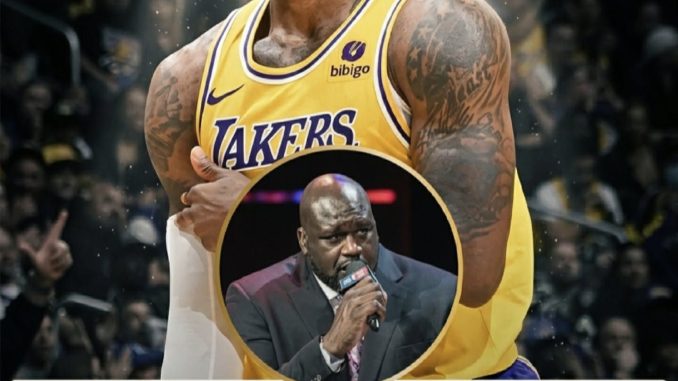
Few debates in sports have generated as much passion, division, and longevity as the conversation surrounding the NBA’s greatest player of all time. For decades, fans, analysts, former players, and legends have argued the merits of different basketball icons, comparing championships, statistics, longevity, influence, and cultural impact. While names such as Michael Jordan, Kareem Abdul-Jabbar, Magic Johnson, and Bill Russell frequently emerge in the discussion, one player has continued to push the boundaries of what was once thought possible in professional basketball: LeBron James.
As LeBron continues to add chapters to a career that has already spanned more than two decades, a statement made by Shaquille O’Neal in 2021 is aging remarkably well. At a time when the GOAT debate remained fiercely contested, Shaq offered a perspective that stood out because of both his stature in the game and his willingness to acknowledge what he was witnessing in real time. While many former players hesitated to place LeBron above Jordan or crown him basketball’s greatest figure, Shaq recognized that James was building a résumé unlike anything the sport had ever seen.
Five years later, that assessment looks increasingly prophetic.
When Shaq weighed in on the debate in 2021, LeBron had already secured four NBA championships, four MVP awards, four Finals MVP trophies, and a collection of records that placed him among the most accomplished athletes in sports history. Yet even then, there were still skeptics who believed that the defining achievements of his career were behind him. Many wondered how much longer he could maintain elite production as he approached his late 30s.
Instead of slowing down, LeBron responded by extending the most extraordinary longevity run basketball has ever witnessed.
What separates James from nearly every player who came before him is not merely his peak but the unprecedented combination of peak excellence and sustained greatness. NBA history is filled with legends who dominated for a decade. It is far less common to find a superstar capable of remaining among the league’s best players for more than twenty years.
LeBron has managed exactly that.
Season after season, he has continued to produce numbers that would be considered career years for many younger stars. While athletic decline eventually affects every professional athlete, James has repeatedly redefined expectations regarding aging in sports. His ability to adapt his game, improve his shooting, maintain elite court vision, and preserve his physical condition has allowed him to remain relevant in championship conversations long after most superstars have retired.
This is where Shaq’s perspective becomes particularly significant.
O’Neal knows what dominance looks like. During his own Hall of Fame career, he established himself as one of the most unstoppable forces the sport has ever seen. He played alongside some of basketball’s greatest talents and competed against multiple generations of elite players. When someone with Shaq’s experience identifies greatness unfolding before the world, his opinion carries substantial weight.
In 2021, Shaq emphasized that LeBron’s body of work deserved appreciation while it was still happening. Rather than focusing exclusively on championships or comparing eras, he acknowledged the totality of James’ achievements. That holistic approach now appears more accurate than ever.
The most compelling aspect of LeBron’s case has always been the breadth of his accomplishments. Unlike many all-time greats who excelled primarily in one area, James has consistently impacted every facet of the game. He scores like an elite scorer, rebounds like a forward, passes like a point guard, and defends multiple positions when locked in.
Few players in NBA history have possessed such versatility.
His statistical profile reflects that uniqueness. LeBron ranks among the all-time leaders in points, assists, rebounds, steals, and playoff production. Many legends dominate one category. James has built a legacy across nearly all of them.
That versatility has also translated into sustained team success.
Throughout his career, LeBron has transformed franchises and elevated teammates. Whether with the Cleveland Cavaliers, Miami Heat, or Los Angeles Lakers, his presence has almost always guaranteed relevance and competitiveness. Multiple organizations experienced some of the most successful periods in their histories with James leading the way.
Such influence is difficult to quantify, yet it remains central to the GOAT conversation.
The traditional argument favoring Jordan often centers on perfection in the NBA Finals and his iconic competitive aura. Jordan’s accomplishments remain extraordinary and continue to form the benchmark against which all future superstars are measured. Six championships, six Finals MVP awards, five regular-season MVP trophies, and a global cultural impact ensure that his place in basketball history remains secure.
Yet LeBron’s supporters point to a different type of greatness.
Rather than emphasizing perfection, they focus on durability, adaptability, statistical superiority, and longevity. They note that James has thrived across multiple eras of basketball, competing successfully against different generations of stars while adjusting to evolving styles of play.
From battling the physical defenses of the early 2000s to navigating today’s pace-and-space environment, LeBron has remained elite regardless of context.
That adaptability strengthens Shaq’s original position.
In many ways, James has become basketball’s ultimate evolutionary player. Every phase of his career has showcased a different version of greatness. Early in Cleveland, he was an explosive athletic marvel capable of overwhelming opponents with speed and power. In Miami, he developed into one of the league’s most efficient and complete two-way players. During his second stint in Cleveland, he evolved into a master strategist who delivered one of the greatest championship comebacks in sports history. With the Lakers, he transformed once again, emphasizing playmaking, leadership, and basketball IQ.
Very few superstars have reinvented themselves so successfully.
The result is a career that continues to expand long after most players would have reached their conclusion.
Another factor making Shaq’s 2021 assessment look increasingly accurate is the way LeBron has continued to rewrite the record books. Every season seems to bring another milestone, another achievement, another historical benchmark.
Records that once appeared untouchable have fallen.
Milestones once considered impossible have become reality.
Perhaps most notably, James surpassed Kareem Abdul-Jabbar’s long-standing all-time scoring record, a mark many believed would never be broken. The achievement alone cemented his place in basketball history. Yet LeBron did not stop there. He continued extending the record, creating a scoring total that future generations may find extraordinarily difficult to reach.
What makes that accomplishment particularly remarkable is that James never entered the league with the reputation of being a pure scorer. His greatness was always rooted in his all-around game. Yet he ultimately became the most prolific scorer the NBA has ever seen.
That reality perfectly illustrates why Shaq’s comments resonate today.
The GOAT debate often becomes trapped in selective comparisons. Fans emphasize one statistic, one championship count, or one defining moment. Shaq instead recognized that LeBron’s case rested upon accumulation, consistency, versatility, and excellence sustained over an unprecedented period.
Those qualities have only become more pronounced with time.
Beyond statistics and trophies, James has also expanded his influence off the court. Modern athletes increasingly view him as a blueprint for leveraging sports success into broader cultural and business opportunities. Through philanthropy, media ventures, educational initiatives, and social advocacy, LeBron has built an impact that extends far beyond basketball.
His influence on player empowerment has been particularly significant.
Current stars operate in a league where athletes possess greater control over their careers and public narratives than ever before. While many factors contributed to that evolution, LeBron played a central role in reshaping the relationship between players, teams, and the broader NBA ecosystem.
That legacy adds another layer to his historical standing.
When historians evaluate all-time greatness, they often consider more than championships and statistics. They examine influence, innovation, and the ability to change the sport itself. By that standard, James continues to strengthen his position.
Of course, the GOAT debate remains inherently subjective. Basketball fans will likely continue arguing Jordan versus LeBron for decades. Some will always value Jordan’s flawless Finals record and cultural mystique above all else. Others will prioritize LeBron’s longevity, versatility, and unmatched cumulative accomplishments.
There may never be a universally accepted answer.
Yet what has changed since 2021 is the amount of evidence available.
Every additional season has expanded James’ résumé. Every new record has strengthened his case. Every year of elite production has challenged conventional assumptions about athletic aging.
As a result, the perspective Shaq offered several years ago appears increasingly insightful.
Rather than waiting until LeBron’s career concluded, O’Neal recognized that basketball fans were witnessing something historically unique. He understood that greatness should not always be measured solely by nostalgia or mythology. Sometimes it unfolds in real time.
Today, that observation feels more relevant than ever.
LeBron James continues to play at a level that few imagined possible for a player of his age and mileage. His career has become a living monument to excellence, discipline, adaptability, and competitive endurance. Whether one ultimately places him first, second, or somewhere else on an all-time list, the scope of his achievements is impossible to dismiss.
That is why Shaq’s 2021 verdict has aged so gracefully.
While many voices remained cautious, skeptical, or unwilling to shift their long-held opinions, Shaquille O’Neal recognized that LeBron’s journey was unlike any the NBA had ever seen. He saw a player whose greatness transcended traditional measurements and whose impact could not be captured by a single statistic or championship count.
Five years later, as LeBron James continues rewriting basketball history and adding to a résumé that already ranks among the greatest in sports, Shaq’s words serve as a reminder of the importance of appreciating generational talent while it is still performing before our eyes.
The records continue to fall. The milestones continue to mount. The debate continues to rage.
And with every passing season, LeBron James provides more evidence that the verdict Shaquille O’Neal delivered in 2021 may have been one of the most accurate assessments of greatness the basketball world has ever heard.
Be the first to comment