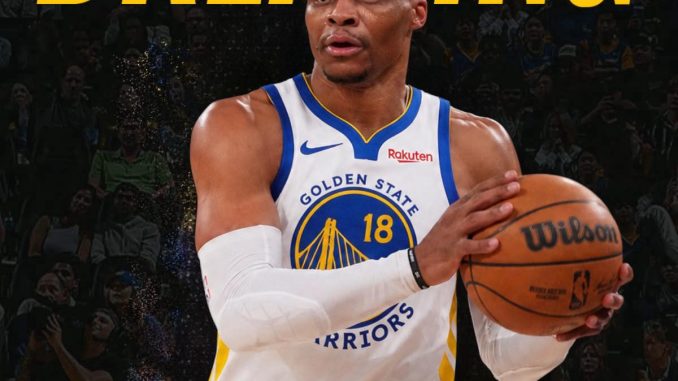
Reports out of league circles have sent shockwaves through the NBA landscape, suggesting that veteran guard Russell Westbrook could be on the verge of a surprising new chapter with the Golden State Warriors this offseason. While nothing has been finalized and front office sources have been careful to emphasize that discussions remain fluid, multiple indications point toward growing mutual interest between the former MVP and the franchise that has defined modern basketball dominance over the last decade.
For a player whose career has been defined by relentless intensity, historic triple-double production, and a style that has both electrified and divided opinion across the league, the possibility of Westbrook joining the Golden State Warriors represents one of the most intriguing potential storylines of the offseason. It is a development that blends basketball curiosity with roster-fit complexity, championship ambition with philosophical risk, and legacy narratives that could reshape how the final chapters of Westbrook’s career are ultimately remembered.
At this stage, league sources describe the situation as exploratory but increasingly “real,” with conversations believed to have progressed beyond simple background interest. The Warriors, led by their established core and championship infrastructure, are understood to be evaluating ways to reinforce their backcourt depth, inject additional ball-handling into second units, and reduce the playmaking burden on their aging stars during the grind of a full regular season. In that context, Westbrook emerges as both a high-upside and high-variance option.
For Westbrook, the potential move would mark yet another stop in a career that has already included stints with multiple franchises since leaving the Oklahoma City Thunder, where he cemented his legacy as one of the most explosive guards in NBA history. His time with the Los Angeles Lakers, Los Angeles Clippers, and Denver Nuggets reflected a clear evolution in role, from primary offensive engine to more situational playmaker and energy-driven contributor. The question that now looms is whether a system as structured and motion-heavy as Golden State’s could finally unlock a more stable version of Westbrook’s late-career identity.
The fit discussion begins with pace and playmaking. Even as Westbrook has aged out of his peak athletic dominance, his ability to push tempo remains elite. The Warriors, built around half-court precision and off-ball movement anchored by Stephen Curry’s gravity, have at times lacked a consistent transition initiator when Curry rests. Westbrook, in theory, would immediately change that dynamic. Few guards in NBA history have been more dangerous in open court situations, and Golden State has long thrived when they can turn defensive stops into instant offense.
However, the challenges are just as pronounced as the opportunities. Spacing remains the most obvious concern. Westbrook’s career-long struggles as a perimeter shooter could create lineup complications in a system that heavily relies on driving lanes being open for cutting and relocation threes. Defenses would have the option to sag off him, potentially shrinking the floor and limiting some of the Warriors’ signature split-cut and motion actions. The coaching staff would need to be creative in how they deploy him, likely staggering minutes heavily and ensuring that he is surrounded by at least two or three high-level shooters at all times.
Defensively, the conversation becomes even more nuanced. While Westbrook’s effort level has never been questioned, his defensive discipline and off-ball awareness have fluctuated in recent years. The Warriors, historically anchored by a system that demands constant communication and precise rotations, would need to determine whether Westbrook can consistently execute within their scheme or whether they would need to shelter him in specific matchups.
Still, there is a reason the interest is real. Golden State has never been a franchise afraid of unconventional roster construction if the upside aligns with their championship timeline. Over the years, they have rehabilitated careers, optimized non-traditional roles, and maximized players who seemed miscast elsewhere. The idea of taking a high-usage, high-energy guard and reimagining him as a secondary playmaker off the bench is not entirely foreign to their developmental philosophy.
From a roster-building perspective, the Warriors have been searching for stability in their non-Stephen Curry minutes for multiple seasons. When Curry sits, the offense has often struggled to generate quality looks, relying heavily on isolation possessions or forcing secondary creators into primary roles they are not always equipped to handle. Westbrook, even in a reduced capacity, could stabilize those stretches simply by virtue of his ability to create rim pressure and collapse defenses.
League insiders also point to the potential mentorship dynamic within the locker room. While Westbrook has often been portrayed as a fiercely independent competitor, teammates throughout his career have consistently praised his professionalism and intensity. In Golden State’s veteran-heavy environment, there is belief that his competitiveness could be channeled into a complementary role rather than a hierarchical one.
The financial structure of any potential deal remains a critical factor. Westbrook is no longer in the tier of maximum or near-maximum contracts, and any agreement with the Warriors would likely be constructed around veteran minimum considerations or mid-level flexibility, depending on how both sides navigate the cap situation. Golden State’s financial constraints have been well-documented, and any move would need to align with their broader luxury tax strategy and long-term flexibility goals.
There is also the broader question of timing. The Warriors remain committed to maximizing the remaining competitive window of their core, and any offseason addition is being weighed through the lens of immediate playoff impact rather than long-term development. Westbrook, for all his inconsistencies in recent postseason runs, still brings playoff experience, physicality, and a level of intensity that few role players can match.
Around the league, reactions to the reported interest have been mixed. Some executives view it as a classic “Warriors gamble”—a move that could either reignite a veteran career in a perfect ecosystem or expose structural weaknesses in roster construction. Others believe it is more about depth insurance than headline-grabbing transformation, a low-risk experiment designed to see if Westbrook’s energy can be harnessed in short bursts.
What makes the situation particularly fascinating is how it intersects with Westbrook’s legacy. Once the face of a franchise and one of the most statistically dominant guards in NBA history, his post-MVP years have been defined by adaptation and reinvention. A potential stint with the Warriors would place him alongside one of the most iconic dynasties in modern sports, offering both redemption narrative potential and heightened scrutiny.
For the Warriors themselves, the calculus is equally complex. They are a team that has built its identity on cohesion, unselfishness, and system-driven excellence. Adding a player with Westbrook’s usage history requires not only tactical adjustments but cultural buy-in. The success or failure of such a move would depend less on raw talent and more on how seamlessly roles are defined and accepted.
Within the organization, there is understood to be cautious optimism rather than aggressive pursuit at this stage. The front office is believed to be weighing multiple guard options across the market, with Westbrook representing one of several possible pathways to address backcourt depth. No formal agreement is imminent, and conversations are expected to continue into the early stages of free agency.
Still, the mere possibility of Westbrook in a Golden State uniform has already sparked widespread debate across the basketball world. Fans and analysts alike are envisioning lineup combinations, questioning spacing dynamics, and revisiting the age-old debate about whether system excellence can neutralize individual inefficiencies.
If the move does materialize, it would mark one of the most polarizing veteran acquisitions of the offseason. If it does not, it will still underscore the Warriors’ continued willingness to explore unconventional solutions as they navigate the final competitive stretch of their dynasty core.
For now, everything remains in the realm of reported interest and ongoing evaluation. But in a league where narratives shift quickly and opportunities emerge unexpectedly, the idea of Russell Westbrook joining the Golden State Warriors has already become one of the most compelling storylines to watch as free agency approaches.
Be the first to comment