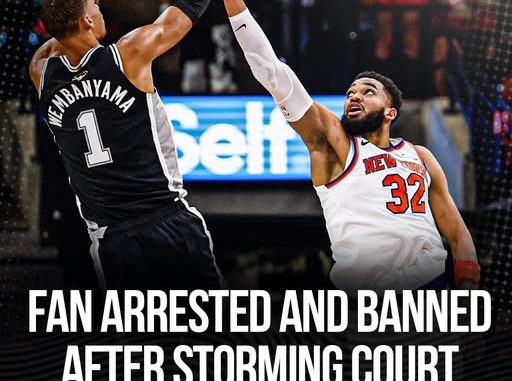
What was meant to be a night defined by championship intensity, elite execution, and the opening chapter of an NBA Finals showdown instead took a sharp detour into chaos, as a fan was arrested and permanently banned from all NBA arenas after running onto the court during Game 1 in an ill-fated attempt to take a selfie with Victor Wembanyama, a league spokesperson confirmed.
The incident, which briefly halted play and stunned players, coaches, and spectators alike, unfolded in the second half of Game 1 of the NBA Finals, when a spectator breached security and made a direct sprint toward the court. According to league officials, the individual’s intent was not malicious in the traditional sense of aggression toward players or officials, but rather a misguided attempt to capture a selfie with one of the league’s most recognizable young superstars. Still, the NBA made clear that intent did not mitigate the severity of the breach.
Arena security personnel quickly intervened, tackling and restraining the fan before he could reach Wembanyama, who was on the floor at the time of the intrusion. Players from both teams immediately backed away from the scene, while referees halted play as security swarmed the area. The stoppage lasted several minutes as officials restored order and ensured no further breaches were imminent.
Within hours of the game’s conclusion, the NBA confirmed that the individual had been arrested and permanently banned from all NBA venues, a decision that reflects the league’s increasingly strict stance on court invasions and player safety protocols. A league spokesperson emphasized that “the safety of players, officials, and fans is non-negotiable,” adding that any breach of the playing surface results in immediate and long-term consequences, regardless of motivation.
The moment, though brief in duration, rippled far beyond the arena floor. It served as yet another reminder of the delicate balance the NBA must maintain between fan engagement and strict security enforcement. Over the past decade, courtside access and fan proximity to players have become defining features of the league’s entertainment appeal, but incidents like this underscore the risks that come with such intimacy.
For Wembanyama, the episode was yet another strange chapter in a season where his presence alone has repeatedly drawn unprecedented attention. Since entering the league, the towering French phenom has become one of basketball’s most magnetic figures, blending rare defensive versatility with an offensive skill set that continues to evolve at a historic pace. His stature and global profile have made him not just a franchise cornerstone for San Antonio, but also a league-wide attraction that often transcends team allegiances.
Security analysts and arena operations staff have long warned that superstar visibility, especially in high-stakes environments like the Finals, increases the likelihood of fan interference. Wembanyama’s rapid ascent into global stardom has only amplified that concern. Still, few anticipated a scenario in which a fan would physically attempt to reach him mid-game for a selfie during the sport’s most important series.
Players across both teams were visibly shaken by the intrusion, though many quickly regained composure as security restored order. One assistant coach, speaking off the record, described the moment as “a reminder that anything can happen in a packed arena when adrenaline meets poor judgment.” While no players were physically harmed, the psychological disruption was evident, particularly in a game already defined by high stakes and emotional intensity.
League officials later confirmed that the individual was charged with trespassing and disorderly conduct in addition to being permanently banned from all NBA facilities and events. The NBA has historically taken a hardline approach to such incidents, often issuing lifetime bans in order to deter copycat behavior. The league has also worked closely with arenas to strengthen perimeter security, including increased monitoring of lower-bowl access points and expanded deployment of court-side security personnel.
The incident immediately sparked conversation across social media platforms, where footage of the fan being tackled circulated widely within minutes. While some users reacted with humor or disbelief, many others expressed concern about how easily the breach occurred during such a high-profile event. Former players and analysts weighed in as well, with several stressing that the NBA must continue tightening security without compromising the fan experience that defines its global appeal.
This is not the first time the league has faced a court intrusion during a marquee event, but the Finals stage adds an entirely different level of scrutiny. The presence of global broadcast cameras, heightened emotional stakes, and the visibility of superstar athletes creates an environment where any disruption is magnified. In this case, the attempted selfie quickly became one of the most talked-about moments of an otherwise tightly contested Game 1.
For the NBA, the optics are particularly sensitive. The league has spent years building a brand that thrives on accessibility—players interacting with fans pregame, courtside celebrities becoming part of the broadcast narrative, and viral moments that blur the line between sport and entertainment. Yet this philosophy relies heavily on controlled environments, where boundaries are respected and enforced without compromise.
The NBA’s immediate and decisive response signals a continued commitment to that balance. Permanent bans are rare but not unprecedented in cases of court invasion, especially when players are directly involved. League officials reiterated that any breach of the playing surface is treated as a serious security violation, regardless of whether physical harm occurs.
Within the broader context of the Finals, the incident briefly overshadowed the basketball itself. Game 1 had been shaping up as a competitive opener, with both teams trading momentum in front of a packed arena buzzing with anticipation. But the intrusion disrupted rhythm and forced players to recalibrate focus in a matter of minutes, a challenge that often goes unnoticed by casual observers but can significantly impact high-level competition.
Veteran players are accustomed to maintaining composure under unpredictable circumstances, but even they acknowledged the unusual nature of the situation. Several players were seen discussing the incident during the stoppage, gesturing toward security personnel and shaking their heads in disbelief. Coaches, meanwhile, worked quickly to refocus their teams as play eventually resumed.
For Wembanyama, the moment was another reflection of the extraordinary attention that follows him wherever he plays. At just the early stage of his NBA career, he has already become a central figure in league marketing, international coverage, and fan fascination. That level of attention brings with it both admiration and, as seen in this case, occasional overreach from spectators who fail to understand the boundaries of professional sports environments.
The NBA is expected to review the incident in full coordination with arena security teams to determine whether additional preventative measures are necessary. While current protocols already include multiple layers of protection—ranging from baseline security staff to rapid-response personnel—the league continues to evolve its systems in response to emerging risks.
As for the individual involved, league officials confirmed that the ban is immediate and indefinite, covering all NBA arenas, events, and affiliated properties. The arrest marks a swift conclusion to an ill-conceived attempt at viral fame that instead resulted in legal consequences and permanent exclusion from the sport’s premier venues.
In many ways, the episode encapsulates the modern intersection of sports, social media, and fan behavior. In an era where viral moments can spread globally within seconds, the temptation for individuals to insert themselves into live events has increased. The NBA, like other major leagues, now finds itself constantly navigating the tension between accessibility and control.
What remains clear is that the league intends to draw a firm line. Court access is sacred territory, and any violation—no matter how brief or seemingly harmless in intent—will be met with immediate enforcement. For the fan in question, the pursuit of a selfie ended not with a memorable photo, but with arrest records and a lifetime ban.
For Wembanyama and the rest of the players on the floor, the incident served as an unwelcome interruption in the sport’s biggest moment. For the league, it was a reminder that even in an era of heightened security and advanced surveillance, unpredictability remains part of the game-day reality.
And for the NBA Finals themselves, it was a strange and surreal footnote in a series that is otherwise meant to be defined by legacy, competition, and championship pursuit—not by a fan’s sprint toward fleeting viral attention that never materialized.
Be the first to comment