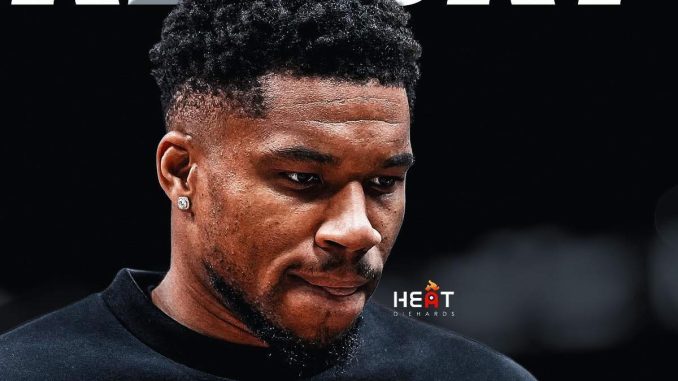
For years, the idea of Giannis Antetokounmpo leaving the Milwaukee Bucks has lived in the NBA’s background noise—sometimes faint, sometimes thunderous, but never fully silenced. Now, with league insiders increasingly circling a long-term crossroads in Milwaukee and the Miami Heat maintaining their reputation as one of the league’s most aggressive star-chasing organizations, a new layer has been added to the conversation: a potential blockbuster push from South Beach that could reshape the entire Eastern Conference.
According to multiple league reports and ongoing front-office chatter, the Miami Heat are positioning themselves for what could become one of the most ambitious recruitment efforts in modern NBA history, preparing an internal framework that would allow them to present a massive extension-style financial and competitive package should Giannis Antetokounmpo ever become available via trade or forced negotiation dynamics.
At the same time, the Milwaukee Bucks are operating with a notably patient posture, signaling to rival teams that there is no immediate rush to dismantle their championship-era core despite growing external speculation about the long-term direction of the franchise. That dual-track reality—Miami’s proactive preparation versus Milwaukee’s controlled patience—has created a quiet but intensifying standoff that league executives are watching closely as the postseason timeline continues to unfold.
Giannis Antetokounmpo remains the gravitational center of it all. The two-time MVP and 2021 NBA champion has consistently expressed loyalty to Milwaukee in public settings, but the league’s understanding of modern superstar mobility has kept rival teams alert to any subtle shift in tone, competitive frustration, or organizational uncertainty. Even without formal trade demands or public indications of departure, the mere possibility of Antetokounmpo becoming available is enough to trigger strategic planning across multiple front offices—none more prominently than Miami’s.
For the Heat, this is not unfamiliar territory. The franchise has built its identity on pursuing elite talent through both free agency and trade leverage, often waiting patiently for stars to reach inflection points in their careers before making decisive moves. From the “Big Three” era to more recent pursuits of top-tier talent, Miami’s front office has repeatedly demonstrated a willingness to clear financial pathways and restructure its roster architecture for a singular transformational acquisition.
This time, however, the stakes would be even higher. Antetokounmpo is not only one of the league’s most dominant forces, but also a player whose combination of size, athleticism, and two-way impact is widely considered irreplaceable. Any hypothetical deal would likely require a combination of franchise cornerstone assets, draft capital stretching years into the future, and complex salary-matching mechanisms that could reshape Miami’s roster for the next half-decade.
Sources around the league describe the Heat’s approach as “prepared but not aggressive—yet,” emphasizing that the franchise is laying the groundwork internally rather than engaging in direct negotiations or public signaling. The idea is to be structurally ready if Milwaukee ever opens the door, even slightly, to discussions involving their superstar forward.
Part of Miami’s motivation stems from its current competitive window. The Heat remain in a state of perpetual contention, anchored by their culture of defensive intensity, disciplined execution, and postseason resilience. But as the Eastern Conference continues to evolve, with younger cores in Cleveland, New York, and Indiana rising, Miami’s leadership has reportedly intensified its focus on ensuring that the franchise does not slip into a transitional phase without another top-five player in place.
Antetokounmpo, at 30 years old and still in his prime, represents the exact type of cornerstone that could extend Miami’s contention timeline deep into the next decade. His fit alongside Miami’s system—transition dominance, defensive versatility, and half-court creation pressure—has been widely discussed by analysts as near-ideal. Even in theoretical frameworks, the pairing is seen as one of the most dangerous possible combinations in the league.
However, Milwaukee’s stance complicates everything. The Bucks remain publicly committed to building around Giannis, continuing to reinforce their belief that their championship window is not closed. The organization has invested heavily in maintaining competitive infrastructure around him, including roster adjustments designed to maximize both immediate playoff viability and long-term sustainability.
Internally, Milwaukee’s patience is not interpreted as passivity but rather strategic control. Rather than reacting to external noise, the Bucks are said to be monitoring the postseason trajectory closely, evaluating how deep playoff runs—or lack thereof—could influence future conversations with their franchise cornerstone. For now, there is no indication that Antetokounmpo has requested a trade or signaled dissatisfaction that would force immediate action.
Still, rival teams understand that the NBA landscape can shift quickly, especially when superstar legacies and championship expectations collide. That understanding is what fuels Miami’s preparation. The Heat are not waiting for certainty; they are preparing for possibility.
League executives also note that Miami’s financial planning around a potential Antetokounmpo acquisition would be among the most complex in recent memory. The franchise would likely need to consolidate multiple high-value contracts, potentially part ways with emerging young talent, and navigate the restrictive realities of the collective bargaining agreement’s second-apron penalties. Such constraints would not deter Miami outright, but they would significantly shape the structure of any hypothetical deal.
What makes this situation even more compelling is the timing. With the postseason serving as both a proving ground and a pressure cooker, every playoff series involving Milwaukee carries added weight. Each game becomes part of a larger narrative—not just about wins and losses, but about organizational direction, roster validation, and long-term trust between superstar and franchise.
For Miami, meanwhile, the timing is about readiness rather than urgency. The Heat are not expected to force premature negotiations, but they are widely viewed as one of the few organizations capable of executing a deal of this magnitude without destabilizing their entire long-term structure. Their combination of market appeal, organizational stability, and track record of attracting stars gives them a unique position in any superstar sweepstakes scenario.
Around the league, executives are also aware that Miami is not operating in isolation. Other franchises with assets, flexibility, and ambition are expected to monitor Milwaukee’s situation closely. However, the Heat’s historical persistence in superstar pursuits gives them a distinct reputation: when they identify a franchise-altering target, they rarely disengage.
For Antetokounmpo himself, the equation remains more grounded. Those close to the situation continue to emphasize his focus on winning, leadership, and legacy-building in Milwaukee. His connection to the city, the franchise, and the championship he delivered remains a significant part of his professional identity. But as with all elite players in the modern NBA, the balance between loyalty and competitive trajectory is constantly evaluated through the lens of roster construction and playoff outcomes.
This is where Milwaukee’s postseason performance becomes especially significant. Deep playoff runs tend to reinforce stability; early exits often trigger reflection. The Bucks understand this dynamic as well as any franchise in the league, which is why their patient approach is paired with a clear expectation of contention.
The Heat, meanwhile, are watching from a distance, calculating not only what it would take to acquire a player of Antetokounmpo’s caliber, but also how such a move would redefine the balance of power in the Eastern Conference. A player of his stature joining Miami would immediately shift championship projections, alter playoff seeding dynamics, and potentially create a new superstructure in the conference hierarchy.
For now, no formal discussions between the two franchises have been reported, and no public indications suggest imminent negotiations. But in the NBA, silence often functions as preparation rather than absence. Front offices do not wait for opportunities like this to arrive—they position themselves for when they inevitably do.
As the postseason continues to unfold and Milwaukee’s championship ambitions are tested once again, the league will be watching closely. Miami’s long-standing reputation for boldness ensures that their name will remain attached to any major superstar conversation, and Giannis Antetokounmpo—given his status, age, and impact—sits at the very top of that conversation.
Whether this develops into a genuine pursuit, a distant possibility, or simply another chapter in the league’s ongoing speculation cycle will depend heavily on what happens on the court in the coming weeks. But one thing is already clear: the Heat are preparing, the Bucks are patient, and the NBA’s next seismic shift may already be forming beneath the surface.
Be the first to comment