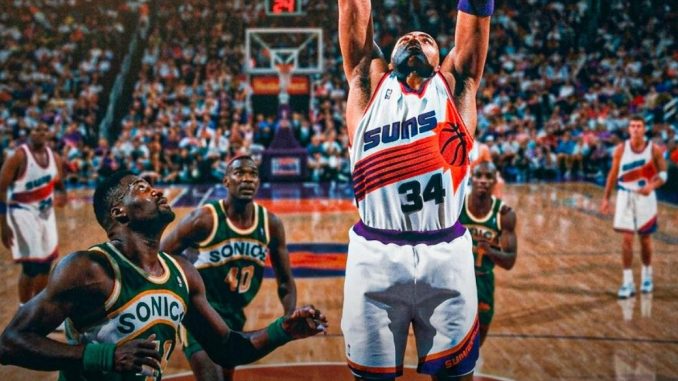
Thirty-three years ago, one of the defining performances of the 1993 NBA Playoffs unfolded under the brightest spotlight of the Western Conference Finals. On a night when everything seemed to hang in the balance, Charles Barkley delivered a masterpiece that remains etched in postseason history, carrying the Phoenix Suns to a critical 120-114 victory over the Seattle SuperSonics in Game 5 of the series.
The stakes could not have been higher. With the series tied and momentum swinging between two of the Western Conference’s elite teams, Game 5 represented a pivotal turning point. The winner would move within a single victory of reaching the NBA Finals, while the loser would face immense pressure heading into the next contest. In that pressure-packed environment, Barkley authored one of the greatest playoff performances of his Hall of Fame career, recording a stunning 43-point, 15-rebound, and 10-assist triple-double that showcased every aspect of his remarkable game.
The performance was more than just a statistical achievement. It was a demonstration of dominance, leadership, and competitive will from a player operating at the absolute peak of his powers. Barkley shot an incredible 16-for-22 from the field, connected on all 11 of his free-throw attempts, collected two steals, blocked two shots, and controlled virtually every meaningful possession throughout the contest.
For Phoenix, the victory was monumental. The Suns had entered the 1992-93 season with championship aspirations after acquiring Barkley from the Philadelphia 76ers in a blockbuster trade. The move immediately transformed the franchise into a legitimate title contender. Under head coach Paul Westphal, Phoenix posted the league’s best regular-season record and established itself as one of the most explosive offensive teams in basketball.
At the center of everything was Barkley.
The forward had arrived in Phoenix motivated to prove that he could lead a championship-caliber team after years of frustration in Philadelphia. Throughout the regular season, he was sensational, averaging dominant numbers while bringing an unmatched level of energy and confidence to the Suns. His impact was recognized when he captured the NBA Most Valuable Player Award, edging out none other than Michael Jordan for the honor.
Yet while the MVP trophy validated Barkley’s brilliance, his ultimate focus remained on winning a championship. Every playoff game represented another step toward that goal, and the Western Conference Finals presented perhaps the toughest challenge of Phoenix’s postseason run.
The SuperSonics were a formidable opponent. Led by stars such as Shawn Kemp and Gary Payton, Seattle possessed a blend of athleticism, defensive intensity, and youthful energy that made them one of the league’s most dangerous teams. Their aggressive style created problems for opponents throughout the season, and they entered the conference finals determined to reach the NBA Finals for the first time since 1979.
The series had already delivered drama through its opening four games, with neither team able to establish complete control. Every possession felt significant, every run answered by a counterpunch. By the time Game 5 tipped off, the tension inside the arena was palpable.
What followed was a showcase from Barkley that would become one of the signature performances of the decade.
From the opening minutes, Barkley attacked with purpose. He scored in transition, overpowered defenders in the paint, and displayed the remarkable touch that made him one of the most efficient scorers in NBA history. Seattle threw multiple defenders at him, attempting to disrupt his rhythm and force the ball out of his hands. It didn’t matter.
When the SuperSonics crowded the lane, Barkley found open teammates with pinpoint passes. When they backed off, he attacked the basket. When they attempted to challenge him physically, he responded with even greater force.
His 43 points came in a variety of ways, illustrating the complete offensive arsenal that made him nearly impossible to defend. He bullied smaller defenders on the block, outran bigger opponents in transition, and consistently found seams in Seattle’s defense. Every time the SuperSonics appeared poised to seize momentum, Barkley delivered another basket, another rebound, or another assist.
Perhaps even more impressive than the scoring was the efficiency.
In playoff basketball, where defensive intensity reaches another level and possessions become increasingly valuable, Barkley’s 16-for-22 shooting performance stands as a remarkable feat. Converting nearly 73 percent of his field-goal attempts while carrying such a significant offensive load is a testament to both his shot selection and his overwhelming effectiveness.
The free-throw line offered no respite for Seattle either. Barkley earned repeated trips to the stripe through relentless attacks on the rim and converted every single opportunity, finishing a flawless 11-for-11. Each made free throw further strengthened Phoenix’s grip on the contest and underscored the discipline Barkley displayed throughout the evening.
Yet the game was about much more than scoring.
The 15 rebounds highlighted Barkley’s determination to control the glass against one of the league’s most athletic frontcourts. Time and again, he battled larger players for position, securing crucial possessions and preventing second-chance opportunities for Seattle.
His 10 assists reflected another often-underappreciated aspect of his greatness. Barkley was not simply a scorer; he was an elite playmaker capable of orchestrating an offense from multiple areas of the floor. His vision and passing repeatedly punished double teams, creating open looks for teammates and forcing Seattle to make impossible defensive choices.
The defensive contributions were equally important. Two steals and two blocks may seem modest compared to the eye-popping offensive numbers, but they represented critical momentum-shifting plays during key stretches of the game. Barkley was involved everywhere, influencing every facet of the contest and leaving his imprint on nearly every possession.
As the game entered its decisive moments, the pressure intensified. Seattle refused to go away, continuing to challenge Phoenix and threatening to erase the Suns’ advantage. The SuperSonics had too much talent and too much pride to surrender easily.
But every time the visitors mounted a charge, Barkley answered.
Whether it was a powerful finish in traffic, a timely rebound in a crowded lane, or a perfectly delivered pass to a cutting teammate, he consistently made the right play. Great players often elevate their performance when the stakes are highest, and Barkley embodied that principle throughout the fourth quarter.
His leadership extended beyond the box score. Teammates fed off his energy, confidence, and relentless competitiveness. There was a sense that Phoenix believed it could weather any storm because Barkley was leading the way.
When the final buzzer sounded on the 120-114 victory, the Suns had secured a crucial 3-2 series lead. More importantly, they were now one win away from reaching the NBA Finals.
The significance of the moment was impossible to ignore.
Playoff history is filled with memorable performances, but only a select few become part of basketball lore. Barkley’s Game 5 masterpiece belongs firmly in that category. Not merely because of the numbers—though those numbers remain extraordinary—but because of the context in which they were achieved.
This was not a first-round game against an overmatched opponent. This was the Western Conference Finals against an elite team fighting for the same championship dream. Every possession carried enormous weight. Every mistake could alter the course of a season.
In that environment, Barkley delivered one of the finest games of his career.
For many observers, the performance represented the ultimate expression of the player Barkley had become in Phoenix. Throughout his career, he had been known as an unstoppable force—an undersized power forward who consistently outworked and outperformed bigger opponents. His combination of strength, quickness, skill, and basketball intelligence made him one of the most unique players the game had ever seen.
Game 5 showcased all of those qualities at once.
The scoring demonstrated his offensive dominance. The rebounding reflected his toughness and determination. The assists highlighted his vision and selflessness. The steals and blocks revealed his defensive engagement. Together, they created a complete performance that few players in NBA history could replicate.
The victory also moved Phoenix closer to fulfilling the promise that had accompanied Barkley’s arrival. After years of postseason disappointment, the Suns were on the verge of returning to basketball’s biggest stage.
Just days later, they would finish the job, defeating Seattle in six games to capture the Western Conference championship and advance to the NBA Finals.
There, they would face Jordan and the Chicago Bulls in one of the most anticipated championship matchups in league history. Although Phoenix ultimately fell short of winning the title, Barkley’s playoff run remains one of the most impressive individual postseason journeys ever produced by an MVP.
Looking back more than three decades later, the numbers from Game 5 still jump off the page.
Forty-three points.
Fifteen rebounds.
Ten assists.
Two steals.
Two blocks.
Seventy-two percent shooting from the field.
Perfect shooting from the free-throw line.
Those statistics alone tell the story of excellence. But they do not fully capture the emotion, intensity, and significance of the night.
Those who watched the game witnessed a superstar seizing control of a conference finals battle and refusing to let his team lose. They witnessed an MVP validating his status against one of the NBA’s toughest opponents. They witnessed a performance that transcended the ordinary and entered the realm of playoff legend.
In an era filled with iconic players and unforgettable moments, Barkley’s Game 5 masterpiece continues to stand out. It remains one of the greatest postseason performances in Suns history and one of the defining games of his Hall of Fame career.
Thirty-three years later, the memory endures not simply because Barkley posted a triple-double, but because he delivered it when everything was on the line. The Suns needed their leader to be extraordinary, and he responded with a performance for the ages.
On that unforgettable night in the Western Conference Finals, Charles Barkley was more than the league’s MVP. He was the best player on the floor, the driving force behind a championship contender, and the author of a playoff masterpiece that still resonates across NBA history. As the Suns moved within one victory of the NBA Finals, Barkley reminded the basketball world exactly why 1993 belonged to him.
Be the first to comment