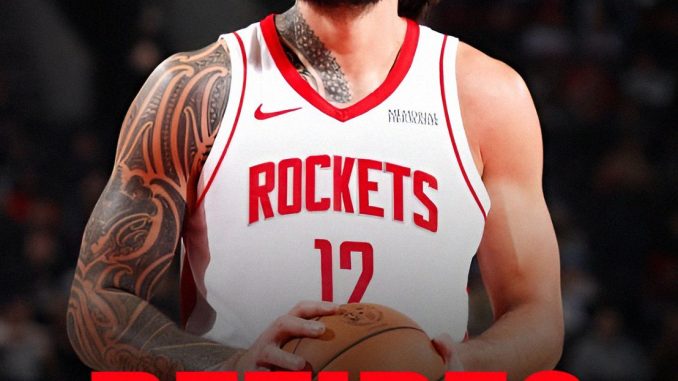
The NBA is saying goodbye to one of its most respected warriors. After 12 seasons defined by toughness, selflessness, and an unwavering commitment to doing the dirty work that often goes unnoticed in box scores, Steven Adams has officially announced his retirement from professional basketball, bringing an end to a career that earned admiration from teammates, coaches, opponents, and fans across the league.
For more than a decade, Adams carved out a unique place in the NBA landscape. In an era increasingly dominated by perimeter shooting, positionless basketball, and advanced analytics, the rugged center from New Zealand remained a symbol of old-school physicality and team-first basketball. He never sought headlines, never chased individual accolades, and rarely found himself in the spotlight. Instead, he built his reputation through relentless screens, bruising rebounds, elite interior defense, and an unmatched willingness to sacrifice personal statistics for team success.
His retirement marks the conclusion of a journey that began when he entered the league as one of the most intriguing international prospects of his generation. Selected by the Oklahoma City Thunder with the 12th overall pick in the 2013 NBA Draft, Adams arrived as a raw but highly promising big man with tremendous physical tools. Standing nearly seven feet tall with exceptional strength and mobility, he possessed the kind of frame that immediately caught the attention of scouts around the league.
What followed was a steady evolution from developmental prospect to one of the NBA’s most dependable centers.
During his early years in Oklahoma City, Adams quickly earned the trust of coaches through his work ethic and toughness. While many young players struggle to find consistent roles, Adams embraced whatever responsibilities were asked of him. Whether it was protecting the rim, battling elite centers in the paint, or setting hard screens to free up star teammates, he approached every assignment with the same level of intensity.
His growth coincided with some of the most competitive years in Thunder franchise history. Sharing the floor with superstars such as Kevin Durant and Russell Westbrook, Adams became a vital component of a team that consistently competed among the Western Conference elite. Though his statistical production often paled in comparison to the team’s marquee names, those inside the organization understood his true value.
Adams became the backbone of Oklahoma City’s physical identity.
Opposing players frequently described him as one of the strongest competitors they had ever faced. His ability to absorb contact, establish position in the post, and dominate the glass made life difficult for even the league’s premier big men. Yet beyond the physical attributes, it was his intelligence and understanding of team basketball that elevated his impact.
Few centers in the NBA were better at creating opportunities for teammates without touching the ball. His screen-setting became legendary throughout the league. Guards often praised Adams for generating open looks simply by creating separation through his powerful picks. While such contributions rarely appeared in traditional statistics, they became a defining aspect of his game.
The 2015-16 season remains one of the most memorable stretches of Adams’ career. That year, Oklahoma City made a deep playoff run and came within one victory of reaching the NBA Finals. Adams emerged as a crucial force throughout the postseason, delivering energetic performances against some of the league’s toughest frontcourts.
His battles with elite Western Conference contenders showcased exactly why he had become indispensable. Whether contesting shots at the rim, securing critical rebounds, or diving for loose balls, Adams consistently delivered winning plays when his team needed them most.
Even as the Thunder roster underwent significant changes in subsequent years, Adams remained a steady presence.
When Durant departed and Westbrook assumed an even larger leadership role, Adams became one of the franchise’s most important veterans. His chemistry with Westbrook proved especially effective. Many of the guard’s historic statistical achievements were aided by Adams’ willingness to box out larger opponents and prioritize team possessions over personal rebounding numbers.
That sacrifice became a hallmark of his career.
In an age where players are often judged by points, rebounds, and assists, Adams built a reputation as someone willing to do whatever was necessary for team success. Coaches frequently cited him as an example of professionalism and selflessness. Younger players looked to him as a model for how to contribute without demanding attention.
Following several productive seasons in Oklahoma City, Adams continued his NBA journey with the New Orleans Pelicans. Though his tenure there was relatively brief, his impact remained significant. He brought veteran leadership to a developing roster and continued to provide the physical presence that had defined his career.
His next chapter would see him join the Memphis Grizzlies, where many observers believed he played some of the most influential basketball of his career.
In Memphis, Adams became a perfect fit for the franchise’s gritty culture. The Grizzlies prided themselves on toughness, rebounding, and defensive intensity—qualities that aligned perfectly with Adams’ strengths. His arrival helped stabilize the frontcourt and provided a veteran anchor for one of the NBA’s most exciting young teams.
The impact extended far beyond statistics.
Players throughout the Grizzlies organization repeatedly credited Adams for helping establish a culture of accountability and professionalism. Younger teammates often spoke about the knowledge he shared behind the scenes and the example he set through his preparation.
When healthy, Adams transformed Memphis into one of the league’s most dominant rebounding teams. His ability to create extra possessions became a critical element of the Grizzlies’ success. Advanced metrics frequently highlighted just how valuable he was despite relatively modest scoring numbers.
Perhaps the greatest testament to Adams’ influence came whenever he was absent from the lineup. Teams quickly discovered how difficult it was to replace his combination of physicality, communication, and basketball IQ. His value often became most apparent when it was missing.
Injuries, however, eventually began to take their toll.
The physical style that made Adams such an effective player also subjected his body to years of punishment. Constant battles in the paint, countless collisions while setting screens, and relentless work on the glass accumulated over more than a decade of NBA competition.
Despite numerous setbacks, Adams consistently approached rehabilitation with the same determination that characterized his play on the court. He remained committed to returning whenever possible and supporting his teammates even during difficult stretches.
Yet the reality of professional basketball is that every career eventually reaches its conclusion.
For Adams, retirement arrives after 12 seasons filled with memorable moments, respected performances, and an enduring reputation as one of the league’s toughest competitors. While he may never have accumulated the accolades associated with Hall of Fame superstars, his impact on winning basketball cannot be overstated.
Throughout his career, Adams appeared in hundreds of NBA games, compiled thousands of rebounds, and established himself as one of the premier role players of his generation. More importantly, he earned universal respect from those who shared the court with him.
That respect transcended team rivalries.
Opponents routinely praised Adams for his honesty and sportsmanship. Despite his intimidating physical presence, he developed a reputation as one of the league’s most likable personalities. His humor, humility, and authenticity made him a favorite among teammates and media members alike.
In an era increasingly shaped by social media narratives and constant attention, Adams remained refreshingly genuine. He rarely sought publicity and consistently redirected praise toward teammates and coaches. That humility only strengthened the admiration people felt for him.
His journey also carried significant importance for basketball in New Zealand.
As one of the country’s most successful NBA players, Adams became a source of inspiration for aspiring athletes across the region. His success demonstrated that players from smaller basketball nations could thrive at the highest level through dedication, perseverance, and hard work.
Young players growing up in New Zealand often viewed Adams as proof that their dreams were attainable. His achievements helped elevate the sport’s profile and contributed to basketball’s growing popularity throughout the country.
Looking back, Adams’ legacy extends beyond numbers and accomplishments.
He represented a style of basketball that values sacrifice, toughness, and teamwork. He showed that a player does not need to lead the league in scoring to become indispensable. His career serves as a reminder that championship-caliber teams require individuals willing to embrace unglamorous responsibilities.
Every franchise he joined benefited from his presence.
Every locker room became stronger because of his leadership.
Every young player who shared the court with him gained valuable lessons about professionalism and commitment.
Those contributions will continue long after his final game.
As tributes pour in from around the basketball world, many will remember Adams for his thunderous screens, dominant rebounding performances, and fierce competitiveness. Others will remember his unforgettable interviews, his sense of humor, and his ability to bring perspective to the pressures of professional sports.
Perhaps the most fitting description of Adams’ career is simple: he was a player every team wanted and every teammate trusted.
The NBA has seen countless stars, scorers, and highlight creators over the years. Steven Adams built his reputation differently. He earned it through effort, consistency, and an unwavering willingness to put the team’s needs ahead of his own.
That approach may not always generate headlines, but it wins respect.
And respect is exactly what Adams leaves behind as he steps away from the game.
The final statistics will tell part of the story. The rebounds, blocks, games played, and seasons completed will all have their place in the historical record. Yet those numbers alone cannot fully capture what Steven Adams meant to the teams he represented or the league he served.
His legacy will live on in the countless teammates he helped, the winning cultures he strengthened, and the example he set for future generations of players.
After 12 grit-filled seasons, the curtain closes on a remarkable NBA journey.
Steven Adams leaves the game much the same way he played it—with dignity, humility, and the respect of an entire basketball community.
The era may be ending, but the impact of one of basketball’s toughest and most selfless competitors will not soon be forgotten.
Be the first to comment