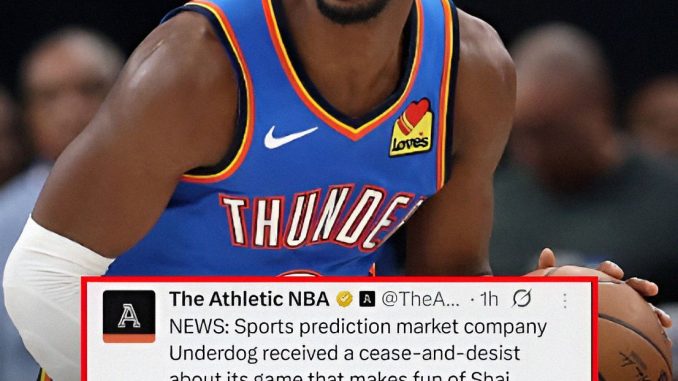
What began as a tongue-in-cheek promotional push in the increasingly competitive sports betting and fantasy sports space has now escalated into a full-blown legal flashpoint, with reports indicating that Underdog Sports has been issued a cease-and-desist order following a controversial promotional campaign that appeared to mock the foul-drawing tendencies of Shai Gilgeous-Alexander.
The situation has quickly rippled across the NBA ecosystem, igniting fresh debate about the boundaries between sports commentary, marketing satire, and outright defamation in an era where player branding is as valuable as on-court production. At the center of the storm is a promo that reportedly leaned heavily into one of Gilgeous-Alexander’s most debated stylistic traits—his elite ability to draw contact and generate free throw attempts—framing it in a way that multiple sources now say crossed the line from playful critique into potentially damaging ridicule.
According to reporting circulating within league and media circles, the promotional material in question was part of a broader campaign by Underdog Fantasy designed to engage NBA audiences with humorous, personality-driven content. The ad allegedly used exaggerated visuals and wording that highlighted Gilgeous-Alexander’s tendency to “live at the line,” a hallmark of his offensive game that has made him both one of the league’s most efficient scorers and one of its most polarizing stars among fans and analysts.
What might have been intended as lighthearted sports banter, however, reportedly drew immediate concern from representatives close to the player, who viewed the creative execution as a step beyond fair commentary. Within days, legal correspondence was allegedly sent demanding that the promotional content be taken down, with the cease-and-desist warning citing concerns over misleading implication, reputational harm, and unauthorized commercial use of an athlete’s identity in a disparaging context.
The NBA has long lived with debates surrounding foul-drawing artistry, with players like James Harden, Trae Young, and Luka Dončić often serving as lightning rods for similar discussions. Gilgeous-Alexander, however, has emerged as one of the most prominent modern examples due to his scoring dominance and his frequent trips to the free throw line, a combination that has fueled both his rise as an MVP-caliber talent and the growing discourse around officiating consistency in today’s game.
But unlike organic fan debate or televised analyst criticism, this situation reportedly centers on paid promotional content, which introduces an entirely different legal and ethical framework. Marketing experts note that while parody and satire are generally protected forms of expression, commercial use tied to a brand—particularly one that indirectly references a specific professional athlete—can quickly become legally sensitive if it implies endorsement, misrepresentation, or reputational damage.
In this case, the tension appears to stem from the blurred line between humor and targeted messaging. The promo allegedly did not simply reference foul-drawing as a basketball skill but framed Gilgeous-Alexander himself as a focal point of the joke in a way that his representatives believed went beyond acceptable creative commentary.
Within the NBA landscape, Gilgeous-Alexander has built a reputation as one of the league’s most polished offensive forces. As the centerpiece of the Oklahoma City Thunder, he has elevated himself into MVP conversations with a blend of mid-range mastery, slithering drives, and an almost surgical ability to initiate contact at the rim without sacrificing efficiency. His free throw rate is not merely a statistical footnote—it is a core component of his scoring architecture.
That very efficiency, however, is what makes him a frequent subject of debate among fans and media personalities who argue over whether his style is an evolution of offensive intelligence or an exploitation of modern officiating tendencies. The Underdog promo, according to descriptions shared online, appears to have leaned heavily into the latter interpretation, packaging it as comedic critique.
Once the cease-and-desist request surfaced, reactions across the sports media landscape were swift and divided. Some argued that the move represented an overreach, suggesting that professional athletes, especially high-profile stars like Gilgeous-Alexander, should expect to be part of the broader cultural humor ecosystem that surrounds the NBA. Others countered that there is a clear distinction between fan discourse and monetized branding campaigns, particularly when a player’s name, likeness, or identity becomes indirectly central to a profit-driven message.
Legal analysts following the situation have pointed out that the modern sports media environment has entered a gray zone where entertainment, gambling-adjacent marketing, and athlete branding intersect more than ever before. Fantasy sports platforms, sports betting companies, and digital media startups increasingly rely on NBA personalities to drive engagement, often using highlight clips, memes, and personality-driven narratives to capture attention in a saturated content landscape.
In that environment, Gilgeous-Alexander has become one of the league’s most marketable stars, not just because of his play but because of his aesthetic appeal as a smooth, controlled scorer who thrives in high-pressure moments. That makes him both a valuable marketing asset and a frequent subject of digital storytelling.
The controversy also reignites an ongoing NBA conversation about how foul drawing is perceived in the modern game. Statistically, free throw generation is one of the most efficient scoring methods in basketball. Teams and players optimize for it constantly, and elite scorers are often distinguished by their ability to manipulate defenders into disadvantageous positions. Yet culturally, it remains one of the most criticized aspects of offensive basketball when viewed through the lens of fans who prioritize “natural” scoring.
Gilgeous-Alexander sits at the center of that contradiction. On one hand, analysts widely praise his footwork, patience, and body control, which allow him to draw legitimate contact and finish plays under pressure. On the other hand, detractors argue that his style sometimes leads to marginal whistles that inflate scoring output. This duality is precisely what made him an attractive subject for a promotional campaign—but also what made the backlash so swift when the execution was perceived as mocking rather than analyzing.
The timing of the controversy adds another layer of sensitivity. Gilgeous-Alexander has been leading the Thunder through one of their most competitive stretches in franchise history, with Oklahoma City emerging as a legitimate Western Conference powerhouse built around a young core and elite defensive identity. His performance has been central to that rise, with his scoring consistency often serving as the stabilizing force in tight postseason environments.
Against that backdrop, any perceived attempt to diminish his legitimacy as a superstar takes on heightened emotional weight among fans and team supporters. Social media reactions reflected that intensity, with many defending the All-NBA guard and criticizing what they saw as an unnecessary and commercially motivated jab at one of the league’s premier talents.
At the same time, some voices in the basketball analytics community pushed back against the backlash, arguing that critique of foul-drawing—even in humorous form—is part of the broader discourse that surrounds all great offensive players. They pointed to historical precedent, noting that elite scorers across generations have faced similar scrutiny, from Kobe Bryant’s aggressive drives to Harden’s step-back era to modern isolation specialists.
Still, the legal dimension complicates what might otherwise have been a simple social media debate. Cease-and-desist orders are not issued lightly in professional sports contexts, especially when they involve potential claims of reputational harm or unauthorized commercial association. While details remain limited, the fact that the matter escalated to formal legal communication suggests that Gilgeous-Alexander’s camp viewed the promo as more than harmless humor.
Industry insiders say this case could serve as a reference point for future disputes involving athlete-related marketing content, especially as sports media companies continue to push boundaries to differentiate themselves in a crowded digital ecosystem. The stakes are high: engagement-driven humor can go viral and generate massive exposure, but miscalculations can lead to legal consequences and strained relationships with players and leagues.
For Underdog Sports, the episode underscores the risks inherent in building brand identity around edgy, personality-driven sports commentary. The company has positioned itself at the intersection of fantasy sports, entertainment, and cultural commentary, where the line between satire and infringement is often intentionally blurred. But as this controversy illustrates, that line can become much clearer when legal teams step in.
For Gilgeous-Alexander, the incident is unlikely to alter his on-court focus, but it does reinforce his growing status as one of the NBA’s most scrutinized offensive stars. Every aspect of his game—efficiency, pace control, scoring volume, and yes, foul drawing—now exists under a magnified lens that extends beyond basketball into marketing, media ethics, and legal interpretation.
As the league continues to evolve into a global content engine as much as a sporting competition, moments like this are becoming increasingly common. The NBA is no longer just played on hardwood floors but also in highlight reels, memes, promotional campaigns, and digital narratives that travel faster than any single game can contain.
In that sense, this controversy is less about a single promotional misstep and more about the modern reality of basketball stardom. Players like Gilgeous-Alexander are not only athletes but also central figures in a massive entertainment economy where every stylistic trait can be turned into content—and every piece of content can carry consequences far beyond its original intent.
Whether this situation fades quietly after legal adjustments or grows into a broader industry precedent remains to be seen. What is clear, however, is that the NBA’s most dynamic scorer is now at the center of a conversation that extends well beyond box scores, free throw attempts, and highlight reels, into the increasingly complex world where sports, media, and commerce collide.
Be the first to comment