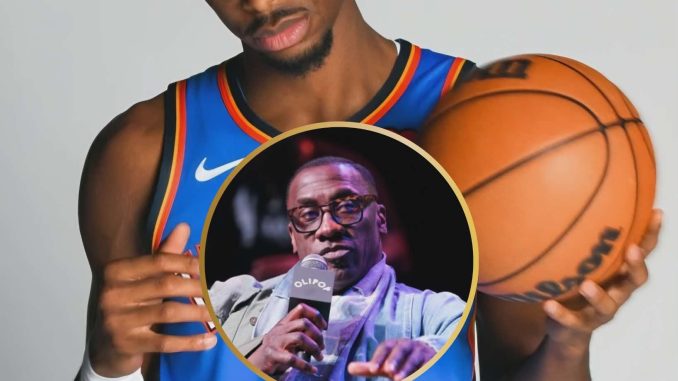
The noise inside Paycom Center was deafening long before the final buzzer sounded, but by the time the Oklahoma City Thunder walked away with a pivotal Game 5 victory, the conversation surrounding the night had shifted away from the scoreboard and directly onto the officiating. At the center of it all was Shai Gilgeous-Alexander, whose relentless attacks to the basket resulted in an eye-popping 17 free-throw attempts in one of the most important games of the postseason. While Thunder fans celebrated the superstar guard’s aggressive performance as the hallmark of a future MVP, critics around the league saw something entirely different. Few reactions were louder than that of Shannon Sharpe, who unleashed a passionate critique shortly after the game ended, declaring, “That’s not basketball.”
The statement instantly spread across sports television and social media, igniting a debate that has followed the NBA throughout the playoffs: where is the line between elite offensive manipulation and officiating imbalance? For Sharpe, the answer was clear. During his reaction on-air, the Hall of Fame tight end turned media personality argued that the game’s rhythm had been destroyed by what he viewed as an endless parade to the free-throw line. In his eyes, the officiating crew rewarded minimal contact while punishing defenders for merely attempting to stay in front of Gilgeous-Alexander.
The Thunder star finished the night with another dominant scoring performance, but the stat that overshadowed everything else was the 17 trips to the stripe. Every whistle intensified frustrations from the opposing side, and every call amplified accusations that modern NBA officiating has become overly favorable toward offensive stars. The reactions became even more explosive because the game itself carried enormous stakes. Oklahoma City entered the contest tied in a brutal Western Conference Finals battle against the San Antonio Spurs, with the winner gaining control of the series and moving one step closer to the NBA Finals.
For much of the night, Gilgeous-Alexander played with the poise and patience that have defined his meteoric rise into superstardom. He consistently attacked the paint, forced defenders into awkward positions, and created contact with subtle shoulder bumps, hesitation dribbles, and sudden changes in pace. Supporters of the Thunder guard argued that his free throws were not gifts from officials but rather the product of an offensive player who understands angles better than almost anyone in the league today.
Still, Sharpe’s criticism resonated because many viewers believed the whistles were inconsistent. Several defenders appeared visibly frustrated after being called for fouls on plays where replays showed only marginal contact. One sequence in particular became a flashpoint online after Gilgeous-Alexander drove into traffic, stopped abruptly, and drew a foul while two Spurs defenders threw their hands into the air in disbelief. Moments later, cameras caught members of San Antonio’s bench arguing furiously with officials.
Sharpe did not stop at criticizing individual calls. He broadened the conversation into what he believes is becoming a league-wide issue. According to Sharpe, the NBA risks alienating fans if physical postseason basketball continues to be interrupted by excessive foul calls. He argued that playoff basketball has traditionally been associated with toughness, defensive intensity, and allowing players to fight through contact. To him, Game 5 represented the opposite.
The debate quickly divided former players and analysts. Some echoed Sharpe’s frustrations, saying the flow of the game became difficult to watch because every major possession seemed to end with a whistle. Others defended Gilgeous-Alexander and suggested the backlash unfairly punishes players who master the art of drawing contact. Several analysts pointed out that stars throughout NBA history, from Michael Jordan to James Harden, have consistently used free throws as a weapon during championship runs.
What makes Gilgeous-Alexander’s situation unique is the calmness with which he plays. Unlike some players who visibly exaggerate contact, the Thunder guard often absorbs hits while maintaining balance and composure. That subtle style can create an unusual perception among viewers. Because his movements appear controlled and smooth, some fans struggle to recognize how much contact defenders are actually making. Yet referees consistently reward his ability to attack downhill and force defenders into compromising positions.
Thunder head coach Mark Daigneault defended his star after the game, praising Gilgeous-Alexander’s discipline and physicality. Daigneault emphasized that aggressive players earn calls by pressuring the rim repeatedly, not by settling for jump shots. He also pointed out that Oklahoma City’s offensive system is built around constant penetration, which naturally increases foul opportunities.
The Spurs, however, were clearly frustrated. Players stopped short of publicly criticizing officiating in detail, but their body language throughout the second half spoke volumes. Several defenders appeared hesitant late in the game, wary of picking up additional fouls while trying to contain Gilgeous-Alexander. That hesitation created even more driving lanes for the Thunder star, allowing Oklahoma City to seize momentum in crucial moments.
For San Antonio, the loss was particularly painful because it overshadowed another brilliant postseason performance from Victor Wembanyama. The young superstar continued to showcase why many already view him as the future face of basketball, delivering stretches of dominant scoring and rim protection. Yet despite Wembanyama’s heroics, the conversation after the game centered almost entirely around whistles and officiating rather than basketball execution.
That reality frustrated many fans who simply wanted to celebrate a high-level playoff matchup between two emerging Western Conference powers. Instead, the discourse shifted toward replay clips, foul compilations, and heated arguments over officiating philosophy. Social media exploded with slow-motion breakdowns of nearly every foul drawn by Gilgeous-Alexander, with supporters and critics interpreting the same clips in wildly different ways.
Sharpe’s comments carried extra weight because of his growing influence within basketball media. Though best known for his NFL career, Sharpe has become one of the loudest and most recognizable voices in sports commentary. His passionate delivery and blunt opinions frequently dominate online conversations, and his “That’s not basketball” remark quickly became one of the defining soundbites of the postseason.
The timing of the controversy also matters because the NBA has spent years attempting to balance offensive freedom with defensive competitiveness. League officials previously introduced points of emphasis aimed at discouraging unnatural foul-baiting tactics, particularly after criticism surrounding players abruptly jumping sideways into defenders. Many believed those rule adjustments would reduce whistle-heavy games. Yet performances like Gilgeous-Alexander’s Game 5 outing suggest the debate remains far from settled.
From Oklahoma City’s perspective, however, the criticism may actually serve as validation of their star’s evolution. Gilgeous-Alexander has spent years refining an offensive game built less on explosive athleticism and more on precision. He changes speeds masterfully, manipulates defenders with footwork, and rarely appears rushed. Those qualities make him extraordinarily difficult to guard without fouling.
It is also important to note that free throws alone did not decide the game. Oklahoma City executed efficiently in late-game situations, defended with energy, and capitalized on key Spurs turnovers during the fourth quarter. Yet in the eyes of critics, the whistles altered the emotional tone of the matchup and disrupted San Antonio’s defensive aggression.
Even some neutral observers admitted feeling conflicted. On one hand, Gilgeous-Alexander repeatedly attacked the basket and absorbed contact, something coaches consistently teach offensive stars to do. On the other hand, playoff basketball traditionally carries a more physical standard, and many believed the officiating crew failed to maintain that balance consistently throughout the night.
The larger issue facing the NBA is perception. Whether the calls were technically correct or not, many fans left Game 5 feeling unsatisfied by how often play stopped. In an era where every possession is dissected instantly online, optics matter almost as much as accuracy. A technically correct whistle can still frustrate audiences if it interrupts momentum repeatedly during a marquee playoff game.
For Gilgeous-Alexander himself, the controversy hardly seemed to matter. Postgame, the Thunder star remained composed while addressing questions about the officiating discussion. He reiterated that his focus is simply on being aggressive and helping his team win. He did not engage with Sharpe’s criticism directly, nor did he attempt to defend the officiating publicly. Instead, he emphasized Oklahoma City’s resilience and the importance of staying locked in as the series continues.
That response reflected the maturity that has made Gilgeous-Alexander such a respected leader within the Thunder organization. At just 27 years old, he has already transformed from a promising young guard into one of basketball’s most complete offensive weapons. His ability to control tempo and create efficient scoring opportunities has elevated Oklahoma City from rebuilding project to legitimate championship contender.
Meanwhile, Sharpe’s comments ensured the debate will not disappear anytime soon. Television panels, podcasts, and social media accounts continued arguing about the officiating well into the following day. Some fans accused Sharpe of unfairly targeting Gilgeous-Alexander, while others praised him for voicing frustrations shared by many viewers.
The controversy also reignited longstanding conversations about how defensive players are supposed to guard elite scorers in today’s NBA. Modern rules heavily favor offensive freedom, particularly on drives to the basket. Defenders must avoid hand-checking, limit physical contact, and maintain verticality simultaneously, a combination that often feels nearly impossible against crafty scorers like Gilgeous-Alexander.
Former players frequently note that defensive standards have changed dramatically compared to previous eras. Sharpe leaned into that perspective during his reaction, suggesting that older generations of basketball would never have rewarded some of the contact seen in Game 5. Whether that criticism is fair remains subjective, but it reflects a broader nostalgia many fans have for more physical playoff basketball.
As the series moves forward, the pressure on officiating crews will only intensify. Every whistle involving Gilgeous-Alexander is now likely to receive microscopic scrutiny. Opposing fans will watch closely for consistency, while Thunder supporters will argue their superstar is simply being punished for mastering an elite offensive skill.
Lost within the controversy is just how remarkable the basketball itself has been throughout this Western Conference Finals showdown. Oklahoma City and San Antonio have delivered thrilling performances, dramatic momentum swings, and superstar moments from both Gilgeous-Alexander and Wembanyama. The series has showcased the NBA’s next generation of franchise faces competing under enormous pressure.
Yet perhaps that is why the officiating debate feels so emotionally charged. Fans recognize they are witnessing the emergence of a potential new rivalry that could define the league for years. When games of that magnitude appear overshadowed by whistles, frustrations naturally intensify.
Still, the reality remains simple: Oklahoma City now holds control of the series, and Gilgeous-Alexander once again proved impossible to contain. Whether critics believe the whistles were justified or excessive, the Thunder star continues finding ways to dominate when the stakes are highest.
Sharpe may insist, “That’s not basketball,” but the NBA’s current landscape suggests otherwise. In today’s game, creating contact, drawing fouls, and living at the free-throw line are not viewed as side effects of offensive greatness — they are central components of it. Gilgeous-Alexander understands that better than most, and until opponents discover a cleaner way to stop him, the debate surrounding his style will likely continue growing louder with every postseason performance.
Be the first to comment