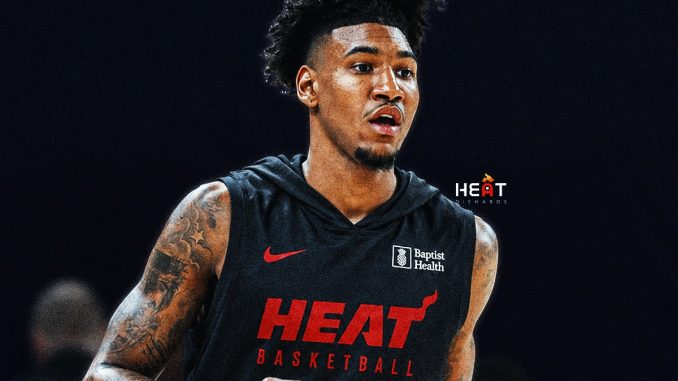
The NBA Draft process has a way of turning quiet workouts into loud signals, and for one of the more intriguing two-way prospects in this class, that noise is beginning to grow at just the right time. Dillon Mitchell’s recent workout with the Miami Heat has only intensified league-wide curiosity about where his name will land on draft night, as front offices continue to weigh upside, versatility, and defensive identity in a class that feels increasingly defined by wings who can switch, defend, and grow into larger offensive roles. For the Heat, a franchise that has built its modern identity on developmental precision and positional flexibility, the evaluation is less about whether Mitchell belongs in the league and more about how quickly he can be molded into a playoff-caliber piece within their system.
Mitchell’s path to this point has been shaped by physical tools that jump off the screen before his skill set even settles in. At 6-foot-8 with a strong frame, long arms, and explosive leaping ability, he embodies the modern forward archetype teams continue to chase. His ability to guard multiple positions, switch onto guards in space, and still hold his own against bigger wings gives him immediate value in a league that increasingly punishes defensive mismatches. In a workout setting, those traits translate quickly. Miami’s staff, known for putting prospects through demanding, detail-heavy sessions, reportedly pushed Mitchell through defensive shell drills, transition reads, and spacing decisions designed to test processing speed as much as athletic ability. What stood out wasn’t just the physical response, but the energy level he maintained across repeated reps, an area Miami historically values as much as raw production.
The Heat’s interest in Mitchell is not occurring in isolation. Across the league, teams have been searching for forwards who can defend at a high level without being offensive liabilities, and Mitchell fits that mold more comfortably than many prospects in his tier. While his offensive game is still evolving—particularly in half-court creation and consistent perimeter shooting—there is growing confidence in his ability to become a functional finisher and transition weapon. In Miami’s system, where undrafted players and late picks often develop into rotation staples, the emphasis is less on polished scoring and more on decision-making, defensive discipline, and adaptability within structured schemes.
During his workout in Miami, Mitchell was reportedly challenged in scenarios designed to simulate late-clock decision-making. These included short-roll reads, handoff actions, and recovery defense drills that required quick processing rather than instinct alone. Those who observed the session noted that while there were expected moments of hesitation—common for young forwards still refining their offensive instincts—there were also flashes of sharp defensive timing and impressive recovery speed when initially beaten off the dribble. For a player still considered a developmental prospect, those flashes are often the currency that convinces teams to invest future minutes and coaching resources.
What makes Mitchell particularly interesting for Miami is how naturally his skill set aligns with the franchise’s defensive infrastructure. The Heat have consistently prioritized players who can execute complex defensive schemes, communicate effectively on the floor, and maintain physical intensity across all four quarters. Mitchell’s college tape already showed glimpses of that foundation, especially in help-side rotations and weak-side shot contests. While he is not yet a finished product, his instincts in scramble situations suggest a player who understands spacing on the defensive end, even if his offensive role remains undefined.
Offensively, the conversation around Mitchell is more nuanced. He is not projected to be a primary scorer at the NBA level, at least not early in his career, but his value may lie in being an efficient connector. In transition, he thrives when running the floor, filling lanes aggressively, and finishing above the rim when given open space. In half-court sets, the focus will be on improving his catch-and-shoot consistency and developing comfort handling pressure when attacked off the dribble. Miami’s development program has a long history of transforming limited offensive prospects into serviceable rotation pieces by simplifying reads and emphasizing efficiency over volume, a pathway that could suit Mitchell’s trajectory.
One of the more intriguing elements of Mitchell’s evaluation process is how different teams interpret his ceiling. Some organizations view him as a high-end role player whose defensive versatility will earn him immediate minutes, while others see untapped offensive upside that could emerge with time and repetition. The Heat, however, tend to fall somewhere in the middle of that spectrum. They value immediate defensive utility but also trust their internal development system to expand a player’s offensive toolkit incrementally. That balance is likely what makes Mitchell a legitimate consideration on their board as the draft approaches.
There is also the matter of fit within Miami’s roster construction timeline. The Heat have been navigating a competitive Eastern Conference landscape that demands both win-now contributors and future flexibility. Adding a player like Mitchell would not necessarily be about immediate offensive impact, but rather about strengthening the team’s defensive depth and ensuring continuity in their wing rotation. In a league where playoff series are often decided by defensive matchups on the perimeter, having another switchable forward becomes a strategic advantage rather than a developmental luxury.
Around the league, scouts continue to emphasize that Mitchell’s draft range remains fluid. Workouts like the one in Miami play a significant role in stabilizing that projection. Strong showings in controlled environments can elevate a player into late lottery conversations or solidify mid-first-round positioning, depending on team needs. For Mitchell, the feedback loop from these sessions is as important as the workout itself. Every drill, every film session, and every coaching interaction feeds into a larger narrative teams build about his professional readiness.
In Miami’s case, that narrative also includes cultural fit. The Heat’s organizational identity is built on what is often referred to as “Heat Culture,” a term that extends beyond branding into daily expectations around conditioning, discipline, and accountability. Prospects are routinely evaluated not just on talent, but on how they respond to criticism, how quickly they learn new concepts, and how consistently they maintain effort across repetitive tasks. Mitchell’s workout reportedly checked several of those boxes, particularly in terms of effort level and willingness to engage in correction during drill work.
Still, questions remain, as they do with most prospects outside the top tier. Mitchell’s shooting mechanics, while not broken, still require refinement to become a reliable NBA threat. His handle, though improved since his high school days, is not yet at the level where he can consistently create separation against elite defenders. And like many young forwards, his offensive decision-making under pressure will determine whether he settles into a rotational role or expands into something more significant. These are not disqualifiers, but rather developmental checkpoints that will define his early years in the league.
What separates Mitchell from many similarly ranked prospects, however, is his defensive floor. NBA teams consistently value players who can contribute without needing the ball, and Mitchell’s ability to impact games through rebounding, switching, and transition defense gives him a baseline that is difficult to ignore. Even on nights when his shot is not falling, there are clear pathways for him to remain on the floor, a trait that coaches across the league tend to prioritize when building playoff rotations.
As the draft approaches, Miami’s front office will continue cycling through evaluations, comparing Mitchell’s profile against other wings and forwards in their range. The decision-making process will likely come down to a combination of upside, positional need, and internal confidence in their ability to develop his offensive game. Historically, the Heat have not shied away from betting on physical tools and defensive instincts, especially when paired with strong character and work ethic indicators.
For Mitchell, the workout represents another step in what has become a steady climb through the pre-draft process. Each team visit adds another layer to his evaluation profile, and each performance either reinforces or reshapes how front offices view his trajectory. Miami’s interest is particularly meaningful not just because of its organizational reputation, but because of its track record in maximizing players with similar archetypes.
As draft night nears, the question surrounding Mitchell is not whether he belongs in the NBA—that consensus appears increasingly secure—but rather where his development curve begins and how quickly he can ascend it. The Miami Heat have provided a glimpse of one possible landing spot, one that could align perfectly with both his defensive strengths and long-term offensive potential. In a league constantly searching for the next two-way wing who can survive playoff basketball, Mitchell’s name is beginning to circulate with just enough momentum to suggest that his story is only starting to accelerate, not settle.
Be the first to comment