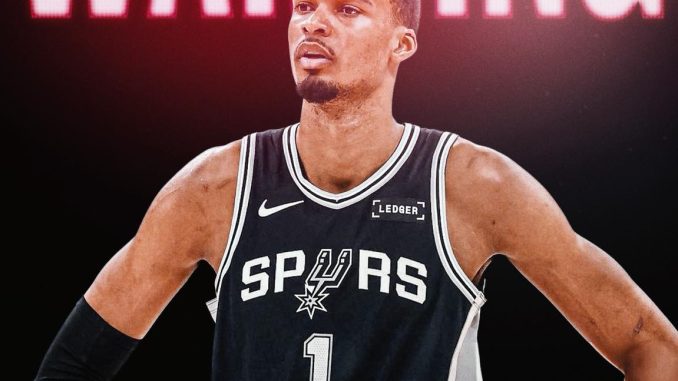
The NBA postseason drama has taken a sharp turn off the hardwood, with league offices reportedly stepping in after a tense Game 5 night that extended far beyond the final buzzer. According to league sources, the NBA has issued a formal media warning to San Antonio Spurs superstar Victor Wembanyama following his decision to skip mandatory postgame media availability after his team’s defeat to the Oklahoma City Thunder in Game 5 of the Western Conference Finals. The move, though not unprecedented in league history, has quickly escalated into one of the most discussed off-court storylines of the 2026 playoffs, placing renewed scrutiny on player-media obligations during high-stakes moments.
The incident reportedly unfolded immediately after the final horn in Oklahoma City’s Game 5 victory, a contest that saw the Thunder seize control of the series and push the Spurs to the brink of elimination. While players from both teams cycled through their usual media commitments in the arena’s designated interview areas, Wembanyama did not appear for his scheduled availability, prompting concern among league officials and triggering what sources describe as a “standard but firm reminder” of the NBA’s media participation policy.
Under NBA rules, players who participate in playoff games are required to make themselves available to the media after both wins and losses, barring medical or family emergencies. The policy, reinforced in recent Collective Bargaining Agreement language, is designed to maintain transparency, ensure league access for broadcasters and journalists, and uphold the commercial obligations tied to postseason coverage. When players fail to comply without an approved exemption, the league is empowered to issue warnings or fines depending on the circumstances and any prior history.
In this case, league insiders emphasize that the warning issued to Wembanyama is not considered disciplinary in the punitive sense but rather corrective, signaling the league’s expectation that all players adhere to postseason media requirements moving forward. Still, given the magnitude of the player involved and the timing within the Western Conference Finals, the situation has taken on a far larger public profile than a typical compliance reminder.
The Spurs’ silence following the game added to the intrigue. Team representatives declined to provide an immediate explanation for Wembanyama’s absence from the media room, only stating that the organization was “aware of the league’s communication” and would “address the matter internally.” That brief response did little to quell speculation, particularly given the emotional weight of the Game 5 loss, which placed San Antonio in a precarious 3–2 series deficit heading into Game 6.
For a franchise built around its generational centerpiece, expectations for visibility and leadership have grown in tandem with its competitive rise. Wembanyama, widely regarded as one of the league’s most marketable and influential young stars, has typically embraced media responsibilities throughout his career, often engaging thoughtfully and extensively after both regular-season and playoff games. His absence following such a pivotal defeat therefore stood out not only as a procedural issue but also as a narrative break in what has otherwise been a carefully managed public persona.
Sources close to the situation suggest that the decision to skip media availability may have been driven by emotional frustration following a physically and mentally exhausting performance. Game 5 carried enormous stakes, with both teams trading momentum in a bruising, high-intensity environment that stretched San Antonio’s rotation and tested its composure down the stretch. The Thunder’s late-game execution ultimately separated the sides, allowing Oklahoma City to capitalize and take control of the series heading back to Texas.
Inside the locker room, the Spurs were described as “visibly deflated” after the loss. The postseason journey had already demanded heavy minutes from the team’s core, and the weight of expectations surrounding Wembanyama has only intensified as the franchise continues its push toward championship contention. In that context, the emotional toll of the defeat may have contributed to his decision to avoid the postgame spotlight, though the league’s stance remains clear that emotional circumstances do not exempt players from their media duties.
The NBA’s relationship with its stars and the media has long been a balancing act, particularly in the modern era where player expression and mental health considerations often intersect with strict professional obligations. Over the past decade, several high-profile incidents involving postgame media refusals have prompted the league to reaffirm its expectations. While enforcement has varied depending on context, the overarching principle has remained consistent: participation is mandatory unless explicitly excused.
In postseason settings, that expectation becomes even more pronounced. The league’s global broadcast partnerships and commercial commitments rely heavily on consistent player access, especially during marquee matchups such as the Western Conference Finals. A figure like Wembanyama, whose presence draws international attention and drives significant viewership, becomes central to that ecosystem, making any deviation from protocol a matter of league-wide interest rather than a team-specific issue.
The Spurs organization now finds itself navigating both competitive and reputational challenges simultaneously. On the court, they must respond to a Thunder team that has steadily gained confidence and rhythm in the series, leveraging defensive pressure and late-game execution to tilt momentum. Off the court, they must manage the narrative surrounding their franchise cornerstone, ensuring that a single postgame decision does not overshadow what has otherwise been a landmark playoff run for the young roster.
Within league circles, there is also recognition that the situation could be resolved quickly. Historically, media warnings of this nature often serve as formal reminders rather than precursors to escalating punishment, especially for players without prior infractions. If Wembanyama returns to standard compliance in Game 6 and beyond, the matter is expected to recede into the background of the series narrative. However, the visibility of the Western Conference Finals ensures that any deviation from protocol is magnified under the postseason spotlight.
The Thunder, meanwhile, have maintained focus on the court rather than the surrounding controversy. Their Game 5 victory was built on disciplined defense, timely shot-making, and a collective effort that neutralized San Antonio’s interior presence for key stretches. With the series now tilted in their favor, Oklahoma City enters Game 6 with an opportunity to close out one of the most anticipated matchups of the postseason and return to the NBA Finals.
Still, the conversation inevitably circles back to Wembanyama, whose development and leadership are under constant examination given his status as one of the league’s defining young talents. Every postseason moment adds to the evolving picture of how he handles pressure, adversity, and the responsibilities that come with superstardom. While the absence from media availability is a relatively small procedural matter in isolation, its timing during a critical playoff juncture has amplified its significance.
Around the league, reactions have been mixed. Some former players and analysts have suggested that emotional space after a devastating loss is understandable, especially for a player who shoulders as much responsibility as Wembanyama does. Others argue that playoff media obligations are part of the professional contract and that leadership includes showing up even in difficult moments. The NBA, for its part, appears focused on ensuring consistency rather than escalating confrontation, opting for a measured warning rather than immediate financial penalties.
As the series shifts back to San Antonio for Game 6, attention will now turn to how both the Spurs and their star respond. On the court, adjustments will be critical if San Antonio hopes to extend the series and regain momentum. Off the court, Wembanyama’s next postgame media appearance will be closely watched, not for controversy, but for compliance and closure.
In high-level playoff basketball, narratives often extend beyond the final score, shaped by moments that occur in tunnels, locker rooms, and press rooms just as much as on the hardwood. This latest development underscores how tightly woven those worlds have become, particularly for players operating under the brightest lights. For Wembanyama and the Spurs, the challenge now is not only to answer Oklahoma City’s on-court pressure, but also to ensure that the off-court storyline does not overshadow their pursuit of a championship breakthrough.
Be the first to comment