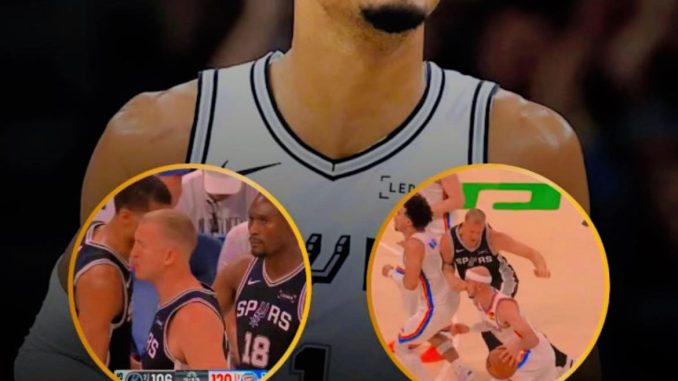
The NBA playoffs have delivered drama at every turn this season, but few stories have shaken the basketball world quite like the latest controversy surrounding Victor Wembanyama and the San Antonio Spurs. According to multiple reports circulating around the league Wednesday morning, the NBA has issued a one-game suspension to the Spurs superstar after reviewing a series of hard fouls involving Oklahoma City Thunder guard Jared McCain during the Western Conference Finals. The decision comes after tensions boiled over in Game 5, where McCain was forced to leave the contest late following what many analysts, fans, and former players described as excessive physical play from San Antonio.
The reported suspension means Wembanyama would miss the critical Game 6 matchup with San Antonio facing elimination, instantly transforming the balance of the series and igniting a firestorm of debate across the NBA landscape. For a Spurs team already trailing in the series and struggling to contain Oklahoma City’s relentless pace, losing their franchise cornerstone at this stage could prove devastating.
What was once shaping up to be a classic postseason battle between two rising Western Conference powers has now evolved into one of the most polarizing playoff controversies in recent memory.
The incident itself unfolded during the closing moments of Game 5 in Oklahoma City. With the Thunder protecting a double-digit lead and emotions running high, physicality escalated on multiple possessions involving McCain, who had torched San Antonio throughout the second half with fearless drives and timely perimeter shooting. Television cameras captured several aggressive sequences in which Spurs players delivered hard contact to the rookie guard, including plays that quickly drew criticism online and sparked accusations that San Antonio was intentionally targeting Oklahoma City’s emerging star.
Wembanyama’s involvement became the focal point almost immediately.
While the 7-foot-4 phenom had already been battling frustration throughout the night after enduring one of his roughest offensive performances of the postseason, replay angles appeared to show him directing visible irritation toward McCain during multiple possessions. Following the game, social media exploded with slowed-down clips, frame-by-frame analysis, and heated debate over whether the fouls crossed the line from playoff intensity into dangerous conduct.
The NBA reportedly spent much of Tuesday reviewing game footage before ultimately arriving at the suspension decision.
League insiders indicated the punishment stemmed not from a single isolated play, but from what officials allegedly viewed as a pattern of unnecessary physical behavior that escalated the danger level late in the contest. While the NBA has historically allowed a more physical brand of basketball during the postseason, protecting player safety remains a central point of emphasis — especially when contact appears retaliatory or excessive.
For Wembanyama, the reported suspension marks the latest controversial chapter in what has otherwise been a spectacular playoff breakthrough campaign.
The French superstar entered the postseason carrying enormous expectations, and in many ways he exceeded them. Throughout San Antonio’s playoff run, Wembanyama showcased exactly why many around the league already view him as the future face of basketball. His combination of elite rim protection, guard-like perimeter skills, and impossible defensive versatility has turned every Spurs game into must-watch television.
Against Oklahoma City earlier in the series, Wembanyama delivered multiple signature performances, including a dominant 41-point, 24-rebound masterpiece that instantly entered playoff lore. His ability to take over games on both ends of the floor transformed San Antonio from an exciting young team into a legitimate championship threat seemingly ahead of schedule.
But as the pressure intensified deeper into the Western Conference Finals, so did the physical nature of the matchup.
The Thunder have consistently attacked Wembanyama with speed, spacing, and aggressive drives to force him into uncomfortable defensive situations. Meanwhile, Oklahoma City defenders have crowded him relentlessly, refusing to allow easy catches or uncontested opportunities around the basket. Several Spurs players and coaches had quietly expressed frustration throughout the series regarding the officiating and the physical treatment Wembanyama received.
That frustration may now have boiled over in the worst possible way.
The fallout from the suspension was immediate.
NBA fans flooded social media with divided reactions within minutes of the reports surfacing. Some argued the league made the correct call in order to protect players and maintain discipline during the postseason. Others believed suspending one of the NBA’s brightest young stars during an elimination game was excessive, especially considering the high level of physicality commonly seen in playoff basketball.
Former players were similarly split.
Several analysts on national television defended the league’s stance, arguing that the NBA cannot allow retaliation or dangerous fouls to escalate unchecked, regardless of a player’s superstar status. Others questioned whether Wembanyama was being unfairly scrutinized because of his growing visibility and marketability.
Regardless of perspective, there is little disagreement on one point: the suspension dramatically alters the outlook for Game 6.
Without Wembanyama, the Spurs lose not only their best scorer and rebounder, but also the defensive anchor who fundamentally changes the geometry of the court. His presence alone forces opposing offenses to rethink shots at the rim, while his offensive gravity creates opportunities for teammates across the floor.
San Antonio head coach Mitch Johnson now faces the enormous challenge of keeping the Spurs season alive without the player around whom the entire system revolves.
The pressure will immediately shift toward San Antonio’s supporting cast, particularly young guards Stephon Castle and Devin Vassell, both of whom must elevate their offensive production in Wembanyama’s absence. Veterans such as Harrison Barnes and Keldon Johnson could also play larger roles as the Spurs attempt to extend the series and force a decisive Game 7.
Yet replacing Wembanyama’s impact is virtually impossible.
There simply is no substitute for a player capable of protecting the rim, switching onto guards, grabbing rebounds above traffic, and generating offense from anywhere on the floor. His absence changes every defensive coverage, every transition possession, and every late-game adjustment.
For Oklahoma City, meanwhile, the suspension represents a massive opportunity.
The Thunder entered the series as one of the NBA’s deepest and most disciplined teams, but McCain’s emergence has added another explosive dimension to their attack. The rookie guard has become a breakout postseason sensation, combining fearless shot creation with relentless energy that repeatedly shifted momentum throughout the series.
Game 5 may have been his defining playoff moment yet.
McCain attacked San Antonio’s defense without hesitation, scoring key baskets in the second half while repeatedly putting pressure on the rim. His confidence appeared to frustrate the Spurs defense as the game slipped away, and by the final minutes he had become the emotional center of Oklahoma City’s crowd and bench.
Now, instead of focusing solely on basketball adjustments, the Thunder suddenly find themselves navigating the emotional aftermath of a heated controversy.
Oklahoma City players largely avoided inflammatory comments publicly after Game 5, but frustration inside the locker room reportedly ran high. Several Thunder veterans were visibly upset following the hard fouls involving McCain, and there was concern within the organization about the escalating physicality late in the contest.
If anything, the suspension may further galvanize a Thunder roster already one win away from the NBA Finals.
League-wide reaction has also reignited larger conversations about modern playoff basketball and how the NBA should handle physicality involving star players. Some believe the league has become too quick to discipline hard playoff fouls, arguing that intensity and emotional volatility are natural parts of championship basketball. Others insist the NBA must continue prioritizing player safety, especially as younger stars become increasingly valuable to the league’s long-term future.
Wembanyama’s situation is especially significant because of his global profile.
At only 22 years old, he is already one of the NBA’s most recognizable international stars and arguably the league’s most unique talent since the arrival of LeBron James. Every move he makes receives enormous attention, and controversies involving him instantly become headline stories worldwide.
That reality magnifies everything.
Had the same sequence involved a lesser-known role player, the reaction may have been far quieter. But when a generational superstar becomes involved in allegations of dirty play during the conference finals, the spotlight intensifies beyond normal playoff scrutiny.
Even so, many around the Spurs organization reportedly remain furious with the decision.
Sources close to the team believe the league failed to properly account for the physical punishment Wembanyama has absorbed throughout the postseason. There is a growing sense within San Antonio that opponents have consistently pushed the boundaries defensively against the towering superstar while officials allowed excessive contact to continue.
Those frustrations were echoed by portions of the Spurs fanbase, who viewed the suspension as selective enforcement rather than balanced accountability.
Still, emotions and debates will ultimately take a backseat once Game 6 tips off.
The reality is simple: San Antonio’s season now hangs by a thread, and the franchise must attempt to survive without its centerpiece player. The Thunder, meanwhile, suddenly stand in prime position to close out the series and punch their ticket to the NBA Finals.
For Wembanyama personally, the suspension could become a defining learning moment early in his career.
Nearly every all-time great has faced adversity, criticism, or controversy during the climb toward championship contention. How Wembanyama responds — emotionally, mentally, and competitively — may ultimately shape the next stage of his evolution as both a superstar and leader.
Because despite the outrage, debate, and nonstop headlines, one truth remains undeniable: Victor Wembanyama is still one of the most extraordinary talents basketball has ever seen.
And whether this suspension becomes a minor footnote or a major turning point in his career will depend entirely on what happens next.
Be the first to comment