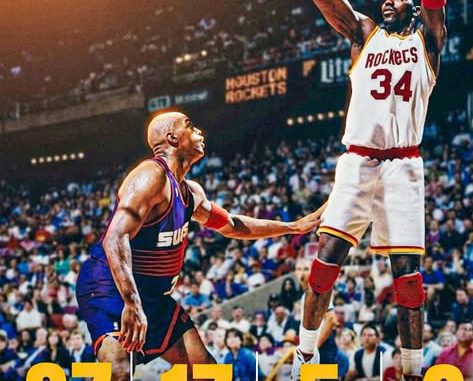
Thirty-two years ago, under the brightest pressure imaginable and with an entire season hanging in the balance, Hakeem Olajuwon delivered one of the defining Game 7 performances of the modern NBA era, lifting the Houston Rockets to a dramatic victory that completed a stunning comeback and ignited the franchise’s unforgettable first championship journey. What unfolded that night was more than just a playoff win. It was the moment Houston transformed from a talented contender into a battle-tested force capable of conquering the league, with Olajuwon standing at the center of it all like a man destined for greatness.
The year was 1994, and the Rockets were searching for validation after building one of the strongest regular seasons in franchise history. Houston had finished with 58 wins behind the brilliance of Olajuwon, who had evolved into the most dominant two-way player in basketball. He was already respected as an elite defender and gifted scorer, but that season elevated him into a different category entirely. Every possession seemed to revolve around his intelligence, footwork, timing, and unmatched competitive fire. Yet despite the regular-season success, questions still surrounded the Rockets entering the postseason. Critics wondered whether Houston possessed enough playoff toughness to survive the brutal Western Conference gauntlet. Others questioned whether Olajuwon could truly carry a team all the way to a championship as the undisputed centerpiece.
Those doubts only intensified during Houston’s intense second-round showdown against the Seattle SuperSonics, a powerhouse loaded with athleticism, defensive pressure, and confidence. Seattle had finished with the best record in the NBA and entered the series believing this was finally its time to break through. Led by stars like Gary Payton and Shawn Kemp, the Sonics were explosive, physical, and relentless. Their aggressive style gave opponents little room to breathe, and after taking control of the series early, it appeared Houston’s season was nearing collapse.
The Rockets quickly fell behind 0-2, placing immense pressure on every remaining game. In the history of the NBA playoffs, climbing out of that kind of hole against a top-seeded opponent was already a monumental task. But Olajuwon refused to let Houston unravel. Throughout the series, he maintained an almost eerie calmness, playing with the composure of a player who understood that greatness often requires surviving chaos first. Game after game, he responded with dominant scoring, elite rim protection, and the kind of leadership that stabilized the entire roster.
Houston clawed back into the series with gritty performances at home, and suddenly the pressure shifted toward Seattle. Every game became more physical, more emotional, and more desperate. Olajuwon’s presence loomed over the series like a storm cloud. His famous “Dream Shake” footwork tortured defenders in the post, while his defensive instincts erased mistakes all over the floor. He wasn’t merely producing numbers — he was dictating the emotional rhythm of the series.
Still, by the time Game 7 arrived, the odds remained stacked against Houston. Seattle had home-court advantage, a roaring crowd, and the confidence of a team that had dominated the regular season. Historically, Game 7s are where legacies are either immortalized or painfully questioned forever. Every possession carries enormous weight. Every missed shot feels magnified. Superstars are judged not only by talent in those moments, but by their ability to control fear and pressure.
Olajuwon responded with a masterpiece.
From the opening tip, he established complete command of the game. He attacked aggressively in the paint, challenged every shot defensively, and imposed his will on both ends of the court. While Seattle attempted to speed the game up and create chaos, Olajuwon slowed everything down with precision and poise. Every touch felt purposeful. Every defensive rotation felt calculated. He played like a man completely aware that history was waiting on the other side of forty-eight minutes.
The stat line alone was extraordinary. Olajuwon finished with 39 points, 17 rebounds, and multiple blocks in one of the most dominant Game 7 performances the NBA has ever witnessed. But the numbers still fail to capture the totality of his impact. This was not empty production accumulated in favorable circumstances. This was dominance under maximum pressure against the league’s best team on the road with a season hanging in the balance.
Again and again, Seattle threw defenders at him. Double teams arrived instantly. Physical contact increased with every possession. Yet Olajuwon remained unstoppable. He scored with elegant footwork in the post, soft turnaround jumpers, quick spins to the basket, and relentless offensive rebounding. Defensively, he anchored Houston’s entire system, protecting the rim while still recovering fast enough to contest shooters and disrupt passing lanes.
What made the performance even more remarkable was the mental toughness behind it. Great playoff performances are often remembered for spectacular shots or unforgettable highlights, but Game 7 greatness usually comes down to emotional control. Olajuwon never looked rattled. While the crowd erupted after Seattle runs, he responded calmly. While teammates battled nerves, he steadied them. The Rockets fed off his confidence possession after possession.
Houston eventually pulled away in the second half, silencing the Seattle crowd and completing one of the most impressive comeback victories of the postseason. The Rockets had recovered from a 0-2 deficit against the NBA’s top seed, and Olajuwon had officially stamped the series with a performance for the ages. It was the kind of night that permanently changes how a player is viewed historically.
For Houston, the victory represented far more than simply advancing to the next round. It gave the Rockets belief. Championship teams are often shaped by moments when they survive adversity that should have ended their season. That Game 7 became Houston’s defining emotional breakthrough. The Rockets no longer looked like a talented team hoping things would fall into place. They looked like a battle-hardened group capable of surviving anything.
Olajuwon’s brilliance throughout the playoffs only continued from there. The deeper Houston advanced, the more unstoppable he became. He dismantled elite defenders with patience and skill rarely seen from a center. He controlled games defensively without sacrificing offensive aggression. Most importantly, he elevated his game whenever the pressure intensified.
The 1994 postseason eventually became one of the greatest individual playoff runs in NBA history. Olajuwon battled through a gauntlet of elite competition and consistently emerged as the best player on the floor. By the time Houston reached the NBA Finals against the New York Knicks, the Rockets were no longer underdogs searching for respect. They were confident, resilient, and fully convinced their superstar could carry them to the promised land.
That Finals series became another showcase for Olajuwon’s brilliance. Matched up against fellow Hall of Fame center Patrick Ewing, Olajuwon dominated both offensively and defensively. Houston ultimately captured the first championship in franchise history, with Olajuwon earning Finals MVP honors and cementing himself among the greatest centers the sport has ever seen.
But as incredible as the Finals triumph was, many Rockets fans still point back to that Game 7 in Seattle as the true turning point of the championship run. Without Olajuwon’s masterpiece in that hostile environment, none of the glory that followed would have happened. Championships often hinge on a single moment when everything could have collapsed. For Houston, that moment came in Seattle — and Olajuwon answered it with legendary brilliance.
The performance also helped redefine how basketball fans viewed dominant big men in the modern era. During the 1990s, the NBA was filled with elite centers, making the position arguably the strongest it had ever been. Yet even among legends, Olajuwon stood apart because of his versatility. He combined graceful footwork with elite athleticism and defensive instincts that bordered on supernatural. Unlike many traditional centers, he could beat defenders with finesse just as easily as power. His game possessed artistry.
That artistry was on full display during the Rockets’ comeback series. Every move seemed perfectly timed. Every fake created separation. Every spin move left defenders helpless. Young players around the league studied his footwork for years afterward, and many modern stars still cite Olajuwon as one of the most technically gifted players in basketball history.
The emotional significance of that championship run also carried deeper meaning for Houston as a city. Sports championships can reshape communities, and the Rockets’ breakthrough title provided a defining moment for fans who had waited decades to see the franchise reach the top. Olajuwon became more than just a superstar athlete. He became a symbol of perseverance, professionalism, and excellence.
Even decades later, the image of Olajuwon dominating in that Game 7 remains vivid in NBA history. The intensity in his eyes, the calmness under pressure, and the sheer force of his performance continue to resonate with basketball fans old enough to remember it and younger fans discovering the footage years later. It serves as a reminder that true greatness is often revealed not when circumstances are easy, but when failure feels dangerously close.
Today’s NBA is driven heavily by perimeter play and three-point shooting, but performances like Olajuwon’s Game 7 masterpiece still stand timeless because they represent the purest essence of playoff basketball. There was no reliance on overwhelming spacing or high-volume outside shooting. It was a superstar imposing his will through skill, toughness, and competitive greatness.
Many legendary postseason performances have occurred since then, but few carried the same combination of stakes, pressure, and individual dominance. Olajuwon was not simply great that night — he was transcendent. Every championship run has defining snapshots, and for the 1994 Rockets, that snapshot will forever be Olajuwon conquering Seattle on the road with his season hanging by a thread.
The legacy of that performance has only grown stronger with time. Younger generations studying NBA history continue to revisit the game as an example of what true playoff leadership looks like. Analysts regularly rank it among the greatest Game 7 performances ever delivered. Rockets fans still celebrate it as one of the proudest nights in franchise history.
Perhaps what makes it so unforgettable is how perfectly it encapsulated who Olajuwon was as a player. He never relied on theatrics or excessive self-promotion. His dominance came through execution, discipline, and relentless focus. In an era filled with larger-than-life personalities, Olajuwon often let his game speak loudest. And on that unforgettable night 32 years ago, it spoke with thunderous authority.
By the final buzzer, Houston’s comeback was complete, Seattle’s dream season was over, and a future champion had fully arrived. The Rockets walked off the court believing they could beat anyone. Their superstar had carried them through fire and emerged even stronger.
The rest became basketball history.
A championship soon followed. Another title came the next year. Olajuwon’s legacy ascended into immortality. But before the trophies, before the parades, and before the banners hanging in Houston, there was Game 7 — the night Hakeem Olajuwon authored a masterpiece that changed everything for the Houston Rockets forever.
Be the first to comment