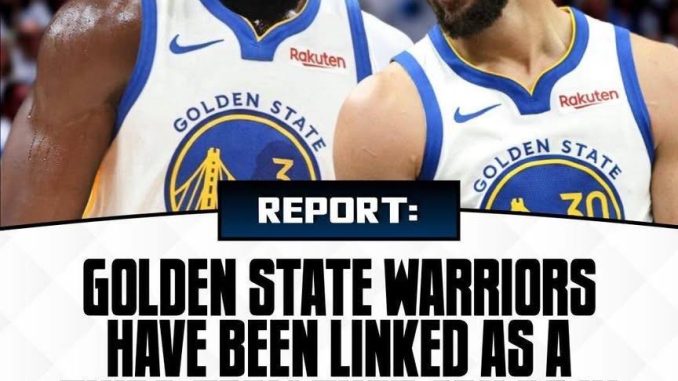
The rumor mill has already begun to spin ahead of what could be one of the most fascinating NBA offseasons in recent memory. According to veteran NBA insider Sean Deveney of Heavy, the Golden State Warriors have reportedly emerged as a potential third-team participant in a possible trade involving Boston Celtics star Jaylen Brown should Boston ultimately decide to explore moving the former Finals MVP. While no formal discussions have been confirmed and the Celtics have publicly shown no indication that a Brown trade is imminent, the mere possibility of Golden State entering such a conversation has immediately captured the attention of executives, fans, and analysts across the league.
For the Warriors, the speculation arrives at a pivotal moment in franchise history. Golden State remains committed to maximizing the championship window of Stephen Curry, whose brilliance continues to defy age. Despite remaining one of basketball’s most dangerous offensive players, Curry understands as well as anyone that championship opportunities become increasingly precious as a player moves deeper into his career. The Warriors’ front office, led by general manager Mike Dunleavy Jr., faces the difficult challenge of balancing long-term sustainability with an urgent desire to compete for another title while Curry remains an elite superstar.
That reality is what makes Brown such an intriguing name.
The Celtics forward has developed into one of the NBA’s premier two-way wings. Entering the prime years of his career, Brown combines elite athleticism, scoring versatility, defensive toughness, and playoff experience in a package that every contender covets. He has evolved from a promising young prospect into a perennial All-Star capable of carrying an offense for extended stretches while also defending multiple positions at a high level.
Brown’s resume speaks for itself. He has been a central figure in Boston’s rise to championship contention over the past several seasons, helping the Celtics establish themselves as one of the league’s most successful organizations. His ability to score at all three levels, attack the rim with power, create his own shot, and contribute on the defensive end has made him one of the most valuable wings in the NBA.
The possibility of Golden State acquiring a player of Brown’s caliber naturally raises an important question: would such a move actually make sense for the Warriors?
From a basketball standpoint, the answer appears straightforward.
Brown would immediately become Golden State’s second-best player and perhaps the ideal running mate for Curry. One of the Warriors’ biggest challenges in recent years has been finding a consistent secondary scorer capable of easing the offensive burden on their franchise icon. While players such as Jimmy Butler, Andrew Wiggins, and others have contributed at various points, Golden State has often struggled when opponents successfully limited Curry’s opportunities.
Brown would significantly change that dynamic.
Unlike many stars who require constant ball dominance, Brown has demonstrated the ability to thrive both on and off the ball. He can attack closeouts, run in transition, finish through contact, and create offense in isolation situations when possessions break down. That versatility would fit naturally within Golden State’s motion-heavy offensive system.
Imagine the pressure opposing defenses would face attempting to contain Curry’s limitless shooting range while simultaneously accounting for Brown’s explosive downhill attacks. Teams could no longer load up on Curry without risking Brown punishing them in one-on-one situations. Likewise, Brown would benefit from the spacing and offensive creativity generated by Curry’s presence.
Defensively, the fit could be equally appealing.
One of the Warriors’ strengths throughout their championship years was their ability to deploy versatile defenders across multiple positions. Brown remains one of the league’s premier wing defenders when fully engaged. His combination of strength, quickness, and athleticism allows him to guard elite perimeter scorers while also switching onto larger forwards.
For a Golden State team that has occasionally struggled against bigger, more athletic opponents, Brown would provide an immediate solution. His presence would allow the Warriors to match up more effectively against Western Conference contenders loaded with star wings and dynamic scorers.
However, while the basketball fit may seem obvious, constructing an actual trade presents a far more complicated challenge.
Brown is not merely a star player. He is a franchise cornerstone earning a maximum contract. Any team interested in acquiring him would need to assemble a significant package of players, draft assets, and financial considerations.
For Boston, moving Brown would represent a monumental organizational decision. The Celtics have spent years building around the duo of Brown and Jayson Tatum, creating one of the league’s most successful partnerships. Trading Brown would only make sense if Boston believed it could either significantly improve its roster flexibility or receive enough assets to reshape its future.
That is where Golden State’s reported role as a third team becomes particularly interesting.
Rather than acquiring Brown directly in a traditional one-for-one blockbuster, the Warriors could potentially facilitate a more complex multi-team arrangement. Three-team trades have become increasingly common as franchises attempt to navigate salary cap restrictions and maximize asset value.
Golden State possesses several pieces that could attract interest from teams seeking young talent, draft capital, or salary relief. The Warriors’ front office has spent recent years trying to bridge two timelines, developing younger players while simultaneously pursuing championships. Those younger assets could become valuable trade chips if the organization determines that another title run should take priority.
The challenge, of course, lies in determining how much is too much.
Any pursuit of Brown would likely require substantial sacrifices. Golden State would almost certainly need to part with key rotational contributors, promising young talent, and future draft picks. Such moves can accelerate championship pursuits, but they also carry significant risk.
History provides examples of both successful and unsuccessful superstar acquisitions.
The Warriors themselves benefited enormously from bold roster decisions during their dynasty years. Acquiring Kevin Durant transformed an already great team into one of the most dominant forces in NBA history. At the same time, numerous franchises have depleted their futures chasing stars only to discover that talent alone does not guarantee championships.
That reality forces Golden State’s decision-makers to weigh several factors.
First, how much longer can Curry realistically remain an MVP-level player?
Second, can the current roster legitimately compete with the league’s elite teams without another major addition?
Third, would Brown’s arrival elevate the Warriors from playoff contender to genuine championship favorite?
Many around the league would argue that the answer to the third question is yes.
Brown’s age is particularly attractive. Unlike many veteran stars who become available via trade, Brown is still firmly in his prime. Acquiring him would not simply be about maximizing Curry’s remaining years; it could also provide Golden State with a foundational star capable of leading the franchise into its next era.
That long-term value distinguishes Brown from many other potential trade targets.
For years, the Warriors have searched for ways to remain competitive beyond the Curry era. While no player can truly replace one of the greatest shooters in basketball history, Brown represents the type of elite talent around whom organizations can build. His presence could ease the eventual transition while simultaneously helping Golden State contend in the present.
From Boston’s perspective, however, there remains a compelling argument for maintaining the status quo.
Brown and Tatum have already proven they can compete at the highest levels of the sport. Championship-caliber wings are among the rarest commodities in basketball, and teams typically spend years searching for players with Brown’s combination of skill, athleticism, and experience.
Unless the Celtics receive an extraordinary offer, many league observers believe moving Brown would be difficult to justify.
That uncertainty is why this report should currently be viewed as exploratory rather than inevitable.
NBA executives routinely evaluate scenarios involving star players, especially during the offseason. Teams prepare contingency plans, examine trade frameworks, and assess opportunities long before formal negotiations begin. The fact that Golden State has reportedly emerged as a potential participant does not necessarily mean discussions are advanced or that a trade is likely.
Still, the report highlights an important truth about the Warriors’ current mindset.
Golden State understands the urgency of the moment.
Every season with Curry represents a valuable opportunity to chase another championship banner. While patience and long-term planning remain important, championship organizations recognize when aggressive action may be necessary.
Brown embodies the type of player capable of changing a franchise’s trajectory.
His combination of scoring, defense, durability, and playoff pedigree would instantly make nearly any contender better. Few available players possess his blend of immediate impact and future value. That reality ensures his name will remain at the center of speculation whenever trade discussions emerge.
For Warriors fans, the prospect of seeing Brown alongside Curry is undeniably exciting. The pairing would create one of the league’s most dangerous star duos, blending Curry’s generational shooting and offensive gravity with Brown’s physicality, athleticism, and two-way excellence.
The Western Conference remains loaded with talent, featuring championship hopefuls built around young superstars and established veterans alike. To navigate that landscape, Golden State may need another elite player capable of delivering on the biggest stage.
Brown certainly fits that description.
Whether such a blockbuster ever materializes remains uncertain. Trades involving players of Brown’s stature are extraordinarily difficult to complete, particularly when multiple teams become involved. Salary considerations, asset valuations, organizational priorities, and market dynamics all influence negotiations.
Yet the report serves as a reminder that the NBA never stops evolving.
As front offices prepare for a critical offseason, conversations that seem unlikely today can rapidly gain momentum tomorrow. The Warriors have repeatedly demonstrated a willingness to explore ambitious opportunities in pursuit of championships, and Brown represents exactly the kind of transformative talent worthy of serious consideration.
For now, the situation remains speculative. Boston has not indicated a desire to move Brown, and Golden State’s precise level of interest remains unknown. But if circumstances change and the Celtics become open to discussions, the Warriors appear prepared to at least explore their options.
And if a pathway to acquiring Jaylen Brown ever truly becomes available, it is difficult to imagine Golden State ignoring the opportunity to pair one of the NBA’s premier two-way stars with Stephen Curry in what could become one of the most compelling partnerships in professional basketball.
Be the first to comment