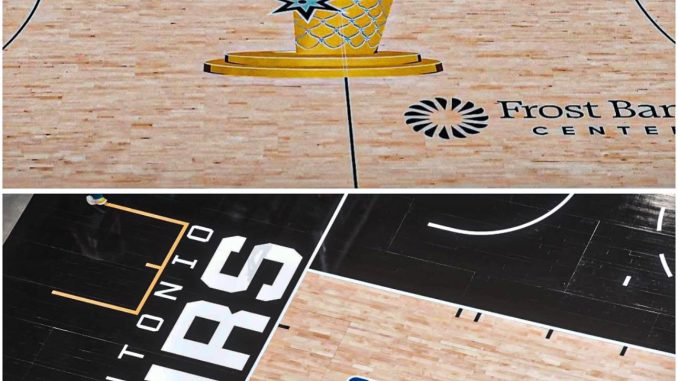
The NBA has officially turned back the clock, and in doing so, it may have rediscovered one of the most cherished traditions in professional basketball. As anticipation builds for the upcoming NBA Finals between the San Antonio Spurs and the New York Knicks, fans were greeted with a sight many believed had been lost to history: the return of the iconic Larry O’Brien Trophy logo at center court and the classic “Finals” script painted along the baselines.
It is a visual change that may seem minor to casual observers, but for longtime basketball fans, players, and historians of the game, it represents something far more significant. The return of the traditional NBA Finals court design signals a renewed embrace of the league’s championship heritage, reconnecting today’s biggest stage with decades of unforgettable moments that helped shape the sport.
For the first time since 2009, the giant Larry O’Brien Trophy logo will once again sit proudly at center court during the NBA Finals. Meanwhile, the familiar “Finals” lettering returns to the baselines for the first time since 2014, restoring a look that many fans associate with some of the greatest championship battles ever played.
In an era increasingly dominated by digital enhancements, LED displays, virtual advertisements, and constantly evolving presentation styles, the NBA’s decision to bring back the painted hardwood design feels both refreshing and meaningful. There are no holograms. No elaborate digital projections. No futuristic visual effects designed to dominate the broadcast. Instead, the focus shifts back to the court itself—a simple yet powerful reminder that the Finals are about basketball history, championship pressure, and the pursuit of greatness.
The announcement immediately sparked excitement across social media, where fans shared images from legendary Finals series that featured the iconic court design. Generations of basketball enthusiasts remember watching championship games where the center-court trophy served as a visual symbol that the stakes had reached their highest level. Whether it was Michael Jordan chasing titles in Chicago, Kobe Bryant leading the Lakers, Tim Duncan building the Spurs dynasty, or countless other stars competing for basketball immortality, the Finals court was part of the experience.
For many, the painted trophy was more than decoration. It represented arrival.
The moment players stepped onto that court, they knew they were competing on the sport’s grandest stage. Every possession carried additional weight. Every shot seemed larger. Every mistake felt magnified. The court itself became part of the storytelling, creating a visual identity unique to the NBA Finals.
That identity gradually disappeared over the years as the league moved toward cleaner, more standardized court designs. While the games remained just as important, many fans felt something was missing. The Finals looked different. The visual distinction between a regular-season game and a championship game became less pronounced. The spectacle remained, but a beloved piece of tradition had quietly faded away.
Now, with the trophy logo returning to center court, the NBA appears to be acknowledging the emotional connection fans have with the league’s history. Nostalgia alone does not win championships, but it can strengthen the bond between generations of fans and the game they love.
The timing of the decision could not be more fitting.
This year’s Finals matchup between the Spurs and Knicks already carries a unique sense of historical significance. Both franchises possess rich traditions and passionate fan bases. Both have experienced periods of triumph and heartbreak. Both enter this championship series with an opportunity to add another memorable chapter to their respective stories.
For San Antonio, the Finals represent a continuation of a proud basketball legacy. The Spurs have long been recognized as one of the NBA’s model organizations, built on stability, discipline, and a commitment to excellence. Over the years, the franchise became synonymous with championship basketball, establishing a culture that consistently produced winning seasons and postseason success.
Now, a new generation has the chance to create its own defining moment under the brightest lights. Competing on a Finals court that evokes memories of previous championship runs adds another layer of significance to the occasion. It connects today’s players with the legends who helped establish the franchise’s reputation as one of basketball’s gold standards.
For New York, the opportunity feels equally monumental.
The Knicks remain one of the league’s most iconic franchises, representing the largest basketball market in the world and carrying decades of history. Their fan base has endured years of frustration while remaining among the most loyal and passionate supporters in professional sports. The chance to compete for a championship is a moment many Knicks fans have waited a lifetime to experience.
The return of the traditional Finals court only enhances the sense of occasion. For a franchise steeped in basketball history, the classic visual presentation feels like a perfect backdrop for a championship pursuit that could resonate for generations.
Beyond the teams themselves, the restored court design speaks to a broader trend in sports. Across professional leagues, there has been a growing appreciation for tradition and authenticity. Fans increasingly value elements that connect the present to the past. Whether it involves throwback uniforms, retro logos, classic arenas, or historical tributes, organizations have discovered that honoring history can deepen engagement and enrich the overall experience.
The NBA Finals court is a prime example.
For decades, the painted Larry O’Brien Trophy served as one of the league’s most recognizable symbols. Television broadcasts immediately felt different when viewers saw the championship logo at center court. It created anticipation before the opening tip and reinforced the importance of every game throughout the series.
Those visual cues matter.
Sports are built on memories, and memories are often tied to images. Fans remember championship-winning shots, emotional celebrations, dramatic comebacks, and iconic performances. They also remember the environments where those moments occurred. The court becomes part of the memory. It serves as the stage upon which greatness unfolds.
When fans think back to some of the most unforgettable Finals moments in league history, they often picture them against the backdrop of the traditional championship court. The restored design taps directly into that emotional connection.
Players are likely to feel it as well.
Athletes frequently speak about the importance of appreciating the history of their sport. Many current stars grew up watching NBA Finals games featuring the very court design that is now returning. For them, stepping onto that floor could be a powerful reminder of childhood dreams and the journey required to reach basketball’s highest level.
The symbolism should not be underestimated.
Every championship series carries pressure, but visual traditions can amplify the sense of occasion. The painted trophy at center court serves as a constant reminder of what is at stake. It is impossible to ignore. Players glance down and see the ultimate prize represented beneath their feet. Fans see it on television and immediately understand the magnitude of the moment.
The return also reflects the NBA’s ability to listen to its audience.
For years, fans voiced their desire to see the classic Finals presentation make a comeback. Conversations frequently emerged during every championship series, with supporters reminiscing about the old court designs and wondering why they had disappeared. The demand never truly went away.
Now, the league has responded.
The decision demonstrates an understanding that innovation and tradition do not have to exist in opposition. The NBA continues to embrace modern technology, advanced analytics, and cutting-edge broadcasting techniques. At the same time, it can preserve the traditions that helped build its global popularity.
That balance may be one of the league’s greatest strengths.
As the Finals approach, excitement continues to build around what promises to be a compelling championship showdown. The Spurs and Knicks bring contrasting styles, compelling storylines, and enormous expectations into the series. Every game will be scrutinized. Every possession will matter. Every victory will move one team closer to basketball immortality.
Now, those moments will unfold on a court that looks and feels worthy of the occasion.
The return of the Larry O’Brien Trophy logo and Finals baseline lettering may not influence the outcome of a single game. It will not determine who makes the biggest shot, who secures the crucial rebound, or who ultimately lifts the championship trophy when the series concludes.
But it will shape the atmosphere.
It will remind viewers of the rich history surrounding the NBA Finals. It will evoke memories of legendary players and unforgettable championship battles. It will create a visual bridge connecting basketball’s past, present, and future.
Most importantly, it will make the Finals feel unmistakably like the Finals again.
In many ways, that is exactly what fans have been asking for.
The NBA’s championship round has always been more than just a series of basketball games. It is the culmination of an entire season, the stage where careers are defined and legacies are cemented. Every detail matters, from the intensity of the competition to the presentation of the event itself.
This year, that presentation will feature a familiar and beloved look that instantly communicates prestige and importance.
As the Spurs and Knicks prepare to battle for the Larry O’Brien Trophy, the championship stage itself has already delivered a victory for basketball traditionalists. The classic Finals court is back, bringing with it a sense of nostalgia, authenticity, and timeless greatness.
The players will provide the drama. The coaches will craft the strategies. The fans will create the energy.
And beneath it all, at center court, the iconic trophy logo will once again serve as a reminder of what the NBA Finals are all about: history, excellence, and the pursuit of a championship that lasts forever. With one of basketball’s most cherished traditions restored and two proud franchises ready to compete for the sport’s ultimate prize, the stage is set for a Finals that feels every bit as legendary as the moments that inspired it.
Be the first to comment