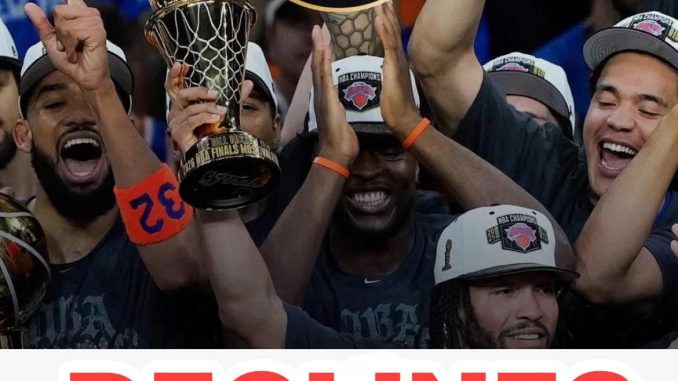
The New York Knicks’ long-awaited championship celebration has reportedly taken an unexpected turn beyond the basketball court. According to emerging reports, the franchise is expected to decline the traditional White House visit that is often extended to championship-winning teams, adding a political dimension to what has otherwise been one of the most celebrated seasons in franchise history.
The Knicks captured the NBA title in emphatic fashion, ending decades of frustration for one of the league’s most passionate fan bases. New York’s championship run was defined by resilience, star power, defensive intensity, and a relentless commitment to team basketball. The organization’s triumph marked a historic moment for a franchise that had spent years searching for its return to basketball’s highest stage.
Now, however, attention has shifted from the hardwood to the broader national conversation after reports surfaced suggesting the team intends to skip the customary visit to the White House.
Sources familiar with the situation indicate that lingering frustrations remain within the organization following President Donald Trump’s appearance at Game 3 of the NBA Finals. That contest ultimately became New York’s lone defeat in an otherwise dominant championship series. While there is no indication that Trump’s attendance had any direct impact on the game itself, reports suggest that tensions surrounding the appearance have not fully subsided in the aftermath of the title run.
The White House championship visit has long been a symbolic tradition in American sports. Championship-winning teams from professional leagues such as the NBA, NFL, MLB, and NHL have historically been invited to Washington, D.C., to celebrate their achievements alongside the sitting president. For many teams, the visit serves as a recognition of excellence and a chance to commemorate a historic accomplishment on a national stage.
Yet in recent years, those visits have increasingly become subjects of debate. Athletes and organizations have occasionally chosen not to attend White House ceremonies due to political differences, scheduling conflicts, or broader concerns about social and cultural issues. The Knicks’ reported decision, if finalized, would place them among a growing list of championship teams that have either declined invitations or altered their participation in such traditions.
For New York, the reported move arrives during a period of immense celebration. The franchise’s championship victory has generated a wave of excitement throughout the city. Fans packed streets, bars, restaurants, and public viewing areas throughout the postseason, creating an atmosphere reminiscent of some of the greatest moments in New York sports history.
Madison Square Garden became the epicenter of that excitement. Throughout the playoffs, the arena transformed into one of the most electric venues in professional sports. Every possession carried enormous significance, and every victory pushed the franchise closer to a championship that many fans had waited a lifetime to witness.
The Knicks’ Finals journey showcased the depth and determination that had defined their season. After navigating a grueling Eastern Conference playoff path, New York entered the Finals with confidence and momentum. Their balanced attack, anchored by elite defensive play and timely scoring, proved too much for their opponent over the course of the series.
Game 3, however, stood out as the lone blemish on an otherwise remarkable championship run. It remains the only Finals loss suffered by New York during the series. President Trump’s attendance at that contest drew significant attention before, during, and after the game, generating widespread discussion across social media platforms and sports talk shows.
While sports and politics have frequently intersected throughout American history, the relationship often becomes especially visible during championship celebrations and high-profile events. Athletes today possess larger public platforms than ever before, and many are increasingly willing to express opinions on issues that extend beyond competition.
That reality has transformed what were once routine ceremonial appearances into moments that can carry broader significance. A White House visit is no longer viewed solely through the lens of sports achievement. Instead, it often becomes part of a larger national conversation involving politics, public perception, and organizational values.
For the Knicks, the reported decision would represent a notable departure from tradition at a time when the franchise is receiving unprecedented attention. The championship itself has already restored New York’s place among the NBA’s elite organizations. Declining a White House visit would likely generate another wave of headlines and debate, extending the team’s presence in national discussions long after the final buzzer of the season.
Neither the Knicks organization nor league officials have publicly provided extensive details regarding the reports. As a result, much of the conversation remains centered on speculation about the factors influencing the expected decision.
Players have largely focused their public comments on the championship itself. In the days following the title-clinching victory, discussions centered on the journey, the sacrifices made throughout the season, and the emotional impact of delivering a championship to New York fans.
Veteran leaders emphasized the importance of perseverance, while younger contributors reflected on the significance of achieving basketball immortality. Coaches and executives highlighted the collective effort required to reach the mountaintop, praising the organization’s culture and commitment to excellence.
Those accomplishments remain the defining story of the Knicks’ season.
For decades, the franchise carried the burden of immense expectations. Few teams in professional sports operate under a brighter spotlight than New York. Every roster move, coaching decision, and playoff performance is scrutinized intensely by one of the largest media markets in the world.
That pressure only intensified as the team advanced deeper into the postseason. Yet rather than shrinking under the spotlight, the Knicks embraced it. They consistently delivered in crucial moments, demonstrating the poise and toughness necessary to win a championship.
The resulting title instantly elevated numerous players into franchise lore. Championship teams are remembered forever, and this Knicks roster has secured a permanent place in the organization’s history. Future generations of fans will look back on this season as the year New York finally returned to the top of the basketball world.
Still, the reported White House decision ensures that conversations surrounding the championship will continue evolving.
Supporters of the move argue that teams should have the freedom to determine how they celebrate their accomplishments. Athletes, coaches, and executives represent diverse backgrounds and perspectives, making participation in ceremonial events a matter of personal and organizational choice.
Others believe championship visits should remain separate from political considerations, emphasizing the tradition’s historical significance regardless of the administration in office. Those differing viewpoints have become increasingly common whenever championship teams face decisions regarding White House invitations.
The NBA itself has often found itself at the center of broader cultural discussions. Players across the league have used their platforms to advocate for social causes, discuss political issues, and engage in conversations extending far beyond basketball. As a result, decisions involving league personnel frequently attract attention from audiences well outside traditional sports circles.
The Knicks’ championship season was already destined to be remembered as one of the defining stories of the year. A reported decision to skip a White House visit would only add another chapter to an already fascinating narrative.
What remains undeniable is the magnitude of New York’s achievement on the court. Winning an NBA championship requires extraordinary talent, chemistry, health, and resilience. Every postseason presents countless challenges, and only one team ultimately emerges victorious.
This year, that team was New York.
The franchise’s success energized a city, captivated basketball fans around the world, and ended years of anticipation. From opening night through the championship celebration, the Knicks demonstrated why they belonged among the league’s elite.
Whether the team ultimately confirms its intention to decline the White House invitation or chooses a different course, the decision is unlikely to overshadow what was accomplished during the season itself. Championships define legacies, and New York’s players, coaches, and executives have already secured theirs through their performance on the court.
As the offseason begins, attention will inevitably shift toward roster decisions, future title defenses, and preparations for the next campaign. Yet the conversation surrounding the White House tradition ensures that the Knicks will remain firmly in the national spotlight.
For now, New York stands as the NBA’s champion, having completed a memorable Finals run that delivered a title to one of basketball’s most iconic franchises. The reported decision regarding a White House visit may spark debate across sports and political circles alike, but it does not change the fundamental reality of the season: the Knicks reached the summit of the NBA, captured the championship, and gave their fans a moment that will be remembered for generations.
Be the first to comment