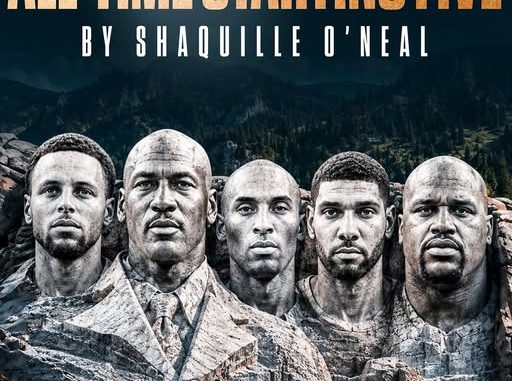
Few figures in basketball history carry the authority to spark debate quite like Shaquille O’Neal. A four-time NBA champion, three-time Finals MVP, and one of the most dominant forces the league has ever witnessed, O’Neal has never been shy about expressing his opinions on the game’s greatest players. His latest declaration, however, may reignite one of basketball’s most enduring conversations: which collection of superstars would form the greatest lineup in NBA history?
During a recent discussion about all-time greatness, O’Neal unveiled his personal all-time NBA starting five, assembling a roster packed with legendary talent and championship pedigree. The Hall of Fame center selected Stephen Curry at point guard, Kobe Bryant at shooting guard, Michael Jordan at small forward, Tim Duncan at power forward, and himself at center.
The lineup alone was enough to generate headlines across the basketball world. Yet O’Neal did not stop there. With the same confidence that defined his playing career, he doubled down on the selection, insisting that no team in NBA history would be capable of defeating the group he assembled.
For a player whose career was built on overpowering opponents and embracing the spotlight, such a statement is hardly surprising. Still, the sheer star power of the lineup makes O’Neal’s argument difficult to dismiss. The five players selected combine for 20 NBA championships, numerous MVP awards, countless All-NBA selections, and a collective legacy that spans multiple eras of professional basketball.
At point guard, O’Neal chose Curry, the revolutionary shooter who transformed the modern game. While traditionalists often point to legendary floor generals such as Magic Johnson or John Stockton when constructing all-time teams, O’Neal’s selection reflects the immense impact Curry has had on basketball strategy and offensive philosophy.
Curry’s ability to stretch defenses far beyond the three-point line fundamentally changed how teams approach offense. His unparalleled shooting range forces defenders to guard him the moment he crosses half court, creating opportunities not only for himself but also for every teammate on the floor. In a lineup featuring Jordan, Bryant, Duncan, and O’Neal, Curry’s spacing would make an already terrifying offense virtually impossible to contain.
The choice of Bryant at shooting guard carries special significance for O’Neal. The two superstars famously formed one of the most dominant duos in NBA history during their time with the Los Angeles Lakers. Together, they captured three consecutive championships from 2000 through 2002 and established a dynasty that overwhelmed opponents with a blend of skill, athleticism, and competitive fire.
Despite a relationship that experienced well-documented ups and downs throughout their careers, O’Neal has repeatedly acknowledged Bryant’s relentless work ethic and unmatched desire to win. Bryant’s inclusion reflects not only his remarkable accomplishments but also his reputation as one of the fiercest competitors the sport has ever seen.
As a scorer, Bryant possessed an arsenal capable of attacking defenses from every angle. Whether operating in the post, attacking off the dribble, or knocking down contested jump shots, he consistently delivered in the biggest moments. His defensive abilities further strengthen the lineup, giving O’Neal another elite perimeter stopper alongside Jordan.
Speaking of Jordan, few selections in an all-time lineup generate universal agreement quite like the six-time champion. Widely regarded by many as the greatest player ever, Jordan remains the benchmark against which all basketball superstars are measured.
Jordan’s résumé speaks for itself. Six championships, six Finals MVP awards, five regular-season MVP trophies, ten scoring titles, and a career filled with iconic performances have cemented his place atop countless all-time rankings. His combination of athleticism, scoring prowess, defensive excellence, and competitive intensity made him one of the most complete players the game has ever seen.
In O’Neal’s lineup, Jordan would likely assume the role of primary offensive engine while simultaneously serving as a lockdown defender on the perimeter. The prospect of Jordan and Bryant sharing the same backcourt is enough to make any opposing offense uncomfortable, while their combined scoring capabilities would place extraordinary pressure on opposing defenses.
At power forward, O’Neal selected Duncan, a choice that underscores the value of consistency, leadership, and winning. Duncan’s career with the San Antonio Spurs is often viewed as one of the greatest examples of sustained excellence in professional sports.
Unlike many superstars who relied heavily on flashy highlights and attention-grabbing performances, Duncan built his legacy through efficiency, discipline, and an unwavering commitment to team success. Over the course of his career, he won five championships, earned multiple MVP awards, and established himself as arguably the greatest power forward in NBA history.
Duncan’s inclusion also provides crucial balance to the lineup. While Jordan, Bryant, Curry, and O’Neal naturally attract headlines for their offensive exploits, Duncan’s defensive versatility, rebounding, and willingness to do the less glamorous work would allow the group to function seamlessly. His ability to protect the rim, anchor defensive schemes, and contribute offensively without requiring constant touches makes him an ideal complement to the other stars.
Then comes the centerpiece of O’Neal’s team: himself.
Throughout NBA history, few players have dominated the paint as thoroughly as O’Neal did during his prime. Standing over seven feet tall and possessing a rare combination of size, strength, agility, and athleticism, he routinely overwhelmed defenders regardless of their reputation or credentials.
At his peak, O’Neal was virtually unstoppable near the basket. Opposing teams often devoted multiple defenders to slowing him down, yet many still failed to prevent him from posting massive scoring and rebounding numbers. His presence alone altered defensive game plans and created opportunities for teammates.
By inserting himself into the lineup, O’Neal is essentially betting on the version of himself that terrorized opponents during the early 2000s. That player was capable of controlling games through sheer physical dominance, forcing defenses into impossible choices and dictating the flow of competition.
When examining the lineup as a whole, one can understand why O’Neal believes no team could defeat it. The roster features elite shooting, perimeter defense, interior defense, rebounding, leadership, scoring, playmaking, and championship experience. Every player selected has proven capable of thriving under immense pressure, and each possesses a track record of elevating performance during postseason competition.
Offensively, the possibilities appear endless. Curry’s shooting would stretch defenses to their breaking point. Jordan and Bryant would relentlessly attack mismatches. Duncan would provide efficient scoring and fundamental execution. O’Neal would command double teams in the paint. The result would be a unit capable of scoring from virtually every area of the floor.
Defensively, the lineup is equally impressive. Jordan and Bryant were elite perimeter defenders during their primes. Duncan anchored championship-caliber defenses throughout his career. O’Neal protected the rim and controlled the glass. Even Curry, often targeted by critics for his defense early in his career, developed into a reliable team defender capable of holding his own within structured systems.
The lineup also boasts an extraordinary level of basketball intelligence. Each player demonstrated a deep understanding of the game throughout his career, allowing them to adapt to different situations and styles of play. Whether facing a fast-paced modern offense or a physical half-court attack from a previous era, O’Neal’s group would likely find ways to adjust.
Of course, debates involving all-time teams inevitably invite counterarguments. Some fans may question the omission of Magic Johnson, whose unique blend of size, passing, and leadership helped redefine the point guard position. Others may wonder whether LeBron James deserves a place in the lineup given his longevity, versatility, and statistical accomplishments.
Names such as Kareem Abdul-Jabbar, Larry Bird, Hakeem Olajuwon, and Wilt Chamberlain are also commonly mentioned whenever discussions about the greatest players arise. Each possesses a legitimate case for inclusion on an all-time roster.
LeBron’s absence, in particular, is likely to generate substantial discussion. The four-time champion has spent years building a résumé that many believe places him alongside Jordan in the greatest-of-all-time conversation. His versatility would seemingly make him a natural fit on any all-time team.
Yet O’Neal’s selections reveal an emphasis on fit as much as individual greatness. Curry provides unmatched spacing. Bryant and Jordan offer elite scoring and perimeter defense. Duncan delivers stability and defensive excellence. O’Neal supplies overwhelming interior dominance. Together, the pieces form a cohesive basketball unit rather than merely a collection of superstar names.
That distinction may explain why O’Neal remains so confident in his choice. Great teams require more than talent; they require complementary skill sets. By that measure, his lineup checks nearly every conceivable box.
The debate itself speaks to the richness of NBA history. Every generation produces transformative players who redefine expectations and challenge previous standards. Comparing legends across different eras remains one of sports’ most fascinating exercises because there is rarely a definitive answer.
Would O’Neal’s lineup truly be unbeatable? Basketball history suggests no team is invincible. The sport has repeatedly shown that chemistry, matchups, coaching, and circumstance can influence outcomes in unexpected ways. Even the most talented rosters occasionally encounter opponents capable of exploiting weaknesses or delivering extraordinary performances.
However, if the objective is to assemble a team with as few weaknesses as possible, O’Neal’s group presents a compelling argument. The combination of Curry’s shooting, Bryant’s skill, Jordan’s greatness, Duncan’s reliability, and O’Neal’s dominance creates a roster that would challenge any team ever assembled.
Perhaps that is precisely why O’Neal delivered his statement with such conviction. He understands what it takes to win at the highest level because he has done it repeatedly. He has shared the floor with legends, battled against Hall of Famers, and experienced championship basketball from every angle. When he looks at his all-time starting five, he sees a collection of players whose strengths complement one another in ways that few lineups ever could.
Whether fans agree with every selection or not, one thing is certain: O’Neal’s all-time starting five has once again ignited one of basketball’s favorite debates. And as long as the NBA continues producing new legends while preserving the legacies of past icons, discussions about the greatest lineup ever assembled will remain a central part of the sport’s culture. For now, O’Neal’s verdict is clear. Put Curry, Bryant, Jordan, Duncan, and O’Neal on the same court, and in his eyes, the outcome is already decided before the opening tip.
Be the first to comment