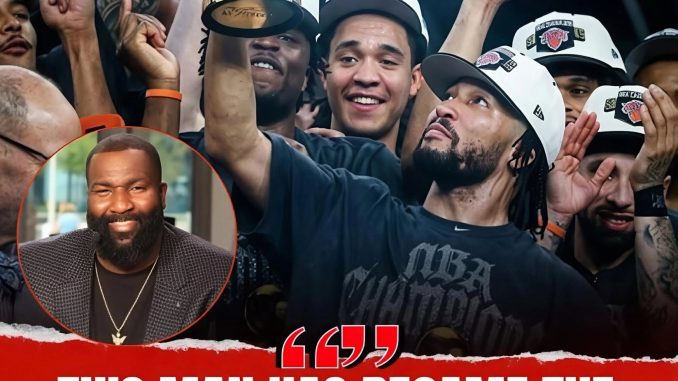
For 53 long years, the New York Knicks carried the weight of history on their shoulders. Generations of fans filled Madison Square Garden hoping to witness the moment when one of basketball’s most iconic franchises would finally return to the top of the NBA mountain. That moment arrived when New York captured the championship, ending a drought that stretched back to 1973 and instantly creating one of the most memorable chapters in franchise history.
As the celebrations continue across New York City, a fascinating debate has emerged among fans, former players, analysts, and basketball historians alike: has Jalen Brunson now earned the right to be called the greatest player in Knicks history?
It is a question that would have seemed almost impossible just a few years ago. The Knicks franchise has been home to legends whose names are woven into the fabric of basketball history. Greats such as Walt Frazier, Willis Reed, Patrick Ewing, Dave DeBusschere, and Carmelo Anthony have each left their mark on the organization. Their accomplishments span championships, Hall of Fame careers, iconic moments, and decades of influence.
Yet Brunson’s rise has forced a fresh examination of what greatness truly means.
When the Knicks signed Brunson in free agency, there were questions throughout the league. Some wondered whether he could handle the responsibilities of being the face of basketball in New York. Others questioned whether he was worth the financial commitment. The spotlight in Manhattan has consumed many talented players over the years, and history suggested that carrying the Knicks back to championship contention would be one of the most difficult tasks in professional sports.
Brunson embraced that challenge from day one.
Instead of shrinking under the pressure, he transformed the culture of the franchise. His leadership, toughness, consistency, and relentless competitiveness quickly made him a fan favorite. More importantly, he elevated the expectations surrounding the organization. The Knicks were no longer simply trying to reach the playoffs or win a series. Under Brunson’s leadership, they became legitimate championship contenders.
What separates Brunson from many stars who have worn a Knicks uniform is his ability to deliver in the biggest moments. Throughout the championship run, he consistently answered every challenge thrown his way. Whether it was scoring in clutch situations, creating opportunities for teammates, or controlling the pace of games against elite competition, Brunson repeatedly demonstrated why he had become one of the league’s premier guards.
Championships have always carried enormous weight in conversations about legacy. Fair or not, players are often judged by whether they ultimately reached the pinnacle of the sport. For decades, that reality complicated discussions involving several Knicks legends.
Patrick Ewing remains one of the greatest centers in NBA history and unquestionably one of the most beloved figures the franchise has ever produced. He led New York through an era defined by grit, toughness, and championship aspirations. His teams came agonizingly close to winning it all, including an NBA Finals appearance in 1994 and another trip to the Finals in 1999. Yet a championship ultimately eluded him.
Carmelo Anthony brought excitement and star power back to Madison Square Garden. His scoring brilliance created countless memorable moments and helped revive relevance for the franchise during his tenure. However, the ultimate goal of bringing a championship to New York remained out of reach.
Walt Frazier and Willis Reed, meanwhile, stand atop the franchise’s historical mountain because they delivered what generations of Knicks fans value most: championships. Reed’s legendary performance in Game 7 of the 1970 NBA Finals remains one of the most iconic moments in sports history. Frazier’s masterful display in that same game helped secure one of the most celebrated titles in NBA history.
For decades, those accomplishments formed the foundation of the argument regarding the greatest Knick ever.
Now Brunson has entered that conversation with unprecedented force.
Ending a 53-year championship drought is not merely another achievement. It is a transformational accomplishment that reshapes an entire franchise’s identity. The pressure associated with carrying those expectations cannot be overstated. Every season that passed without a title increased the burden on the players who followed. Every playoff disappointment added another layer to the narrative.
Brunson ultimately became the player who broke that cycle.
In doing so, he accomplished something no Knicks star had managed in more than half a century. That fact alone significantly strengthens his case in any all-time discussion.
What makes Brunson’s argument even more compelling is the manner in which he achieved it. He was not a superstar who forced his way to New York after already establishing a Hall of Fame résumé elsewhere. He arrived with something to prove and built his legacy alongside the franchise’s resurgence. His growth mirrored the team’s ascent.
That journey resonates deeply with Knicks fans.
New York sports culture has always embraced players who embody resilience and work ethic. Brunson’s game reflects those values perfectly. He is not defined by overwhelming athleticism or highlight-reel dunks. Instead, he succeeds through intelligence, footwork, toughness, preparation, and an unwavering confidence in critical moments.
Those traits have made him the heartbeat of the team.
Throughout the championship season, Brunson consistently demonstrated why teammates trust him in the biggest possessions. Opposing defenses often knew where the ball was going late in games, yet stopping him proved incredibly difficult. His ability to control tempo, create separation, and make the right basketball decision became one of the defining characteristics of New York’s title run.
Beyond statistics, leadership plays a crucial role in evaluating historical greatness. Championship teams require more than talent. They need players capable of establishing standards, setting examples, and maintaining belief through adversity.
By all accounts, Brunson excelled in those areas.
His influence extended far beyond the box score. Coaches praised his professionalism. Teammates consistently highlighted his work ethic and accountability. Fans saw a player who never appeared overwhelmed by the magnitude of the moment.
Those qualities helped transform the Knicks from a promising team into champions.
Still, declaring Brunson the greatest Knick ever is not a unanimous conclusion.
Supporters of Walt Frazier can point to multiple championships, Hall of Fame credentials, and a sustained period of excellence that helped define an era. Frazier remains one of the greatest two-way guards the game has ever seen and was instrumental in both Knicks championship teams.
Advocates for Willis Reed can emphasize his MVP awards, championship success, and lasting cultural impact. Reed’s leadership and iconic Finals moment have become inseparable from the history of the franchise.
Others may argue that Patrick Ewing’s longevity, consistency, and dominance over more than a decade make him the franchise’s most accomplished individual player. Ewing carried the Knicks through some of the most competitive years in NBA history and remains the organization’s all-time leader in numerous statistical categories.
Those arguments carry tremendous weight.
Greatness can be measured in many ways. Championships matter. Longevity matters. Individual accolades matter. Cultural impact matters. Different fans prioritize different criteria, which is why these debates rarely produce universal agreement.
What cannot be disputed, however, is that Brunson has elevated himself into the highest tier of Knicks legends.
Before the championship, discussions about the franchise’s Mount Rushmore generally revolved around Frazier, Reed, Ewing, and a select group of other iconic figures. After delivering a title and ending the longest championship drought in franchise history, Brunson’s place among those legends appears secure.
The only question is whether he has climbed all the way to the top.
Perhaps the most remarkable aspect of this conversation is that Brunson’s story is still being written. Unlike many historical figures whose careers can only be evaluated in retrospect, Brunson remains in the middle of his prime. Every additional playoff run, All-Star appearance, or championship pursuit has the potential to strengthen his case even further.
If he continues leading the Knicks deep into the postseason, the debate may eventually disappear altogether.
For now, the discussion remains one of the most fascinating topics in basketball. Fans across New York are celebrating a championship while simultaneously reevaluating decades of franchise history. That alone illustrates the magnitude of Brunson’s achievement.
Fifty-three years of frustration, heartbreak, near misses, and unrealized dreams have finally been replaced by the joy of a championship parade. In a city that demands excellence and remembers every triumph and failure, Jalen Brunson delivered the moment generations had been waiting to see.
Whether one believes the greatest Knick of all time remains Walt Frazier, Willis Reed, Patrick Ewing, or another franchise icon, there is no denying that Brunson has earned a seat at the table. His leadership, playoff brilliance, and role in ending one of the longest championship droughts in professional sports have permanently altered the conversation.
History often remembers the player who changes everything.
For the New York Knicks, Jalen Brunson may very well be that player. And as the celebrations continue throughout New York, the argument over his place in franchise history is likely to grow louder with each passing day. What once seemed unthinkable is now a legitimate basketball discussion: the possibility that the man who finally brought a championship back to Madison Square Garden has become the greatest player ever to wear a Knicks uniform.
Be the first to comment