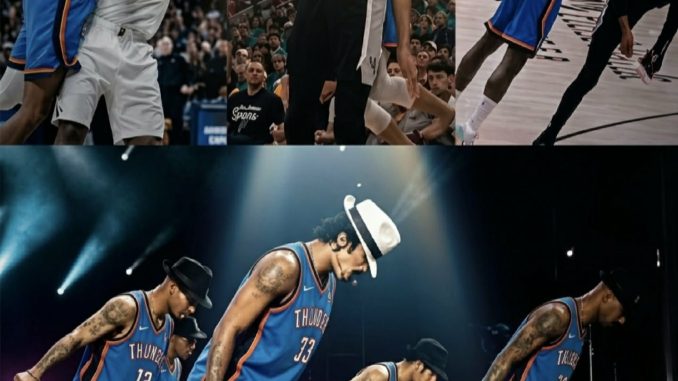
The noise inside Paycom Center felt different long before the final buzzer sounded. Every possession carried the energy of a franchise beginning to realize its championship window is no longer a dream of the future but a demand of the present. On a night when the lights burned brightest and the pressure reached another playoff peak, the Oklahoma City Thunder delivered a ruthless reminder to the basketball world: this young group is no longer learning how to win. They are mastering how to control games, dictate tempo, and bury opponents beneath a relentless wave of confidence, athleticism, and swagger.
Their 127-114 victory over the San Antonio Spurs in Game 5 of the Western Conference Finals was not merely another playoff win. It was a statement performance from a team that has embraced its identity completely. Smooth ball movement. Ruthless transition offense. Suffocating defensive pressure. Timely shot-making. And perhaps most importantly, the unmistakable aura of a team enjoying every second of dismantling elite competition.
The Thunder now hold a 3-2 series advantage, and the momentum surrounding the franchise feels impossible to ignore. One more victory separates Oklahoma City from an NBA Finals appearance that once seemed years away during the rebuilding process. Instead, the Thunder have accelerated their rise behind one of the league’s most electrifying young cores, led by the calm brilliance of Shai Gilgeous-Alexander.
If there was a defining image from Game 5, it may have been Gilgeous-Alexander gliding through traffic late in the third quarter, freezing defenders with his hesitation dribble before casually burying a mid-range jumper as the crowd erupted around him. It was smooth. Effortless. Cold-blooded. The kind of sequence that perfectly captured why social media quickly flooded with reactions calling the Thunder “Smooth Criminals” after the game.
The nickname fit the performance perfectly.
Oklahoma City played with a level of rhythm and precision that repeatedly left San Antonio scrambling defensively. The Thunder pushed pace when opportunities appeared, slowed the game when composure was needed, and consistently punished defensive breakdowns with devastating efficiency. Every player seemed connected to the same pulse, moving in harmony like a veteran contender rather than one of the NBA’s youngest rosters.
Gilgeous-Alexander once again operated as the engine behind everything. The All-NBA superstar controlled the floor with his signature patience, never appearing rushed even as defenders trapped him near halfcourt and collapsed into the lane. His ability to manipulate defenders continues to separate him from nearly every guard in basketball. One hesitation creates space. One shoulder fake forces help defense to rotate. One controlled drive suddenly becomes an open corner three for a teammate.
That level of offensive orchestration has become routine for Oklahoma City throughout this postseason run.
But what made Game 5 especially dangerous for San Antonio was the Thunder’s balance. Gilgeous-Alexander didn’t have to carry the offense alone because the supporting cast delivered with force from the opening quarter onward. Jalen Williams attacked aggressively downhill, punishing mismatches and finishing through contact. Chet Holmgren altered the game defensively while stretching the floor offensively. Oklahoma City’s role players knocked down timely perimeter shots and brought relentless energy on loose balls and defensive rotations.
The Thunder looked faster. Sharper. Hungrier.
After dropping Game 4 in San Antonio, there was legitimate curiosity surrounding how Oklahoma City would respond to adversity. The Spurs had successfully slowed tempo, controlled the glass, and forced the Thunder into uncomfortable offensive possessions during that win. Questions naturally followed. Could Oklahoma City regain control of the series against a disciplined San Antonio squad led by generational phenom Victor Wembanyama?
The answer arrived quickly Tuesday night.
From the opening minutes, the Thunder attacked with purpose. Defensive pressure started high above the arc, forcing San Antonio’s ball handlers into rushed decisions. Passing lanes disappeared almost instantly. Oklahoma City turned steals into transition opportunities, and transition opportunities into crowd-shaking momentum swings.
That defensive intensity remains one of the most underrated aspects of the Thunder’s playoff identity. While much of the attention naturally centers around their offensive creativity, Oklahoma City has repeatedly shown the ability to suffocate opponents with length, communication, and nonstop activity. Multiple defenders can switch across positions. Holmgren protects the rim without sacrificing mobility. Gilgeous-Alexander uses his wingspan effectively to disrupt passing lanes. Williams brings physicality and versatility on the perimeter.
Together, it creates a defensive structure capable of overwhelming even elite offenses for extended stretches.
San Antonio experienced that reality repeatedly in Game 5. The Spurs had moments offensively, particularly behind Wembanyama’s brilliance, but every mini-run felt temporary because Oklahoma City responded almost immediately with another explosive burst. A transition dunk. A corner three. A strip steal leading to free throws. Every time the Spurs threatened to close the gap, the Thunder answered with poise.
What makes this Oklahoma City group especially dangerous is how naturally confidence flows throughout the roster. There is no fear in their approach. No hesitation. No visible intimidation despite the stakes growing larger each round. Instead, the Thunder play with a joy that has become infectious across the league.
That confidence was visible throughout the fourth quarter as Oklahoma City protected its lead. Rather than tightening under pressure, the Thunder continued attacking. Gilgeous-Alexander calmly navigated double teams. Williams embraced contact at the rim. Holmgren anchored the defense with timely contests and rebounds. Even the bench unit maintained the same aggressive mentality that defined the starters.
It felt less like a young team trying to survive and more like a contender fully aware of its power.
The atmosphere inside Oklahoma City reflected that realization. Fans stood for long stretches during the second half as the Thunder methodically pushed the lead back into double digits. Every defensive stop triggered another eruption. Every Gilgeous-Alexander bucket amplified the energy further. By the closing minutes, the arena carried the sound of a city beginning to believe something special is unfolding.
That belief has grown steadily throughout the playoffs.
For years, Oklahoma City patiently assembled this roster through draft capital, player development, and long-term vision. Critics questioned the timeline during the rebuilding stages. Some wondered whether accumulating young talent would ever translate into genuine championship contention. Now, those doubts look increasingly outdated.
The Thunder are not simply talented. They are connected.
Chemistry continues to define this roster as much as athleticism or skill. Players celebrate each other’s success with genuine enthusiasm. Defensive communication remains constant. Ball movement rarely sticks. Everyone appears committed to the same mission rather than individual numbers or spotlight moments.
That culture has become one of the franchise’s greatest strengths.
Head coach Mark Daigneault deserves enormous credit for helping cultivate that identity. Oklahoma City consistently plays with discipline without sacrificing creativity. The Thunder understand spacing, pace, and defensive principles at a remarkably high level considering the average age of the roster. More importantly, they trust one another completely in high-pressure moments.
That trust was evident throughout Game 5.
When San Antonio attempted to blitz Gilgeous-Alexander, Oklahoma City immediately punished the rotations. When the Spurs tried switching defensively, Williams attacked mismatches. When Wembanyama dominated stretches near the basket, Holmgren responded with physical contests and perimeter shot-making that forced the Spurs big man to defend in space.
The chess match within the game constantly shifted, yet Oklahoma City consistently stayed one move ahead.
San Antonio still deserves enormous respect for the fight it showed throughout the series. Wembanyama continues to deliver jaw-dropping performances that reinforce why many already view him as the future face of the NBA. His combination of length, fluidity, and shot-making remains nearly impossible to fully contain. Even in defeat, he flashed moments of brilliance that reminded everyone how terrifying his ceiling truly is.
But Game 5 belonged to Oklahoma City’s collective force.
The Thunder controlled the emotional tone of the night from start to finish. They played with urgency after the Game 4 loss while maintaining the confidence that has defined their postseason run. Most importantly, they looked comfortable under pressure.
That comfort matters enormously at this stage of the playoffs.
Championship-caliber teams rarely panic. They absorb adversity without losing identity. They respond to losses with sharper execution rather than emotional overreaction. Oklahoma City showed those qualities throughout Game 5, which may ultimately become one of the defining victories of the franchise’s modern era if this playoff journey continues.
The image of Gilgeous-Alexander walking off the floor after the final buzzer captured that mood perfectly. Calm expression. Quiet confidence. Businesslike focus. The Thunder celebrated the win, but there was also a visible understanding that the mission remains unfinished.
One more victory is still required.
That next challenge arrives in Game 6 in San Antonio, where the Spurs will attempt to force a decisive Game 7. Closing out a conference finals on the road is never simple, especially against a talented team fighting to keep its season alive. The Spurs have already proven capable of responding under pressure, and Wembanyama alone guarantees danger every time he steps on the floor.
Still, the pressure may now belong more heavily to San Antonio.
The Thunder have reclaimed control of the series both strategically and emotionally. Their offensive rhythm returned in devastating fashion during Game 5. Their defense rediscovered its disruptive edge. Their stars embraced the spotlight. And their home crowd delivered an atmosphere worthy of the moment.
Everything currently points toward a team peaking at exactly the right time.
Perhaps the most impressive part of Oklahoma City’s rise is how sustainable it appears. This does not feel like a lucky playoff run fueled by temporary momentum. The Thunder possess elite shot creators, versatile defenders, strong coaching, roster depth, and one of the NBA’s clearest organizational visions. Most importantly, their stars continue improving.
Gilgeous-Alexander already performs with the poise of a championship-level centerpiece. Williams keeps evolving into one of the league’s premier two-way wings. Holmgren’s impact stretches far beyond the stat sheet because of his defensive instincts and spacing ability. Around them, Oklahoma City has built a roster filled with interchangeable, high-energy contributors who embrace their roles completely.
That formula has transformed the Thunder from a promising young team into a legitimate powerhouse.
And on Tuesday night, they made sure the basketball world felt it.
The “Smooth Criminal” label spreading online after the game may have started as a playful reaction to Oklahoma City’s style, but it also reflected something deeper about this team. The Thunder play with rhythm. They attack with confidence. They steal momentum with devastating speed. And when they find their flow, opponents suddenly realize the game is slipping away before they can stop it.
That is exactly what happened in Game 5.
San Antonio fought hard. Wembanyama delivered highlights. The stakes felt enormous. Yet by the final minutes, the Thunder had completely seized the stage once again, reminding everyone that this postseason may ultimately belong to Oklahoma City.
One win away from the NBA Finals, the Thunder no longer look like future contenders.
They look like contenders right now.
Be the first to comment