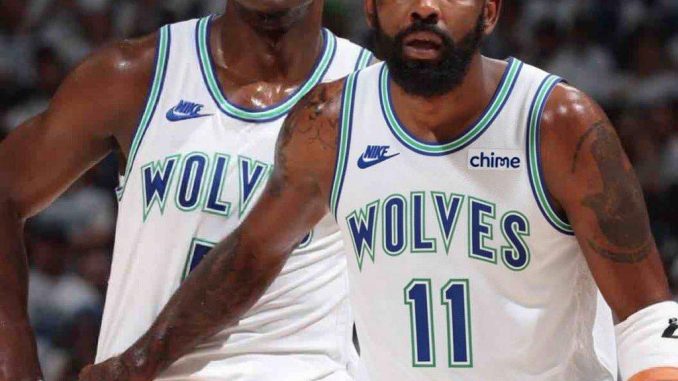
MINNEAPOLIS — The Minnesota Timberwolves’ rise to contender status has been defined by youth, ambition, and a rapidly evolving superstar core led by Anthony Edwards. Now, according to multiple reports circulating around league circles, that ambition may be taking an even more aggressive turn—one that could reshape not just Minnesota’s backcourt, but the entire Western Conference landscape.
The latest buzz centers on a bold internal push from Edwards himself, who is reportedly “privately” encouraging the Timberwolves’ front office to explore the possibility of pairing him with a healthy Kyrie Irving in a potential blockbuster backcourt shake-up. The idea, still in the realm of early-stage speculation, has already sent shockwaves through NBA front offices and fan bases alike, given Irving’s superstar pedigree and the complexity of any trade or acquisition involving the Dallas Mavericks guard.
Edwards, who has rapidly ascended into one of the league’s most dynamic scoring threats, has never shied away from competitive challenges or big-game pressure. That mentality appears to extend beyond the court, with league sources suggesting he views Irving not just as a veteran star, but as a stylistic match capable of elevating Minnesota into a championship tier offense almost immediately.
Irving’s game has long been defined by elite shot creation, tight handle work in isolation, and a rare ability to break down defenses late in possessions. In many ways, his offensive skill set mirrors aspects of Edwards’ own evolving game, though with decades of refinement in clutch execution and half-court control. The pairing, on paper, would create one of the most unpredictable and offensively explosive backcourts in modern NBA history.
However, while the talent fit is obvious, the practicality is far more complicated.
Irving remains under contract with the Dallas Mavericks, where he has formed a high-profile partnership in recent seasons and delivered deep playoff runs alongside Luka Dončić. Any move to acquire him would require a significant package of salary matching, draft capital, and likely multiple rotation-level players. More importantly, it would hinge on Dallas’ willingness to even consider parting with a player who remains central to their championship aspirations.
Still, the mere idea that Edwards is actively pushing for such a scenario signals a shift in Minnesota’s internal mentality. The Timberwolves have built a contender around Edwards, Karl-Anthony Towns’ departure reshaping the roster dynamic and allowing a more guard-driven offensive identity to emerge. Adding a veteran like Irving would represent an aggressive pivot toward maximizing the current competitive window rather than continuing a gradual developmental approach.
League insiders have long speculated about Edwards’ admiration for elite shot creators around the league. Irving, in particular, has been a frequent point of reference in conversations about guard skill evolution, ball handling artistry, and late-game scoring confidence. Edwards has even referenced Irving’s influence in past matchups, acknowledging the veteran’s creativity and offensive instincts as part of his own learning curve.
That mutual respect has been visible on the court as well. In recent meetings between the Timberwolves and Mavericks, the two guards have engaged in highly competitive battles, often trading highlight-level shot-making sequences that underscore just how seamlessly their offensive styles could, in theory, complement one another.
But Minnesota’s front office faces a critical balancing act.
While pairing Edwards with another ball-dominant superstar could elevate the team’s ceiling, it could also introduce questions about spacing, usage distribution, and defensive consistency. Irving’s offensive brilliance is undeniable, but integrating two high-usage guards requires careful roster construction to avoid diminishing returns.
There is also the broader question of long-term team identity. The Timberwolves have spent years building continuity, defensive structure, and chemistry-driven cohesion. A move of this magnitude would test that foundation, potentially accelerating their timeline at the cost of roster stability.
Still, in today’s NBA, championship windows are often narrow, and opportunities to stack elite talent rarely come without risk.
Around the league, executives are reportedly monitoring the situation closely, not necessarily because a deal is imminent, but because Edwards’ reported interest signals something larger: Minnesota is no longer thinking like a rebuilding or mid-tier playoff team. They are thinking like a franchise prepared to swing big.
Irving’s own future remains equally complex. His tenure in Dallas has been defined by both brilliance and volatility, with stretches of elite postseason production balanced against injury concerns, availability questions, and the inherent unpredictability that has followed him throughout his career. Yet when fully engaged and healthy, Irving remains one of the most feared offensive guards in the league, capable of single-handedly shifting playoff series momentum.
That duality is precisely what makes him both an intriguing and polarizing trade target.
For Minnesota, the calculus would not be simple. Any pursuit would likely require surrendering significant depth, future flexibility, and potentially young core contributors who have helped establish the team’s identity around Edwards. But the upside—an Edwards-Irving partnership—would be undeniable in its star power and offensive firepower.
For now, there is no indication that formal discussions between the Timberwolves and Mavericks have advanced to a serious stage. Sources emphasize that the report reflects internal sentiment and exploratory interest rather than active negotiations.
Still, in a league where superstar pairings often begin as whispers before becoming reality, even private pushes from franchise cornerstones carry weight.
And in Anthony Edwards, Minnesota has a player whose voice is already powerful enough to influence the direction of an entire organization.
Whether that voice ultimately leads to a seismic roster shake-up or remains a reflection of competitive ambition will depend on what comes next in a rapidly evolving NBA landscape.
Be the first to comment