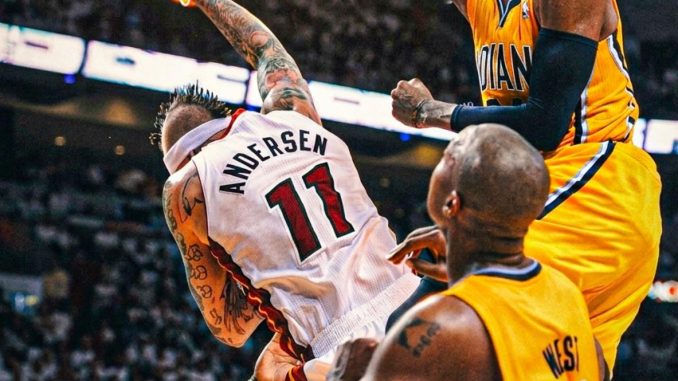
Thirteen years ago, under the blazing spotlight of the 2013 Eastern Conference Finals, a young star announced to the basketball world that he belonged among the NBA’s elite. In a series dominated by tension, physicality, and superstar power, it was Paul George who delivered one of the defining moments of the postseason when he exploded past LeBron James and rose over Chris Andersen for a thunderous poster dunk that instantly became part of playoff history.
The moment came during Game 2 of the 2013 Eastern Conference Finals between the Indiana Pacers and the Miami Heat, a series that represented far more than just a battle for a trip to the NBA Finals. It was the collision between the league’s reigning superpower and a fearless young challenger determined to disrupt the hierarchy. Miami entered the matchup as defending champions, led by LeBron James at the peak of his dominance alongside Dwyane Wade and Chris Bosh. Indiana, meanwhile, was built on toughness, defense, and a growing belief that its young core was ready for the biggest stage.
At the center of that belief stood Paul George.
Before the series began, George was already respected as an emerging two-way talent. He had made his first All-Star team earlier that season and earned praise for his versatility, athleticism, and defensive excellence. But there remained a major difference between being viewed as a promising young player and being recognized as a legitimate superstar capable of challenging the very best in the game. The Eastern Conference Finals became George’s proving ground, and one unforgettable sequence changed the way the basketball world viewed him forever.
The play itself remains etched into NBA playoff lore.
George caught the ball in transition with momentum building rapidly. Standing between him and the basket was LeBron James, the four-time MVP who was widely regarded as the most dominant force in basketball. Most players would have hesitated against LeBron in the open floor, especially in a playoff game on the road inside a roaring AmericanAirlines Arena. George did the opposite. He attacked.
With explosive acceleration, George blew right past LeBron on the perimeter, turning the corner before James could fully react. Waiting at the rim was Chris Andersen, better known as Birdman, one of the league’s fiercest interior defenders and emotional enforcers. Andersen had built a reputation on high-energy shot blocking and intimidating finishes around the basket. None of that mattered in the moment.
George launched into the air with fearless aggression and hammered home a vicious right-handed dunk directly over Andersen, sending the crowd into stunned disbelief. The collision of speed, power, and confidence created an instant classic — the kind of playoff moment replayed endlessly for years afterward.
For a split second, time seemed frozen.
LeBron turned to look back at the rim after being beaten off the dribble. Birdman landed underneath the basket after absorbing the force of the dunk. George screamed in celebration as his teammates erupted from the bench. The replay immediately became a staple across sports television, social media highlights, and playoff montages. But beyond the spectacle, the dunk carried a deeper meaning.
It was a declaration.
Paul George was no longer simply a rising talent with potential. He was ready to challenge the kings of the conference head-on.
The timing of the moment made it even more significant. During that era, the Miami Heat represented basketball royalty. LeBron James was in the middle of perhaps the greatest stretch of basketball in his career, coming off a championship season and an MVP campaign that many analysts considered historically dominant. Miami had won 66 games during the regular season and carried the confidence of a team that fully expected to repeat as champions.
Indiana was not supposed to intimidate them.
Yet throughout the series, the Pacers consistently pushed Miami into uncomfortable territory. Roy Hibbert controlled the paint. David West delivered relentless physicality. Lance Stephenson brought energy and chaos. George Hill provided composure at point guard. And Paul George emerged as the fearless centerpiece capable of matching the Heat’s stars possession after possession.
The iconic dunk symbolized Indiana’s mentality during that playoff run. The Pacers were unafraid.
For George personally, the play became a turning point in his career trajectory. Although he had already shown flashes of brilliance earlier in the season, moments like that are what transform perception in the NBA. Superstars are often defined not just by statistics, but by unforgettable playoff moments against elite competition. George’s dunk against Miami instantly joined the catalog of signature postseason highlights that fans never forget.
It also showcased the rare athletic gifts that made George such a unique player.
At 6-foot-8 with elite agility, fluid ball-handling ability, and explosive leaping power, George represented the modern prototype of the NBA wing. He could defend multiple positions, create offense off the dribble, shoot from distance, and finish above the rim with spectacular flair. Against Miami, he displayed every aspect of that package. Going directly at LeBron and Andersen on one play demonstrated supreme confidence, especially for a 23-year-old competing in his first conference finals appearance as the team’s leading star.
LeBron himself later acknowledged George’s emergence during those battles with Indiana. The respect between the two stars grew throughout the series as George repeatedly challenged Miami’s dominance. While James ultimately helped the Heat survive the Pacers in seven hard-fought games, many observers walked away believing George was destined to become one of the next faces of the league.
That belief only intensified in the seasons that followed.
George continued ascending into superstardom, becoming one of the NBA’s premier two-way players and earning multiple All-NBA and All-Defensive selections. His rivalry with LeBron and the Heat became one of the defining storylines of the Eastern Conference during the early 2010s. The Pacers pushed Miami to seven games again in the 2014 Eastern Conference Finals, further cementing their status as legitimate contenders during the Heat’s championship era.
Still, for many fans, the image most associated with those battles remains that soaring dunk over Birdman.
Part of what made the moment resonate so deeply was the sheer audacity of it. Very few players attacked the rim against Miami with that level of aggression during those years. The Heat thrived on intimidation, athleticism, and defensive pressure. LeBron and Andersen, in particular, were elite transition defenders capable of erasing fast-break opportunities in spectacular fashion. George ignored the reputation entirely.
Instead of pulling the ball back out or settling for a jumper, he attacked two of the most intimidating defenders in basketball and finished emphatically.
That mentality reflected the identity of the Pacers under head coach Frank Vogel. Indiana embraced a bruising, fearless style that contrasted sharply with Miami’s flashy pace-and-space approach. Every game between the teams felt like a war. Hard fouls, emotional exchanges, and intense defensive battles defined the rivalry. George’s poster dunk became the ultimate visual representation of Indiana’s refusal to back down.
The NBA has always been fueled by moments that transcend the box score, and this was one of them.
Fans still remember exactly where they were when they saw it. Broadcasters nearly lost their voices calling the play. Teammates celebrated as though the dunk itself had shifted the energy of the series. Even years later, highlights of the play continue circulating across basketball platforms whenever discussions arise about the greatest playoff dunks ever recorded.
The clip also remains a favorite among younger players and fans who grew up watching George’s rise. In many ways, it introduced an entirely new audience to the type of superstar he was becoming. His combination of smooth perimeter skill and explosive athleticism helped inspire a generation of versatile wings entering the NBA.
There is also an important historical context surrounding the play.
The 2013 Eastern Conference Finals represented one of the final great defensive playoff battles before the NBA’s offensive explosion fully took over the league. Games were physical, possessions mattered deeply, and every highlight carried enormous emotional weight. George’s dunk cut through that defensive intensity with a flash of pure athletic brilliance. It was not just aesthetically incredible — it was meaningful within the pressure of a championship-level series.
That is why the moment has endured for more than a decade.
Some dunks are forgotten after a few days because they occur in meaningless regular-season games or against overmatched opponents. George’s slam carried playoff stakes, superstar opposition, and historical significance. It happened against the best player in the world on the biggest stage of George’s young career. That combination elevated the moment into NBA mythology.
For Indiana fans, the dunk remains one of the proudest memories in franchise history despite the team ultimately falling short of the Finals. It symbolized a brief era when the Pacers stood toe-to-toe with basketball’s greatest powerhouse and genuinely threatened to dethrone them. George was the face of that challenge.
For LeBron and the Heat, it served as a reminder that the Eastern Conference was no longer a guaranteed path to the Finals. Indiana’s emergence forced Miami into grueling playoff battles that tested the limits of its championship resolve.
And for Paul George, it became the defining image of his arrival.
Today, George’s career has included All-Star appearances, Olympic gold medals, playoff runs, devastating injuries, and remarkable comebacks. He has played for multiple franchises and evolved his game over the years, becoming one of the most respected veterans in basketball. Yet no matter how many accomplishments he adds to his résumé, that playoff poster dunk against Miami continues to hold a special place in NBA culture.
It represented youth challenging greatness without fear.
It represented a star announcing himself before the entire basketball world.
And perhaps most importantly, it captured the essence of playoff basketball at its absolute best — high stakes, elite competition, raw emotion, and one unforgettable moment powerful enough to echo through history.
Thirteen years later, the image still feels larger than life: Paul George sprinting down the lane, LeBron trailing behind, Birdman waiting at the rim, and the explosion that followed.
For one breathtaking moment, the league was officially put on notice.
Be the first to comment