The NBA Finals has always been the ultimate proving ground for greatness. Regular-season dominance can build a reputation, and playoff success can elevate a star, but championships are often where legends are truly defined. Across generations, the sport’s greatest players have all faced the pressure, scrutiny, and expectations that come with competing on basketball’s biggest stage. Their performances in the Finals remain some of the most memorable moments in sports history, helping shape the debate over who deserves a place among basketball’s all-time elite.
When discussing the ten greatest players ever to step onto an NBA court, Finals records inevitably become a major part of the conversation. While championships alone do not determine greatness, success under the brightest lights carries significant weight. Some legends built dynasties that dominated entire decades, while others overcame seemingly impossible odds to secure titles that cemented their legacy forever.
At the top of any discussion stands Michael Jordan, whose perfect 6-0 record in the NBA Finals remains one of the most celebrated achievements in professional sports. Jordan never allowed a Finals series to reach a Game 7 and never experienced defeat on basketball’s biggest stage. Between 1991 and 1998, he led the Chicago Bulls to six championships, capturing Finals MVP honors each time. His relentless competitiveness, clutch performances, and unmatched ability to deliver in crucial moments helped create an aura that still surrounds his legacy decades later. For many fans and analysts, Jordan’s flawless Finals record remains one of the strongest arguments in the GOAT debate.
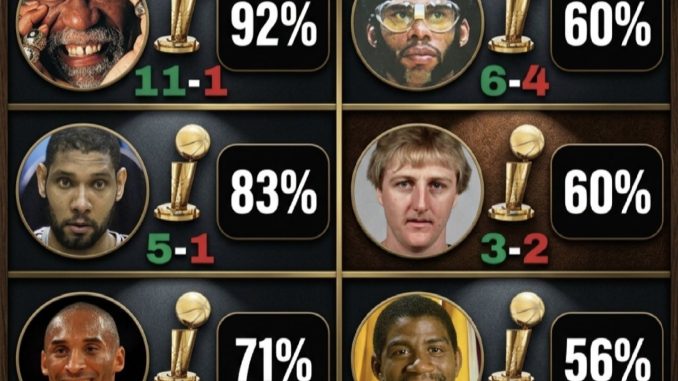
Close behind is Bill Russell, whose championship résumé remains unmatched in league history. Russell appeared in 12 NBA Finals and emerged victorious in 11 of them. During the Celtics’ dominant run throughout the 1950s and 1960s, Russell anchored one of the greatest dynasties sports has ever seen. His impact extended far beyond statistics, as his leadership, defensive brilliance, and commitment to winning transformed Boston into a perennial champion. Although the league was much smaller during his era, Russell’s ability to consistently deliver championships remains one of the most remarkable accomplishments in basketball history.
Another giant of the game, Kareem Abdul-Jabbar, enjoyed Finals success across two different decades. Kareem reached the Finals ten times and won six championships. From his early triumph with the Milwaukee Bucks to his iconic years with the Los Angeles Lakers, Abdul-Jabbar demonstrated extraordinary longevity and excellence. His signature skyhook became one of the most unstoppable weapons the sport has ever seen, helping him remain dominant well into his late 30s. His six titles, six MVP awards, and sustained excellence place him firmly among basketball’s greatest champions.
The story of Magic Johnson is equally impressive. Magic appeared in nine NBA Finals during the 1980s and captured five championships. As the leader of the “Showtime” Lakers, Johnson revolutionized the point guard position with his size, vision, and creativity. His unforgettable rookie-season performance in Game 6 of the 1980 Finals remains one of the most legendary moments in NBA history. Stepping in at center for the injured Kareem Abdul-Jabbar, Magic delivered 42 points, 15 rebounds, and seven assists to secure the championship. His Finals record of 5-4 reflects the fierce competition of his era, particularly against the Celtics led by Larry Bird.
Speaking of Bird, Larry Bird reached five NBA Finals and won three championships. Bird’s rivalry with Magic revitalized the NBA during the 1980s and helped elevate the league’s popularity worldwide. Known for his shooting, passing, and unmatched confidence, Bird consistently rose to the occasion when the stakes were highest. Though his Finals record of 3-2 may not match some of the other legends on this list, his impact on winning and his role in restoring the Celtics to prominence remain undeniable.
Modern basketball debates frequently center around LeBron James and his remarkable Finals journey. James has appeared in ten NBA Finals, a feat that underscores his incredible consistency and longevity. His Finals record currently stands at four championships and six defeats, but the numbers only tell part of the story. Reaching ten Finals across three different franchises is an achievement few players could ever imagine. His most iconic championship came in 2016 when he led the Cleveland Cavaliers back from a 3-1 series deficit against the 73-win Golden State Warriors. That historic comeback delivered Cleveland its first major professional sports championship in more than five decades and produced one of the greatest Finals performances ever witnessed. While critics often focus on his Finals losses, supporters point to the extraordinary challenge of reaching the championship stage so many times in different eras and circumstances.
Few dominant forces have ever matched the physical presence of Shaquille O’Neal. Shaq reached six NBA Finals and secured four championships. His peak years with the Los Angeles Lakers produced one of the most dominant stretches any player has enjoyed. Between 2000 and 2002, O’Neal won three consecutive Finals MVP awards while leading the Lakers to a historic three-peat. His combination of size, strength, agility, and skill made him nearly impossible to stop in the paint. Although he later added another championship with the Miami Heat, many still remember his Lakers run as one of the most overpowering displays of Finals dominance in league history.
Another legendary big man, Hakeem Olajuwon, boasts a perfect Finals record. Olajuwon reached the NBA Finals twice and won both appearances, leading the Houston Rockets to consecutive championships in 1994 and 1995. During those playoff runs, “The Dream” delivered some of the finest two-way basketball ever seen. His footwork, defensive instincts, shot-blocking ability, and offensive creativity made him one of the most complete centers in NBA history. The fact that he secured back-to-back championships during an era filled with elite competition further strengthens his standing among the game’s immortals.
Among active and recently retired stars, few accomplishments rival those of Tim Duncan. Duncan reached six NBA Finals and won five championships with the San Antonio Spurs. What made Duncan’s success particularly remarkable was its consistency over nearly two decades. Whether paired with veterans like David Robinson or younger stars such as Tony Parker and Manu Ginóbili, Duncan remained the foundation of a championship culture. His calm demeanor, fundamental excellence, and commitment to team basketball helped the Spurs become one of the most respected organizations in professional sports. Duncan’s Finals record of 5-1 stands as a testament to his extraordinary leadership and reliability.
Rounding out many top-ten lists is Kobe Bryant, whose competitive fire and championship pedigree remain legendary. Bryant appeared in seven NBA Finals and won five championships. Early in his career, he formed a dominant partnership with Shaquille O’Neal, helping the Lakers capture three consecutive titles. Later, after many questioned whether he could win without Shaq, Bryant answered with back-to-back championships in 2009 and 2010. His Game 7 triumph over the Boston Celtics in 2010 became one of the defining moments of his career. Kobe’s relentless pursuit of excellence, combined with his ability to thrive under pressure, solidified his place among basketball’s greatest winners.
Comparing Finals records among these legends reveals fascinating contrasts. Jordan’s undefeated mark represents perfection. Russell’s 11 championships symbolize unparalleled team success. Kareem and Duncan showcased extraordinary longevity, winning titles across multiple decades. Magic and Bird helped transform the NBA through their iconic rivalry. LeBron’s ten Finals appearances demonstrate sustained excellence rarely seen in professional sports. Shaq dominated with overwhelming force, while Hakeem delivered flawless efficiency in limited opportunities. Kobe embodied relentless determination and championship resilience.
Yet Finals records alone cannot fully capture greatness. Basketball remains the ultimate team sport, and circumstances often shape championship outcomes. Injuries, roster construction, competition levels, coaching, and organizational stability all influence a player’s ability to win titles. Some legends benefited from dynastic environments loaded with Hall of Fame talent, while others carried heavier burdens throughout their careers. This reality makes comparing Finals records both fascinating and complex.
Still, the Finals remain the stage where reputations are cemented forever. Fans remember Jordan’s game-winning shots, Russell’s championship celebrations, Magic’s dazzling passes, Bird’s clutch shooting, Hakeem’s masterful footwork, Shaq’s dominance in the paint, Duncan’s steady leadership, Kobe’s fearless mentality, and LeBron’s historic comeback. These moments transcend statistics and become part of basketball folklore.
As the NBA continues to evolve and new stars chase their own championship dreams, the Finals records of these ten legends serve as benchmarks for greatness. Every generation produces extraordinary talent, but few players can consistently thrive under the immense pressure that accompanies the pursuit of a championship. That is what separates great players from all-time greats.
The debate over basketball’s greatest player may never be settled. Fans will continue arguing about eras, competition, statistics, and accomplishments. However, one truth remains undeniable: when the brightest lights were shining and the championship was on the line, these ten legends left an indelible mark on NBA history. Their Finals records tell stories of triumph, perseverance, dominance, heartbreak, redemption, and excellence. Together, they represent the gold standard of basketball greatness and the enduring legacy of what it means to perform on the sport’s biggest stage.
Be the first to comment