The lights inside Madison Square Garden have witnessed championship parades, heartbreaking collapses, unforgettable individual greatness, and moments that became permanently stitched into NBA folklore. But on a wild and unforgettable night in the Eastern Conference Finals, the New York Knicks authored a comeback that instantly joined the most legendary moments in franchise history, stunning the basketball world with a rally that seemed mathematically impossible only minutes earlier.
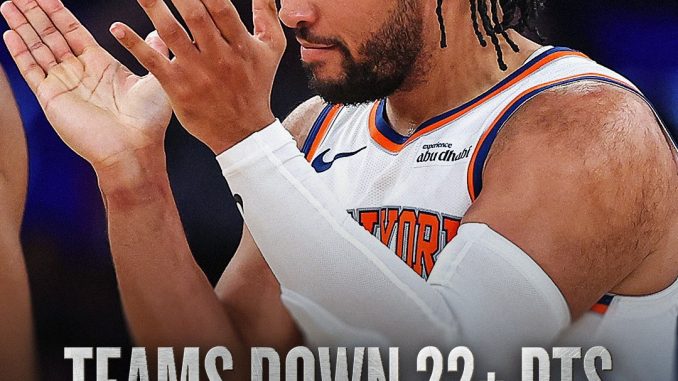
Before Game 1 tipped off, the numbers painted a grim reality for any team facing the type of deficit the Knicks encountered. Since 1997, NBA playoff teams trailing by 22 or more points in the fourth quarter had gone just 1-594. It was the kind of statistic that effectively signaled the end of games before the final buzzer even sounded. Leads that large in postseason basketball are supposed to be death sentences, especially in the conference finals, where every possession is magnified and every mistake can swing an entire series.
Yet somehow, against all logic, against history, and against a roaring wave of momentum that appeared to belong entirely to their opponent, the Knicks clawed their way back from a 22-point fourth-quarter deficit and completed one of the greatest postseason comebacks the NBA has ever seen.
By the time the final horn echoed throughout Madison Square Garden, disbelief had completely overtaken the arena. Fans stood frozen, players screamed in celebration, and social media erupted as the Knicks officially became only the second team in nearly three decades to erase a deficit that large in the fourth quarter of a playoff game. The only other team to accomplish the feat was the Los Angeles Clippers during their memorable 2012 first-round comeback against the Memphis Grizzlies.
For the Knicks, however, this wasn’t just another dramatic playoff victory. This was a statement to the rest of the league that this team possesses something difficult to quantify and nearly impossible to defend: belief.
For most of Game 1, the Knicks looked overwhelmed. Their offense sputtered through long stretches, defensive rotations broke down, and the energy inside Madison Square Garden slowly transformed from anticipation into anxiety. Every time New York attempted to build momentum, the opposition answered with another dagger — whether it was a transition three-pointer, a second-chance basket, or a defensive stop that silenced the crowd.
By early in the fourth quarter, the game appeared over.
The Knicks trailed by 22 points, and thousands of fans inside the Garden had already begun preparing mentally for a frustrating series-opening defeat on their home floor. Television broadcasts flashed the historical statistic on screens across America: teams down 22 or more in the fourth quarter of playoff games since 1997 were 1-594.
One win. Five hundred ninety-four losses.
The number was staggering enough to remove nearly all suspense from the contest.
But the Knicks never stopped fighting.
That refusal to surrender has become the defining characteristic of this New York roster throughout the season and into the postseason. Time after time, this team has leaned on toughness, physicality, resilience, and emotional edge. While many teams rely purely on talent, the Knicks have developed a reputation for surviving chaos. And in the fourth quarter of Game 1, chaos became their greatest ally.
The comeback began subtly.
A defensive stop led to a quick basket. Then came another forced turnover. Suddenly, the pace shifted. Madison Square Garden, which had grown tense and uneasy, rediscovered its voice. The arena grew louder with every possession, and with every made shot, belief spread through the building like wildfire.
The Knicks started attacking defensively with desperation. Passing lanes disappeared. Rebounds turned into fast-break opportunities. Every loose ball became a battle. The team that had looked completely comfortable for three quarters suddenly began playing tight, sensing the pressure rising with each New York run.
Momentum in playoff basketball is powerful, but in Madison Square Garden, momentum can become overwhelming.
The crowd sensed history before the players fully realized it themselves. Chants echoed throughout the arena after every basket. Opposing players who had spent most of the night playing freely suddenly appeared hesitant. Open shots stopped falling. Turnovers increased. The Knicks fed off the panic.
And at the center of it all was the relentless energy that has come to define modern Knicks basketball.
Possession by possession, New York chipped away at the lead.
Twenty-two became 18.
Eighteen became 14.
Then suddenly it was single digits, and the atmosphere transformed completely. What once felt impossible now felt inevitable.
The Garden erupted after every defensive stop. Bench players stood nearly the entire fourth quarter, waving towels and screaming after every basket. Veterans calmed teammates during dead balls while coaches urged composure amid the emotional storm unfolding around them.
The beauty of the comeback wasn’t merely the scoring outburst. It was the defensive intensity and mental toughness that fueled it. The Knicks played every possession as if the season depended on it. Rotations became sharper. Closeouts became harder. Rebounding became vicious.
The opponent, meanwhile, looked increasingly stunned.
In the playoffs, protecting large leads often becomes psychological. Teams begin thinking more about avoiding mistakes than continuing to attack. Aggression fades. Confidence disappears. And once doubt enters the equation, even massive advantages can evaporate quickly.
That’s exactly what unfolded in Game 1.
The Knicks sensed vulnerability and attacked relentlessly. Every successful possession increased the pressure. Every miss by the opposition intensified the tension inside the arena. By the final minutes, the team that had dominated most of the game looked desperate simply to survive.
Then came the defining sequence.
After another New York defensive stop, the Knicks raced down the floor for a transition score that brought the crowd to its loudest level of the night. Madison Square Garden shook beneath the noise. Fans who had spent much of the evening frustrated and anxious now believed they were witnessing something historic.
The opponent attempted to slow the game down, using timeouts to regroup, but the emotional tide had already shifted completely. The Knicks were no longer chasing the game — they were controlling it.
Every star eventually faces a defining playoff moment, and New York’s leaders embraced theirs under the brightest possible spotlight. Veteran poise combined with youthful fearlessness as the Knicks continued landing punch after punch during the final stretch of regulation.
The comeback eventually became complete, not through luck, but through relentless execution.
The final moments felt surreal.
Players celebrated with raw emotion while stunned fans screamed in disbelief. Opposing players walked off the floor trying to process how a game they had controlled for nearly four quarters had slipped away. Analysts immediately began comparing the comeback to some of the greatest postseason rallies in NBA history.
And statistically, the numbers supported the conversation.
Only one other playoff team since 1997 had ever overcome a 22-point fourth-quarter deficit: the 2012 Clippers, led by Chris Paul and Blake Griffin, against the Grizzlies in a game remembered as one of the wildest momentum swings of the modern era.
Now the Knicks have joined that exclusive and nearly unimaginable club.
For New York, the timing made the moment even larger.
This wasn’t a random regular-season comeback in January. This was the Eastern Conference Finals. Every game carries massive weight. Stealing Game 1 in dramatic fashion completely changes the emotional complexion of a series.
Instead of facing questions about missed opportunities and home-court pressure, the Knicks now possess momentum, confidence, and psychological advantage.
The impact of such a comeback can extend far beyond a single night. Teams that suffer devastating collapses often carry emotional scars into the following games. Coaches can adjust schemes and rotations, but rebuilding confidence after blowing a 22-point fourth-quarter lead on the conference finals stage is far more difficult.
The Knicks understand that.
New York’s locker room reportedly erupted in celebration after the victory, with players fully aware they had authored a historic postseason moment. Yet amid the excitement, there was also recognition that the series is far from over. Great playoff teams understand emotional wins only matter if they continue building on them.
Still, moments like this become part of franchise mythology forever.
The Knicks are one of the NBA’s most historic organizations, yet the franchise has endured decades of heartbreak, instability, and postseason disappointment. For years, Madison Square Garden became better known for celebrity courtside appearances than championship contention.
This current Knicks group is changing that narrative.
They have restored belief to one of basketball’s most passionate fanbases. They have reintroduced toughness and identity to a franchise long searching for consistency. And now, with one historic comeback, they have created a moment that fans will discuss for generations.
The victory also reinforced why playoff basketball remains unmatched in sports.
No statistic, no historical trend, and no probability model can fully account for emotion, momentum, and human resilience. Logic suggested the game was over long before the Knicks began their rally. History practically guaranteed defeat.
But sports have always reserved space for the impossible.
That unpredictability is what transforms games into legends.
The images from Game 1 will endure: players diving for loose balls, the Garden crowd exploding with belief, stunned expressions from the opposing bench, and the emotional release after the final buzzer confirmed the comeback was real.
For younger Knicks fans, it may become their defining postseason memory. For older generations, it instantly joins the list of unforgettable Garden moments they never thought they would witness again.
And for the NBA as a whole, it serves as another reminder that no lead is truly safe in the modern era.
The league’s pace, spacing, and three-point shooting have made rapid scoring runs more common than ever before. Yet even in today’s explosive offensive environment, overcoming a 22-point fourth-quarter deficit in a playoff game remains extraordinarily rare.
That’s what makes the Knicks’ achievement so remarkable.
They didn’t merely erase a large lead.
They conquered history itself.
One victory in 595 attempts had previously been achieved by teams facing that situation. Now it’s two wins in 596 games, and the Knicks own one of them.
As the Eastern Conference Finals continue, the pressure will intensify on both sides. Adjustments will come. Emotions will settle. New storylines will emerge.
But regardless of what happens next, Game 1 has already secured its place in postseason history.
Years from now, basketball fans will remember where they were when the Knicks stormed back from 22 down in the fourth quarter of the Eastern Conference Finals. They’ll remember the noise inside Madison Square Garden, the disbelief on television broadcasts, and the feeling that they were watching something impossible unfold in real time.
Because on one unforgettable night in New York, the impossible became reality.
Be the first to comment