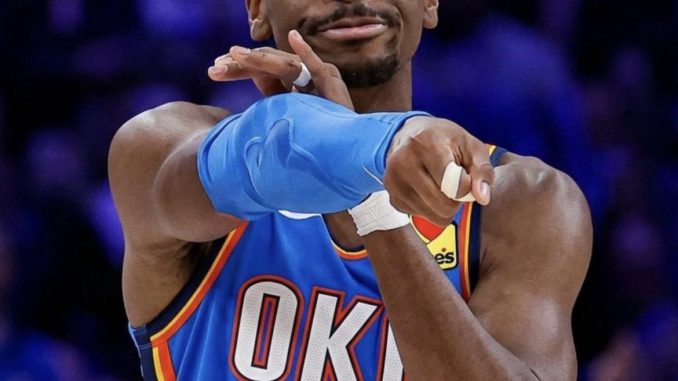
The Oklahoma City Thunder and star guard Shai Gilgeous-Alexander have reportedly raised formal concerns to the NBA league office regarding what the organization views as recurring issues with officiating consistency, including alleged flopping, elevated physical contact, and disputed foul interpretations throughout their ongoing playoff series against the San Antonio Spurs, according to league sources familiar with the situation.
The development adds a significant layer of tension to an already physical and tightly contested postseason matchup, with Oklahoma City believed to be frustrated by what team officials and players perceive as a pattern of calls—or non-calls—that they feel have influenced the flow and outcome of multiple games in the series. While the NBA has not publicly commented on the matter, sources indicate the league is expected to conduct a formal review of several specific possessions and officiating sequences highlighted by the Thunder.
At the center of the concerns is the broader issue of consistency in playoff officiating, a topic that has long been debated across the league but becomes especially magnified in high-stakes postseason environments. Oklahoma City’s complaint reportedly focuses on three primary areas: what they believe is an increase in exaggerated contact designed to draw fouls, what they see as uneven enforcement of physical defensive play, and what they describe as inconsistent application of whistle standards from game to game and even possession to possession.
According to those familiar with the Thunder’s position, the team feels that certain defensive sequences against Gilgeous-Alexander and other key ball-handlers have crossed the line into excessive physicality without corresponding foul calls. On the other end of the floor, Oklahoma City has reportedly pointed to several moments where they believe offensive players on San Antonio appeared to embellish contact, resulting in calls that shifted momentum in tightly contested stretches. The Thunder are not only questioning individual calls, but also the cumulative effect of those decisions across multiple games, which they believe has shaped the rhythm and competitive balance of the series.
Shai Gilgeous-Alexander, one of the league’s premier perimeter scorers and a centerpiece of Oklahoma City’s offense, has been a focal point of the physical defensive attention throughout the matchup. Known for his slithering drives, hesitation moves, and ability to draw contact at the rim, Gilgeous-Alexander often finds himself at the center of officiating scrutiny in playoff settings. In this series, sources say the Thunder believe the whistle has not been consistently favorable—or consistent at all—when it comes to similar contact on either end of the floor.
While the Thunder’s concerns have now escalated to the league office, it is understood that the organization is not formally accusing the officiating crew of bias, but rather requesting clarification and review of specific sequences they believe warrant evaluation. The distinction is important in the NBA’s internal processes, where teams regularly submit clips and feedback following games, particularly during the postseason, when film review between teams and the league office is a routine part of operations.
Still, the situation underscores the intensity of the series between Oklahoma City and San Antonio, two teams that have approached the matchup with contrasting identities but similar competitive urgency. The Spurs, built around their own emerging core and anchored by a physically imposing defensive scheme, have leaned into a style that emphasizes pressure, switching, and rim protection. Oklahoma City, meanwhile, has relied on pace, skill, and perimeter creation, often placing them in direct collision with San Antonio’s more contact-heavy approach.
As the series has progressed, the physical tone has reportedly escalated, with both sides adjusting to what they perceive as the limits of allowable contact. For Oklahoma City, the frustration appears to stem not only from the level of physical play but from what they believe has been a lack of uniform enforcement of those standards. League sources suggest the Thunder have compiled a series of clips they believe illustrate inconsistencies, particularly on drives to the basket and off-ball defensive interactions.
From San Antonio’s perspective, however, the Spurs are believed to view their defensive approach as disciplined and within the framework of playoff basketball, where physicality traditionally increases and referees are often instructed to “let them play” to a certain extent. Within that context, teams frequently adjust by playing through contact and embracing a more rugged style, especially in series that feature young, athletic rosters on both sides.
Around the league, playoff officiating has long been one of the most scrutinized aspects of postseason basketball. Teams routinely express frustration over perceived inconsistencies, particularly in series that swing between tightly called games and more physical, loosely officiated ones. The NBA has repeatedly emphasized its efforts to standardize officiating interpretations, but the inherent speed and complexity of playoff basketball often leads to variations in how contact is judged.
Flopping, in particular, has become a growing point of emphasis for the league in recent seasons. The NBA has introduced fines and postgame reviews for exaggerated reactions designed to draw fouls, but enforcement remains largely post hoc, meaning that while players can be penalized after the fact, the immediate impact of such actions can still influence game outcomes in real time. Oklahoma City’s reported concerns suggest they believe this dynamic has played a role in shaping key moments within the series.
At the same time, the league has also encouraged officials to maintain a balance between allowing physical defense and protecting offensive players, especially star perimeter scorers who generate much of the league’s offensive production. That balance is notoriously difficult to maintain, particularly in playoff environments where defensive intensity naturally increases and scouting familiarity reduces offensive margins for error.
For Oklahoma City, the timing of this formal feedback is significant. In postseason series, momentum swings are often decisive, and teams are highly sensitive to anything they believe alters competitive equilibrium. By elevating their concerns to the league office, the Thunder are signaling not only frustration but also a desire for increased clarity as the series progresses.
The NBA’s review process in such situations typically involves a detailed examination of the plays identified by the team, followed by internal evaluation from the officiating department. While public acknowledgment is rare, the league sometimes issues clarifications or makes subtle adjustments in crew communication for subsequent games in a series. However, it is uncommon for mid-series officiating changes to be made unless there are extraordinary circumstances.
Historically, playoff series involving high-profile players and tightly contested games often generate similar scrutiny. The NBA has long navigated the challenge of maintaining public confidence in officiating while also preserving the flow and competitiveness of games. In recent years, the league has increased transparency around last-two-minute reports and expanded its postgame review processes, but those measures do not eliminate controversy in real time.
Within Oklahoma City’s locker room, sources describe a team that remains focused on performance but increasingly aware of what they view as external variables affecting the series. Players and staff alike are said to be preparing for continued physical intensity while also emphasizing discipline to avoid reactive fouls or technical infractions that could further complicate their position.
For Shai Gilgeous-Alexander, the situation adds another layer to an already demanding postseason assignment. As the primary offensive engine, he absorbs significant defensive attention on nearly every possession, and the physical toll of such coverage often becomes more pronounced as series extend deeper into multiple games. Managing that pressure while maintaining efficiency is a hallmark of elite postseason guards, and Gilgeous-Alexander’s performance has remained central to Oklahoma City’s competitiveness regardless of external circumstances.
San Antonio, meanwhile, is expected to maintain its current approach, trusting in its defensive identity and adaptability. The Spurs’ coaching staff has consistently emphasized defensive discipline and communication, particularly in transition and half-court rotations, which they believe are key to neutralizing Oklahoma City’s perimeter threats.
As the series continues, the spotlight will inevitably remain not only on the players and tactical adjustments but also on how officiating is interpreted and enforced on a possession-by-possession basis. In tightly contested playoff matchups, those margins often become as influential as any schematic decision or individual performance.
The NBA’s expected review of Oklahoma City’s submitted concerns may not produce immediate public outcomes, but it reflects a broader reality of modern playoff basketball: the increasing intersection of competitive intensity, officiating scrutiny, and real-time narrative shaping. With both teams still firmly engaged in the series, the league now finds itself once again managing one of its most persistent postseason dynamics—how to ensure fairness, consistency, and credibility in the most pressure-filled games of the year.
For now, the Thunder await clarity while continuing their pursuit on the court, where they believe the ultimate answers to their concerns must still be earned through execution, resilience, and performance across the remainder of the series.
Be the first to comment