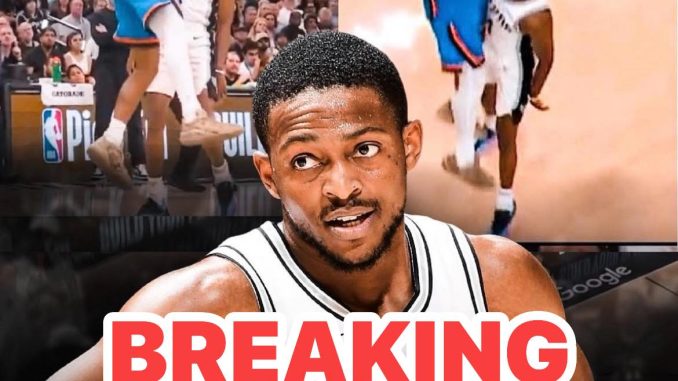
The playoff atmosphere took a dramatic turn on Tuesday morning as the NBA confirmed that De’Aaron Fox has been suspended for Game 5 following a flagrant foul assessed on Shai Gilgeous-Alexander in Game 4, a decision that immediately reshapes the trajectory of the series and intensifies scrutiny on physicality in postseason basketball.
The league’s ruling comes after a review of the late-game incident that saw Fox deliver a high-contact, high-impact defensive challenge on Gilgeous-Alexander during a critical possession in the fourth quarter. Officials initially assessed a flagrant foul on the play, but the NBA’s subsequent disciplinary review escalated the matter, citing unnecessary and excessive contact that met the threshold for suspension under the league’s playoff conduct guidelines.
The suspension sends shockwaves through a tightly contested Western Conference playoff battle between the Sacramento Kings and the Oklahoma City Thunder, a series that had already been defined by pace, physical defense, and escalating emotional intensity. With Game 5 now looming as a potential turning point, the absence of Fox—Sacramento’s primary offensive engine and defensive catalyst—looms large over both tactical planning and psychological momentum.
According to league sources, the review process included multiple angles of the play, player impact analysis, and consultation with the competition committee. While Fox maintained that his intent was to make a legitimate play on the ball, the league concluded that the force and timing of the contact created an “unnecessary risk of injury,” particularly given Gilgeous-Alexander’s position in the air at the moment of impact.
The ruling underscores the NBA’s continued emphasis on player safety, particularly during the postseason when defensive intensity often rises to the edge of legal contact. League officials have repeatedly stressed that while physicality is expected, actions deemed reckless or potentially injurious will be met with heightened disciplinary measures. In this case, the suspension reflects a firm stance on protecting star players during high-stakes playoff moments.
For Sacramento, the timing could not be worse. Fox has been the heartbeat of the Kings’ playoff push, averaging elite production as both scorer and facilitator while often taking on the most difficult defensive assignments. His speed in transition, ability to collapse defenses, and late-game shot creation have been central to Sacramento’s offensive identity throughout the series.
Without him in Game 5, the Kings face a significant recalibration. Offensive responsibility will shift heavily toward secondary creators, forcing Sacramento to rely on increased ball movement, bench production, and tactical adjustments to compensate for the loss of their primary playmaker. The margin for error, already thin in a tightly contested series, becomes even narrower.
For Oklahoma City, the news presents a strategic opening, but one that comes with its own complexities. Gilgeous-Alexander, the centerpiece of the Thunder’s offense and one of the league’s most efficient perimeter scorers, will continue to draw defensive attention, but the absence of Fox removes one of the primary perimeter defenders capable of matching his isolation scoring ability.
Still, Thunder leadership has been careful not to project overconfidence. Sources within the organization emphasized that playoff momentum can shift rapidly, and that Sacramento’s depth and defensive schemes remain formidable even without their star guard. The message internally has been consistent: treat Game 5 as a fully contested challenge rather than an opportunity created by disciplinary circumstances.
The incident itself continues to be debated across the league, with analysts divided over whether the suspension reflects appropriate enforcement or an overly punitive escalation. Some former players argue that playoff basketball naturally includes heightened physicality and that incidents like Fox’s foul often fall within the emotional flow of postseason competition. Others maintain that the league’s intervention was necessary to prevent escalation and protect offensive stars like Gilgeous-Alexander from dangerous airborne contact.
What is not in dispute is the significance of Fox’s absence. In playoff environments, availability of top-tier guards often dictates series outcomes, particularly in matchups where both teams rely heavily on perimeter creation. Fox’s speed in pushing tempo and his ability to generate advantages in transition have repeatedly forced Oklahoma City’s defense into early rotations and scrambling recoveries. Without that pressure point, the Thunder’s defensive structure gains a measure of stability.
Coaching adjustments are expected to be immediate. Sacramento’s staff will likely explore staggered backcourt rotations, increased usage of off-ball screens for secondary guards, and more deliberate half-court sets to offset the loss of Fox’s downhill pressure. The Kings may also lean more heavily on frontcourt initiation to compensate, attempting to diversify their point-of-attack responsibilities.
Defensively, Fox’s absence may prove equally impactful. His on-ball pressure has been a key factor in containing Oklahoma City’s perimeter rhythm, and without him, Sacramento must find new ways to disrupt Gilgeous-Alexander’s comfort zones. That could mean increased help coverage, more zone looks, or higher switching frequency—all of which carry their own risks against a Thunder team that thrives on exploiting mismatches.
Inside the locker room, reactions were described as a mixture of frustration and resolve. Players reportedly expressed disappointment at the ruling, believing that the intensity of playoff basketball should be taken into account when evaluating borderline physical plays. At the same time, there is recognition that the team must adapt quickly if it hopes to remain competitive in the series.
Fox, according to team representatives, plans to support his teammates from the sidelines during Game 5. While he has not publicly commented in detail on the suspension, those close to the situation describe him as “disappointed but focused on the bigger picture,” particularly with the series still within reach depending on the outcome of the upcoming game.
The Thunder, meanwhile, are preparing for multiple scenarios, including adjustments that account for increased defensive attention on Gilgeous-Alexander. Oklahoma City’s coaching staff is expected to emphasize ball movement and secondary scoring options, ensuring that the offense does not become overly predictable even with a key opposing defender sidelined.
League analysts note that while suspensions of this magnitude are rare during the postseason, they are not unprecedented. The NBA has historically taken a stricter approach to flagrant fouls in playoff contexts when the potential for injury is deemed significant. The precedent reinforces the league’s ongoing effort to balance competitive intensity with player protection, even when such decisions alter the competitive landscape of a series.
As Game 5 approaches, the narrative surrounding the series has shifted dramatically. What was once framed as a tightly matched duel between two rising Western Conference contenders is now being redefined by absence, adjustment, and psychological pressure. The Kings must now prove they can withstand the loss of their primary engine, while the Thunder must avoid the trap of complacency in what remains a highly volatile matchup.
Fans and analysts alike will be watching closely to see how Sacramento responds to adversity. Playoff history is filled with moments where teams rallied in the face of unexpected absences, often using the setback as a unifying force. Whether the Kings can summon that resilience without Fox will likely determine not only Game 5, but potentially the direction of the entire series.
For Oklahoma City, the opportunity is clear but not guaranteed. Championship-caliber teams are often defined not by how they respond to advantage, but by how they maintain discipline when the path appears to open. The Thunder’s young core, led by Gilgeous-Alexander, will be tasked with demonstrating maturity in a moment that could easily swing into emotional overreach if not carefully managed.
Ultimately, the suspension of De’Aaron Fox stands as one of the most consequential developments of this playoff series to date. It alters rotations, shifts defensive assignments, and redefines the pressure points that will decide Game 5. Whether it becomes a turning point in Sacramento’s downfall or a rallying moment in their postseason story will depend entirely on execution in the hours ahead.
What remains certain is that the stakes have risen sharply. With one of the series’ defining figures now sidelined, the balance of power tilts—but not decisively. In the NBA playoffs, momentum is never permanent, and Game 5 now carries the weight of an entire narrative still waiting to be written.
Be the first to comment