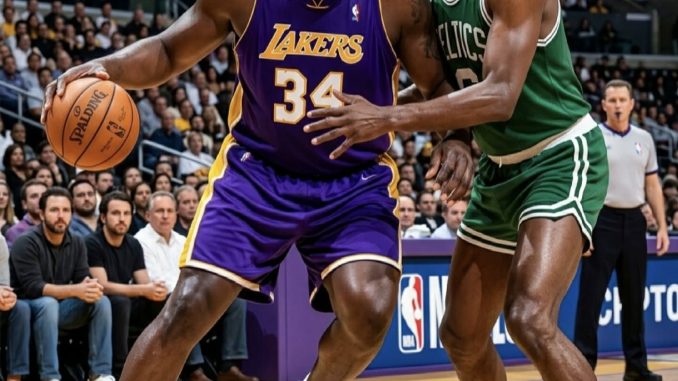
In a revealing look back at one of basketball’s most cerebral defensive minds, Bill Russell once outlined a blueprint for dealing with overpowering centers like Shaquille O’Neal that had nothing to do with brute strength—and everything to do with endurance, pace, and psychological wear-down. In a 1997 double interview alongside Wilt Chamberlain and hosted by Ahmad Rashad, Russell broke down what made dominant big men vulnerable over the course of a game, and why he believed carrying extra weight up and down the floor was the real defensive weapon.
Russell’s philosophy was simple in concept but brutal in execution: never fight power with power on equal terms if you can make that power move longer, run harder, and think deeper for 48 minutes. Against a physical force like Shaquille O’Neal, who stood as one of the most unstoppable interior scorers in NBA history, Russell suggested a counterintuitive approach that relied on tempo manipulation rather than collision.
“You don’t try to match him strength for strength,” Russell explained in essence during the conversation. “You make him work every single possession. You carry that weight up and down the floor until it becomes harder and harder to repeat the same explosion.”
What made the statement so compelling was not just its logic, but the identity of the speaker. Bill Russell was the architect of one of the greatest defensive dynasties in sports history, anchoring the Boston Celtics to 11 championships in 13 seasons. He was never the strongest center on the floor in raw terms, nor the most offensively dominant. But he was, by almost universal historical agreement, the most impactful winner the position has ever seen.
In Russell’s view, the game against a player like Shaquille O’Neal would never be decided in a single collision at the rim. It would be decided in how many sprints it took to get there, how many seals were fought through, how many times a defender could force a big man to run the length of the court before even attempting to establish deep post position.
That endurance-based philosophy reflected how Russell saw basketball at its core: not as a series of isolated possessions, but as a cumulative physical and mental tax system. Every extra step, every forced rotation, every delayed entry pass added up. Against dominant interior scorers, Russell believed fatigue was not a byproduct of defense—it was the strategy itself.
In the same 1997 discussion, Wilt Chamberlain and Bill Russell offered contrasting perspectives shaped by their legendary rivalry. Chamberlain, a record-setting scorer and physical marvel, often embodied the kind of dominance Russell was describing. Yet even Chamberlain acknowledged that long series, fast tempos, and constant defensive pressure could gradually chip away at even the most physically gifted players.
Russell’s approach, however, went beyond conditioning. It was about rhythm disruption. Against a player like Shaquille O’Neal, who thrived on deep seals and immediate paint touches, Russell would emphasize denying early post position and forcing repeated re-establishment of space. Instead of allowing Shaq to comfortably anchor on the block, defenders would front, deny, and rotate—turning every possession into a negotiation rather than a set play.
The idea was not necessarily to stop Shaq from scoring in isolated moments. Russell understood that elite big men will get their points. The goal was to make those points come at a cost so high that efficiency declines over time. If Shaquille O’Neal had to sprint the floor every possession, wrestle for position multiple times, and absorb constant contact before even touching the ball, the cumulative fatigue would begin to affect explosiveness late in games.
In modern basketball analysis, this concept is often framed through pace metrics, transition frequency, and usage burden. But Russell articulated it in more physical, almost elemental terms: weight, distance, repetition. “Carry the weight up and down the floor” was not just metaphorical—it described the literal punishment of forcing a 300-pound center to operate in constant motion.
What makes Russell’s perspective particularly fascinating is how it translates across eras. During his playing days in the late 1950s and 1960s, the NBA was already fast-paced, but nothing like the modern spacing-driven game. Yet Russell intuitively understood what later generations of coaches would formalize: that conditioning is a defensive weapon, and pace is a form of resistance.
Against a player like Shaquille O’Neal, who dominated the early 2000s with sheer force, the challenge for opponents was not simply stopping him in the paint. It was surviving the sequence before the paint touch even happened. Russell’s philosophy would have emphasized early transition defense, immediate bodying in the post, and relentless effort to make every entry pass contested.
There is also a psychological layer embedded in Russell’s blueprint. Fatigue does not only slow the body—it narrows decision-making. For dominant big men who rely on timing, power, and precision footwork, even a slight dip in energy can alter finishing angles, passing reads, and defensive recovery. Russell understood that mental exhaustion often arrives just after physical exhaustion begins to set in.
In the interview setting with Ahmad Rashad facilitating the conversation, Russell’s tone was not theoretical speculation—it was lived experience translated into strategy. He had spent his career absorbing punishment from some of the greatest physical talents in basketball history and still found ways to tilt games through anticipation, timing, and relentless motion.
When comparing eras, it is tempting to assume that a force like Shaquille O’Neal would overwhelm all past defenders purely by size and athletic evolution. But Russell’s comments serve as a reminder that basketball dominance is not purely linear or physical. Systems, effort distribution, and strategic fatigue management can alter even the most lopsided matchups.
Russell’s Celtics teams were known for their conditioning and depth, often wearing down opponents in long playoff series. That identity was not accidental. It was engineered. Fast breaks after made baskets, quick defensive recoveries, and constant rim protection rotations all contributed to a style that quietly accumulated pressure until opponents cracked.
In a hypothetical matchup scenario between eras, Russell’s defensive assignment strategy against Shaquille O’Neal would likely involve a combination of early fronting, weak-side help timing, and constant floor running. Even when Shaq received the ball deep in the paint, the idea would be that he arrived there already slightly depleted—not fresh, not rested, but processed through a series of physical demands before the real battle even began.
That approach contrasts sharply with how many teams of Shaq’s era defended him, often relying on sheer size or single defenders absorbing punishment. Russell’s philosophy rejects that static confrontation entirely. Instead, it disperses the burden across possessions, time, and space.
Modern analytics would likely describe Russell’s concept in terms of efficiency degradation curves: how a player’s shooting percentage, turnover rate, and sprint speed change under cumulative workload. Russell, of course, did not speak in those terms. But his instincts aligned with what modern sports science now confirms—that repeated high-intensity exertion against resistance reduces performance output over time, especially for high-usage interior players.
For all of Shaquille O’Neal’s dominance, his career also reflected moments where conditioning, foul trouble, and fatigue influenced outcomes in long playoff series. Russell’s blueprint offers a lens through which those moments can be interpreted not as anomalies, but as predictable results of sustained physical pressure.
It is also worth noting that Russell’s philosophy was not limited to defending centers. It was a universal defensive principle: make stars uncomfortable by increasing their workload in ways that do not always show up in box scores. Force extra dribbles. Force extra cuts. Force extra decisions. Over 48 minutes, those fractions compound.
In reflecting on his career decades later, Bill Russell consistently emphasized team defense over individual heroics. His approach was never about stopping greatness outright, but about diluting it across time. Against a player like Shaquille O’Neal, that philosophy becomes even more relevant, because the margin for error shrinks dramatically when facing such overwhelming physical presence.
Ultimately, Russell’s “carry the weight up and down the floor” strategy is less about a specific matchup and more about a timeless truth in basketball: no matter how dominant a player is in isolated moments, the game rewards those who can maintain intensity across time. And in Russell’s world, time—not strength—was always the greatest equalizer.
Be the first to comment