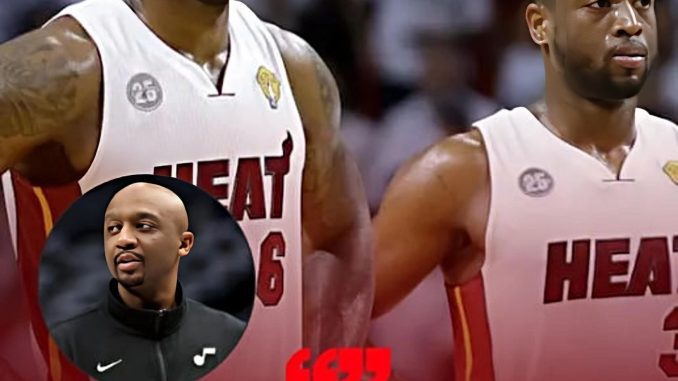
The 2011 NBA Finals remain one of the most dissected championship series in modern basketball history, not only because the Dallas Mavericks shocked the heavily favored Miami Heat, but because the outcome forever altered the legacy of LeBron James and ultimately shaped the next phase of his career. More than a decade later, former Mavericks guard Jason Terry has revealed the simple but ruthless defensive blueprint that helped Dallas dismantle Miami’s superstar trio: let Dwyane Wade dominate, but never allow LeBron to control the series.
It was a strategy rooted in discipline, trust, and a deep understanding of how Miami functioned offensively during the first season of the Big Three era. While Wade erupted throughout the Finals and often looked like the best player on the court, Dallas concentrated its defensive energy on disrupting James’ rhythm, crowding his driving lanes, and forcing him into hesitation. The plan worked beyond even the Mavericks’ expectations, as LeBron averaged just 17.8 points per game — one of the most surprising statistical drops by a superstar in Finals history.
For Dallas, the mission was never about stopping everyone. Against a team featuring James, Wade, and Chris Bosh, completely shutting down the Heat offense was unrealistic. Instead, Mavericks head coach Rick Carlisle and veteran leaders such as Terry, Dirk Nowitzki, and Jason Kidd focused on controlling the areas that mattered most.
According to Terry, Dallas believed Miami was at its most dangerous when LeBron orchestrated the entire game with his combination of scoring, passing, transition dominance, and physical pressure. Wade scoring in isolation was difficult to stop, but the Mavericks felt they could survive it. What they could not survive was LeBron dictating tempo while simultaneously elevating every other Heat player around him.
That distinction became the foundation of one of the greatest underdog title runs the NBA has ever witnessed.
The context surrounding those Finals only magnified the stakes. Miami entered the season under unprecedented scrutiny after James announced his move from Cleveland during the infamous “Decision” television special in the summer of 2010. The spectacle instantly transformed the Heat into the league’s biggest villains. When LeBron declared the team would win “not one, not two, not three” championships during Miami’s celebratory introduction event, expectations exploded to historic levels.
Every arena became hostile territory. Every game felt personal. Opposing fan bases rallied around whoever faced Miami, and by the time the Finals arrived, the Mavericks had become America’s basketball favorite.
Dallas itself was built around veterans many believed had already missed their championship window. Nowitzki had endured years of playoff heartbreak, including the painful 2006 Finals collapse against Wade’s Heat and the stunning first-round loss to the “We Believe” Golden State Warriors in 2007 after a 67-win regular season. Kidd was nearing the end of his Hall of Fame career. Terry had spent years as an elite sixth man without ever reaching the mountaintop. Defensive anchor Tyson Chandler had bounced around the league despite his enormous talent.
The Mavericks carried scars, experience, and motivation.
Miami carried pressure.
That emotional contrast defined the Finals almost immediately.
The Heat opened the series with a Game 1 victory behind strong performances from Wade and James, appearing poised to overwhelm Dallas with athleticism and star power. But the Mavericks never panicked. Internally, they believed the film revealed opportunities. Wade was scoring, yes, but Dallas felt comfortable with the nature of his production. LeBron, however, had not fully imposed himself.
That became the focus heading into the remainder of the series.
The Mavericks began throwing multiple defenders at James, showing bodies early whenever he attacked the paint. Marion, Kidd, Terry, and even Chandler took turns crowding him. Dallas consistently shrunk driving lanes and forced LeBron into half-court indecision. The Mavericks were willing to live with contested jumpers and post-ups, but they refused to allow him to generate downhill momentum.
It was a defensive approach built on psychological pressure as much as tactical execution.
At times, James looked strangely passive, deferring to Wade in critical moments instead of attacking. The most infamous example came during Game 4, when LeBron scored only eight points — the lowest total of his playoff career at that point. Dallas sensed his confidence wavering and intensified the pressure even further.
Meanwhile, Wade was magnificent throughout much of the series.
He averaged 26.5 points, 7 rebounds, and 5.2 assists while attacking relentlessly in transition and the midrange. In many stretches, Wade looked fully capable of carrying Miami to a championship almost by himself. Yet Dallas never abandoned the larger strategy.
Terry later explained that the Mavericks essentially accepted the possibility of Wade having monster games because they believed Miami’s offensive structure became less fluid when LeBron was removed from his natural rhythm as the primary playmaker. The Heat could survive Wade scoring heavily. They struggled when James became tentative.
That tension became increasingly visible as the series progressed.
Instead of overwhelming Dallas physically, Miami began tightening under the pressure of expectations. Late-game execution faltered. Offensive possessions slowed into isolations. The Mavericks, meanwhile, played with remarkable composure. Nowitzki delivered clutch shot after clutch shot despite battling illness and injuries. Terry provided instant offense and swagger off the bench. Kidd controlled tempo with veteran precision. Chandler anchored the defense and energized the team emotionally.
Every game felt like a referendum on mental toughness, and Dallas repeatedly won those moments.
Game 2 became the turning point of the entire Finals.
Miami led by 15 points late in the fourth quarter and appeared ready to take a commanding 2-0 series lead. Then Dallas erupted with one of the greatest comebacks in Finals history. Terry hit huge shots. Nowitzki attacked the rim fearlessly. Miami’s offense suddenly froze under pressure, and the Mavericks stole the game in stunning fashion.
That collapse shifted the emotional balance of the series.
For the first time, the Heat looked vulnerable. More importantly, Dallas realized its defensive plan against James was working. Rather than attacking assertively, LeBron increasingly operated on the perimeter, searching for openings that never fully appeared. The Mavericks continued to shade help defenders toward him, daring others to beat them consistently.
Even when Wade exploded offensively, Dallas stayed committed to its formula.
The brilliance of the strategy was not necessarily that it shut LeBron down entirely, but that it disrupted his instincts. Throughout his career, James has been at his most devastating when he combines scoring aggression with playmaking control. Dallas prevented him from reaching that balance. Every touch appeared overanalyzed. Every drive encountered traffic. Every possession carried visible hesitation.
In hindsight, many analysts believe the 2011 Finals exposed weaknesses in LeBron’s mental approach that ultimately pushed him toward greatness later in his career.
At the time, however, criticism was brutal.
James faced relentless scrutiny from media members, former players, and fans who expected dominance on basketball’s biggest stage. Questions emerged about his mentality in clutch situations. Critics pointed to his unwillingness to attack smaller defenders in the post and his tendency to defer late in games.
The backlash became one of the defining storylines of his career.
Yet what makes the 2011 Finals so historically fascinating is how directly those failures fueled LeBron’s evolution afterward.
In the years that followed, James transformed key areas of his game. He developed a far more reliable post-up attack. He became more comfortable operating without hesitation in physical half-court settings. His mental resilience sharpened dramatically. The defeats and criticism appeared to harden him into a more complete player.
By the time Miami returned to the Finals in 2012, LeBron looked like a different superstar emotionally and strategically.
That postseason run culminated in his first championship and Finals MVP against the Oklahoma City Thunder. He followed it with another title in 2013 against the San Antonio Spurs, cementing the beginning of one of the greatest peaks the sport has ever seen.
Ironically, many around the league now view the pain of 2011 as a necessary chapter in James’ eventual ascension.
Terry himself has acknowledged that Dallas may have awakened something in LeBron that the rest of the NBA later paid for. By attacking his weaknesses so directly and exposing his discomfort under intense defensive pressure, the Mavericks forced James to confront aspects of his game he could no longer avoid refining.
For Dallas, though, the 2011 championship remains far more than simply “LeBron’s collapse.”
That framing often overshadows one of the most intelligent and cohesive title runs in league history.
The Mavericks defeated a gauntlet of elite opponents during that postseason, sweeping the two-time defending champion Los Angeles Lakers, outlasting the young Oklahoma City Thunder led by Kevin Durant, Russell Westbrook, and James Harden, and finally toppling Miami’s superteam on the biggest stage.
They did it through chemistry, execution, toughness, and complete trust in Carlisle’s system.
Terry embodied that confidence throughout the run.
Known for his fearless personality and microwave scoring ability, Terry famously got a tattoo of the Larry O’Brien Trophy before the season even began — a move many initially mocked. By June, it looked prophetic. His scoring bursts repeatedly swung momentum during the Finals, and his emotional energy became contagious across the roster.
Perhaps no moment captured Dallas’ belief better than Terry’s iconic late-game three-pointer over LeBron in Game 5. As the shot splashed through the net, the Mavericks seized full control of the series psychologically. Miami looked rattled. Dallas looked inevitable.
When the Mavericks closed out the championship in Game 6 in Miami, the basketball world witnessed one of the greatest validation stories in sports. Nowitzki finally secured the elusive title that had long defined his legacy debates. Kidd earned the championship missing from his Hall of Fame résumé. Terry cemented his reputation as one of the greatest sixth men ever. Chandler established himself as an elite defensive centerpiece.
And LeBron walked off the floor facing the harshest criticism of his career.
Yet history has added layers of perspective to that defeat.
Rather than permanently damaging James’ legacy, the loss became a catalyst. The humiliation forced introspection. The weaknesses Dallas exposed became areas he relentlessly improved. In many ways, the Mavericks defeated the unfinished version of LeBron before the fully realized version emerged.
That is why Terry’s recent reflection resonates so deeply today.
The Mavericks did not merely stumble into a championship because Miami underperformed. They identified the central engine of the Heat offense, built an entire defensive philosophy around disrupting it, and executed that plan with extraordinary discipline under immense pressure.
“Let Wade get his, stop LeBron” sounds simple in retrospect. In reality, it required near-perfect communication, relentless defensive rotations, and total trust from every player on the floor.
Very few teams in NBA history have possessed the collective poise to pull off such a strategy against a roster filled with superstar talent.
Dallas did.
And in doing so, the Mavericks not only captured the franchise’s first championship but also helped shape the evolution of one of basketball’s greatest players.
Be the first to comment