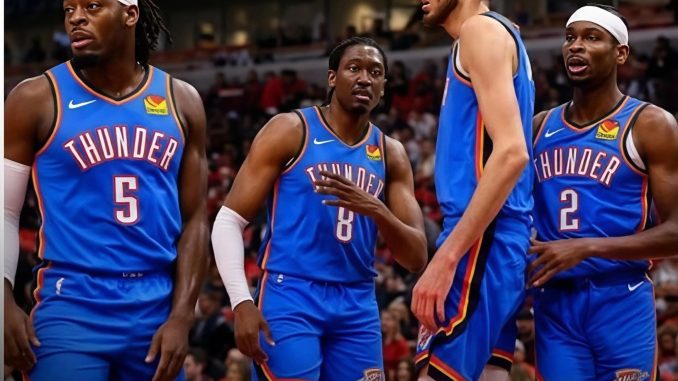
The deeper the Oklahoma City Thunder push into the postseason, the louder the noise becomes around them. Every victory is dissected, every whistle is debated, and every loss unleashes an avalanche of criticism across social media platforms that has transformed Oklahoma City from a young feel-good story into one of the NBA’s most polarizing franchises.
What once looked like a universally admired rebuild has suddenly become a lightning rod for basketball discourse.
The Thunder’s rise was supposed to be celebrated. Built patiently through the draft, developed internally, and powered by one of the league’s youngest cores, Oklahoma City spent years being praised as the blueprint for sustainable success. Fans around the NBA applauded the front office vision, the player development, and the selfless style of basketball that helped elevate the franchise from rebuilding project to championship contender.
Now, however, admiration has started to evolve into resentment.
When the Thunder lose, critics immediately target their youth, physicality, late-game execution, or perceived arrogance. When they win, especially in tightly contested playoff games, the spotlight shifts toward officiating controversies, free-throw disparities, and accusations that the league favors rising superstar Shai Gilgeous-Alexander.
It has created a bizarre environment around the Western Conference Finals, where Oklahoma City’s success seems incapable of existing without controversy attached to it.
The discourse intensified again during the Thunder’s current postseason clash against the San Antonio Spurs, a series that has rapidly become one of the most emotional and aggressively debated matchups of the playoffs. Oklahoma City currently holds a 2-1 series lead after winning back-to-back games following San Antonio’s dramatic double-overtime victory in Game 1.
Much of the online debate has centered on officiating and free throws. Gilgeous-Alexander’s ability to generate contact has become one of the defining topics of the postseason, with opposing fan bases accusing the Thunder star of receiving a softer whistle than other elite players around the league. Every replay is slowed down, every foul call is clipped and reposted, and every trip to the free-throw line fuels another wave of outrage.
Yet Oklahoma City supporters argue the criticism ignores reality.
The Thunder attack the paint relentlessly. They lead with speed, pressure defenses constantly, and force opponents into uncomfortable positions. Gilgeous-Alexander, in particular, thrives because of his hesitation moves, change of pace, and ability to manipulate defenders into committing fouls. To Thunder fans, the constant officiating complaints are simply frustration from opponents unable to contain one of basketball’s most skilled scorers.
That divide has turned the Thunder into an online battleground unlike almost any team remaining in the postseason.
One side views Oklahoma City as an exciting young powerhouse built the “right way.” The other sees a team that flops excessively, benefits from favorable officiating, and carries itself with a swagger that has arrived before accomplishing anything significant.
In many ways, the Thunder are experiencing the natural progression of NBA relevance.
For years, they existed as a neutral team for casual fans. They were harmless, rebuilding, and easy to root for. But contenders eventually lose neutrality. Sustained winning creates enemies. Young stars become targets. Confidence becomes interpreted as cockiness. And playoff intensity magnifies every controversial moment.
The same thing happened to dynasties and contenders before them.
The Golden State Warriors were once celebrated as revolutionary before becoming villains to much of the basketball world. The Miami Heat experienced relentless hostility during the Big Three era. Even the Denver Nuggets and Boston Celtics have faced stretches where playoff success produced growing backlash online.
What makes Oklahoma City unique is how quickly the shift happened.
The Thunder’s core remains remarkably young. Gilgeous-Alexander is in his prime, but players like Jalen Williams and Chet Holmgren are still early in their postseason journeys. Despite that youth, the team already carries the emotional weight usually reserved for veteran contenders.
Part of that stems from expectations.
The Thunder are no longer viewed as an up-and-coming team. They are viewed as a legitimate championship threat, and championship threats attract scrutiny from every direction. Fans dissect their weaknesses because they matter now. Opposing supporters fear them enough to celebrate losses and question victories.
Social media has only accelerated the phenomenon.
Every playoff possession now exists in an endless replay cycle. A missed foul becomes a trending debate within minutes. Highlight clips are selectively edited to support narratives. National conversations are shaped in real time by viral reactions rather than full-game context.
For Oklahoma City, that means nearly every result triggers chaos.
If the Thunder struggle offensively, critics question whether their youth is catching up to them under playoff pressure. If Gilgeous-Alexander has a quiet night, conversations immediately surface about whether he can truly lead a championship team. If Oklahoma City wins, especially in physical games, the focus often pivots toward referees rather than execution.
That dynamic was especially visible after Oklahoma City’s Game 3 victory over San Antonio.
The Thunder controlled key stretches of the second half with aggressive defense, transition scoring, and composure late in the game. Gilgeous-Alexander orchestrated the offense with his trademark patience, while Holmgren protected the rim and altered multiple Spurs possessions defensively.
But much of the postgame discussion online centered on foul calls.
Fans flooded social media platforms with screenshots, slow-motion clips, and officiating compilations. Some argued the Thunder received preferential treatment. Others countered that San Antonio’s defensive approach naturally created foul trouble because of Oklahoma City’s constant downhill pressure.
Lost underneath the noise was the basketball itself.
The Thunder have become one of the NBA’s most complete teams. Their defense rotates with elite speed, their ball movement creates efficient offense, and their versatility allows them to adjust to nearly any matchup. Oklahoma City can play small, fast, physical, or methodical depending on the opponent.
That flexibility is precisely why they are so dangerous.
Head coach Mark Daigneault has quietly become one of basketball’s most respected tacticians, empowering his roster with freedom while demanding discipline defensively. Oklahoma City rarely beats itself with careless mistakes, a remarkable trait for such a young group navigating deep playoff pressure.
Still, the emotional reactions surrounding the Thunder continue to overshadow many of those accomplishments.
Some of it is driven by Gilgeous-Alexander’s style of play. Superstar foul-drawing has always divided fans. Players like James Harden, Joel Embiid, and Luka Dončić have all faced criticism for manipulating defenders and generating free throws. Gilgeous-Alexander is now entering that same territory because of how dominant he has become offensively.
But there is also another factor at play: fear.
NBA fans often dislike teams most when they believe those teams could dominate for years.
The Thunder possess draft assets, elite young talent, organizational stability, and financial flexibility. They are not built around aging stars nearing decline. They are built for longevity. That reality creates anxiety for opposing fan bases who understand Oklahoma City may remain near the top of the Western Conference for a very long time.
Dynasty potential changes perception quickly.
A young underdog can become a hated powerhouse almost overnight once fans begin imagining repeated playoff heartbreak against them.
Oklahoma City is beginning to cross that line.
The atmosphere surrounding the team now reflects a franchise that matters deeply in the league hierarchy. Neutrality has disappeared. Fans either passionately support the Thunder or actively root against them. Few teams inspire such strong emotional reactions this early in a competitive window.
Ironically, that may be the clearest sign of Oklahoma City’s arrival as a true contender.
Great teams are rarely universally loved for long.
Winning consistently forces narratives to evolve. Players who were once charming become irritating to opponents. Celebrations become disrespectful. Confidence becomes arrogance. Every whistle becomes evidence of conspiracy. Every success becomes questioned.
The Thunder are learning that reality in real time.
Inside the locker room, however, Oklahoma City appears unfazed by the outside chaos. Players have repeatedly emphasized their focus on execution rather than online narratives, maintaining the same calm identity that carried them through the regular season.
That composure has become one of their defining strengths.
Even amid nonstop scrutiny, the Thunder continue stacking wins. They continue defending at a high level. They continue trusting their system. And perhaps most importantly, they continue embracing the pressure that comes with being one of the NBA’s final teams standing.
Whether fans love them or hate them, Oklahoma City has undeniably become one of the league’s central storylines.
The Thunder are no longer the NBA’s cute rebuilding project. They are no longer simply a promising young roster with future potential. They are a legitimate title contender operating under the microscope reserved for teams expected to win championships.
And with that spotlight comes everything else — criticism, controversy, officiating debates, and emotional overreactions after every single result.
That reality may frustrate Thunder supporters, but it also signals something important.
The NBA world is watching Oklahoma City differently now.
Not as a future threat.
As a present one.
Be the first to comment