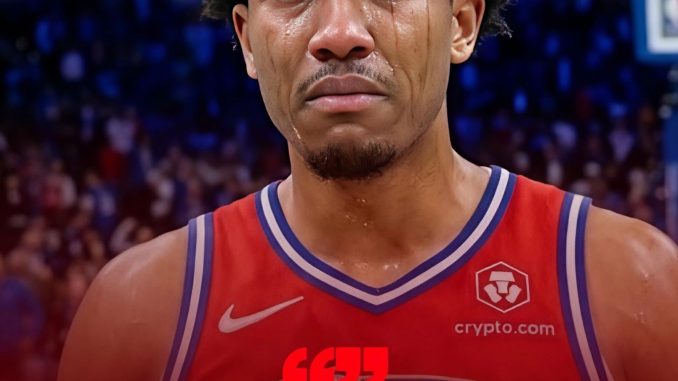
The phone call was supposed to be routine. Maybe it was going to be about travel logistics, training schedules, or a quick offseason check-in. Instead, for Jared McCain, it became one of the most heartbreaking moments of his young NBA career.
In an emotional revelation that quickly sent shockwaves across the basketball world, the former Philadelphia 76ers guard opened up about the devastating moment he learned he had been traded away from the franchise he had already grown to call home. The scene, as McCain described it, unfolded while the team was traveling after a game in San Francisco — a moment that transformed an ordinary trip into an unforgettable emotional wound.
“Tears on the tarmac,” McCain reportedly said while recounting the experience, a phrase that instantly captured the raw pain behind the transaction that stunned both fans and teammates alike.
For many NBA veterans, trades are part of the business. Rosters shift constantly, front offices chase cap flexibility, and executives make difficult decisions in pursuit of championships. But for younger players still building their identity in the league, the emotional impact often cuts much deeper than fans realize. McCain’s story served as a painful reminder that behind every transaction graphic and breaking news alert is a human being processing loss, uncertainty, and separation from people who became family.
According to McCain, the first indication that something was wrong came during what he initially believed would be a standard phone call from his agent. There had been no major warning signs. No lengthy buildup. No expectation that his future with Philadelphia was suddenly in jeopardy. The rookie guard had spent the season trying to carve out his place within the Sixers organization, embracing the city, bonding with teammates, and learning how to navigate the demanding pace of NBA life.
Then the call changed everything.
McCain explained that his agent informed him he had been moved in a trade, news that immediately left him stunned and emotional. Before he could fully process it, another call followed — this one from Daryl Morey, the Sixers’ president of basketball operations.
That confirmation made the reality hit even harder.
“I cried right away,” McCain admitted, describing the immediate emotional reaction that overtook him as the plane sat on the tarmac. The tears were not simply about basketball or relocating to another city. They stemmed from the abrupt realization that the relationships he had built inside Philadelphia’s locker room were suddenly changing overnight.
“These guys were my brothers,” he said.
That single sentence revealed why the trade hurt so deeply.
Inside NBA locker rooms, especially during the grind of an 82-game season, relationships form rapidly and intensely. Players travel together constantly, share victories and frustrations, endure criticism, and spend more time around teammates than family members during the season. For rookies like McCain, veterans often become mentors, while fellow young players turn into emotional support systems as they navigate the pressures of professional basketball.
By all accounts, McCain had become well-liked within Philadelphia’s locker room. Teammates admired his energy, personality, and work ethic. Coaches appreciated his willingness to learn and his positive attitude even during difficult stretches. Fans quickly embraced his charisma, confidence, and natural comfort in front of cameras and microphones.
His departure therefore felt jarring not only to him, but also to many within the organization.
The timing amplified the emotional weight of the moment. Being traded while traveling with the team created a uniquely painful situation. There was no opportunity to quietly process the news at home. No chance to prepare mentally before seeing teammates. Instead, McCain was suddenly forced to confront the emotional reality while physically surrounded by the people he was about to leave behind.
That environment turned an already difficult moment into something almost cinematic.
The image of a young player sitting emotionally shattered after learning his NBA future had abruptly changed resonated strongly with fans online. Social media quickly flooded with reactions from supporters who sympathized with the harsh reality of professional sports. Many pointed out how easy it is for the public to forget the emotional toll that trades can carry, particularly for players at the beginning of their careers.
The NBA has always balanced two competing truths. It is both a business and a brotherhood. Front offices must make calculated decisions aimed at improving rosters and maximizing championship windows. Yet players, coaches, and staff simultaneously build genuine emotional connections that cannot simply be erased by salary cap spreadsheets or trade exceptions.
McCain’s honesty offered a rare glimpse into that collision between business and humanity.
For Philadelphia 76ers, the move represented another aggressive roster decision by Morey and the front office as the franchise continues searching for the right formula around its core stars. Philadelphia remains under enormous pressure to contend in a fiercely competitive Eastern Conference, and every roster decision is scrutinized through the lens of championship urgency.
That pressure often forces difficult choices involving promising young talent.
Executives like Morey understand the emotional consequences of trades, but their responsibility ultimately centers on building the strongest possible roster. In many cases, young players become valuable assets precisely because of their upside and affordability. That reality can place developing talent in vulnerable positions during negotiations.
Still, hearing directly from McCain illustrated how painful those decisions can become on a personal level.
The former first-round pick entered the NBA carrying enormous expectations. A standout collegiate career and massive social media following made him one of the most recognizable rookies in his class even before playing an NBA game. His offensive creativity, confidence, and scoring instincts generated excitement among Philadelphia fans eager to see his long-term development.
Beyond basketball, McCain also brought a refreshing personality to the franchise. In an era where player branding increasingly matters, he connected naturally with younger audiences while still maintaining a serious commitment to improving his game. Teammates frequently praised his energy, while fans appreciated his authenticity.
That made the trade feel even more emotional for supporters who had already become attached to him.
Around the league, stories like McCain’s are far more common than many realize. Players often discover they have been traded through agents, social media alerts, or unexpected phone calls while traveling, eating dinner, or even preparing for games. The suddenness can feel disorienting, especially for younger athletes still adjusting to professional life.
Some players eventually grow numb to the process after years in the league. Others never truly do.
McCain’s willingness to publicly discuss crying after the trade also stood out in a sports culture that has historically encouraged emotional restraint among male athletes. Rather than hiding his reaction behind clichés or polished media answers, he openly acknowledged how deeply the moment affected him.
That vulnerability earned widespread respect.
Fans increasingly appreciate athletes who speak honestly about emotional experiences rather than relying solely on rehearsed professionalism. McCain’s comments humanized a process that is often reduced to headlines, salary figures, and trade grades.
In reality, trades disrupt lives.
Players leave behind teammates, coaching staffs, trainers, routines, communities, and sometimes even family arrangements. Young athletes who may have just begun settling into a city suddenly face relocation, uncertainty, and the challenge of rebuilding chemistry elsewhere. While the financial rewards of professional sports are enormous, moments like McCain’s reveal the emotional sacrifices attached to that lifestyle.
For Philadelphia fans, the story also sparked mixed emotions regarding the franchise’s direction. Some understood the business logic behind the trade and trusted Morey’s aggressive roster-building philosophy. Others struggled emotionally with seeing a promising young player depart before fully reaching his potential.
That tension has followed the Sixers organization for years.
The franchise remains caught between immediate championship ambitions and long-term development. Building around superstar expectations creates urgency that can shorten patience for younger players. Every season becomes framed around whether the roster is strong enough to compete for a title, leaving little room for gradual growth.
McCain unfortunately became part of that equation.
Still, despite the pain surrounding the move, many around the league believe the young guard’s future remains extremely bright. His talent, confidence, and offensive upside continue to intrigue evaluators. More importantly, his emotional reaction demonstrated how seriously he values relationships, team culture, and personal investment — qualities many organizations highly prize.
Several former players and analysts reacted to McCain’s story by recalling their own difficult trade experiences. Many described similar feelings of shock, sadness, and emotional confusion when first learning they had been moved. Some admitted they also cried privately after trades, even if they never publicly discussed it at the time.
That shared experience created a wave of empathy around McCain’s comments.
The modern NBA often feels dominated by nonstop speculation, trade rumors, and transaction culture. Fans discuss players like movable assets, constructing hypothetical trades daily on television and social media. Yet moments like this force the basketball world to pause and remember the human side behind the machine.
For McCain, the trade may eventually become a pivotal chapter in his career growth. Many NBA stars have experienced emotional exits early in their journeys before flourishing elsewhere. Sometimes being traded becomes motivation. Sometimes it leads to greater opportunity. Sometimes it reshapes a player’s perspective entirely.
But in the immediate aftermath, none of that long-term possibility mattered.
What mattered was the heartbreak of saying goodbye to teammates he viewed as brothers.
What mattered was the shock of hearing his future change through a phone call.
What mattered was the image of a young player sitting on a tarmac trying to process the emotional reality of professional basketball.
And what mattered most was the honesty with which he chose to share that experience.
In a league often dominated by carefully crafted narratives and media-trained responses, Jared McCain delivered something far more powerful: authenticity.
His tears were real.
His pain was real.
And for one heartbreaking moment after that call from Daryl Morey, the business side of basketball collided head-on with the deeply personal bonds that make the NBA more than just a game.
Be the first to comment