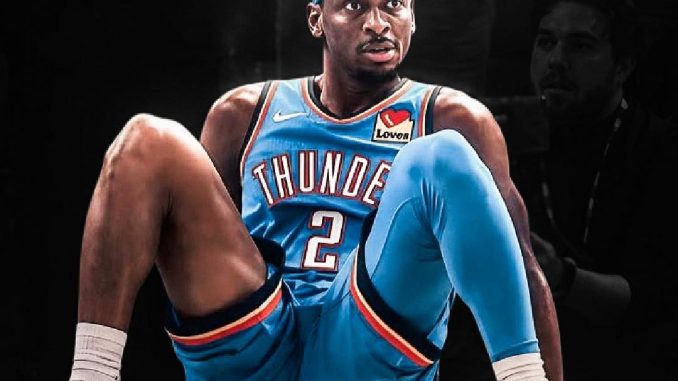
Shai Gilgeous-Alexander UNDER THE MICROSCOPE: NEW PLAYOFF RESEARCH REVEALS UNMATCHED FALL RATE METRICS AS SCIENTISTS TRACK SHOT CONTACT PATTERNS ACROSS LEAGUE LEADERS 📊
In a postseason where every possession is dissected, debated, and replayed frame-by-frame, Shai Gilgeous-Alexander has once again found himself at the center of basketball’s most polarizing analytical conversation—not for a buzzer-beater or a scoring explosion, but for something far more unconventional: how often he ends up on the floor.
A newly circulated wave of playoff research, compiled through advanced shot-tracking models and multi-player comparative datasets, has placed the Oklahoma City Thunder superstar under a statistical microscope, measuring “fall rate” on shot attempts across elite postseason scorers. The findings have ignited discussion throughout the league’s analytical and coaching circles, adding another layer to an already complex narrative surrounding one of the NBA’s most efficient and unguardable offensive engines.
According to the data, Gilgeous-Alexander leads a group of high-usage playoff scorers in how frequently he falls on shot attempts—both when fouls are called and when they are not. In a tracked sample of 224 playoff field-goal attempts involving comparable superstar usage profiles, he was credited with 39 total instances of falling, translating to a 17.4% fall rate, the highest among the group studied (Yahoo Sports).
Even more granular breakdowns reveal where the debate gains its sharpest edge. On plays where no foul was called, Gilgeous-Alexander reportedly fell on 20 of 187 shot attempts, a rate of 10.7%, again the highest among the sampled stars including James Harden, Donovan Mitchell, Jalen Brunson, and Victor Wembanyama (Bleacher Report). The gap between SGA and the rest of the league’s elite scorers has prompted renewed discussion about whether his style of driving contact, balance disruption, and post-contact finishing naturally leads to more floor contact—or whether it reflects something more stylistic in how he sells contact through motion.
Inside NBA analytics circles, however, the conversation is less about accusation and more about classification. Gilgeous-Alexander’s offensive profile has long been defined by his elite footwork, hesitation game, and body control in tight spaces. Defenders routinely describe guarding him as a “possession-long negotiation,” where angles shift by inches and timing windows collapse in milliseconds. In that environment, contact is not incidental—it is structural.
What makes the latest dataset so compelling is not just the frequency of falls, but the consistency of the trend across different defensive matchups. Whether facing rim protectors, perimeter switch defenders, or help-heavy schemes designed to corral his drives, Gilgeous-Alexander’s shot profile shows a repeated pattern of deceleration into traffic, pivot-based shot creation, and mid-air adjustments that often end with either a whistle or a controlled descent to the floor.
Critics of the metric argue that “fall rate” alone is an incomplete lens, pointing out that it does not distinguish between forced imbalance due to legal defensive contact and unforced or stylistic falling. Supporters of the study counter that the consistency of the data across multiple playoff series suggests a repeatable offensive behavior rather than random variance.
What is not in dispute is Gilgeous-Alexander’s continued dominance in scoring efficiency and volume. Across recent postseason runs, he has maintained elite production levels while carrying the offensive load for a Thunder team built on pace control, defensive pressure, and half-court shot creation. In the current playoff stretch, he has regularly hovered near the top of scoring leaders, reinforcing his status as one of the league’s most reliable postseason engines.
The timing of the research has only amplified its impact. Oklahoma City remains deep in a high-stakes Western Conference playoff battle, where every possession carries championship implications and every officiating trend is scrutinized through a competitive lens. Opponents facing the Thunder have privately emphasized the difficulty of defending Gilgeous-Alexander without sending him to the line, a challenge that has shaped defensive game plans from series to series.
Yet even as debate intensifies, the Thunder guard’s on-court production continues to anchor Oklahoma City’s postseason identity. His ability to manipulate defensive positioning, collapse help rotations, and generate high-value possessions—whether through scoring or free throws—remains central to OKC’s offensive success. The same driving style that produces contested finishes also generates defensive hesitation, a factor coaches describe as “the cost of containment.”
Around the league, analysts have pointed out that elite shot creators often occupy statistical outliers in contact-related metrics. Players who live in the paint, absorb rotating defenders, and operate in tight mid-range pockets naturally experience higher levels of physical disruption. In that sense, Gilgeous-Alexander’s numbers may reflect not a deviation from norm, but an extreme version of it.
Still, the visibility of the data ensures the conversation will persist. In an era where every movement is tracked, categorized, and compared across historical baselines, even subtle tendencies become headline material. For Gilgeous-Alexander, whose game already sits at the intersection of artistry and efficiency, the “fall rate” discussion has added an unexpected statistical footnote to an MVP-caliber playoff narrative.
On the court, however, the response remains unchanged. The Thunder continue to lean on their star guard’s ability to bend defenses, control tempo, and produce in isolation-heavy late-game scenarios. Whether he finishes a possession on his feet or on the hardwood, the outcome that matters most is the same: points on the board.
As the playoffs progress deeper into elimination territory, the microscope will only intensify. But so too will the stakes—and for Gilgeous-Alexander, the balance between scrutiny and superstardom has become just another part of the postseason equation he continues to solve in real time.
Be the first to comment