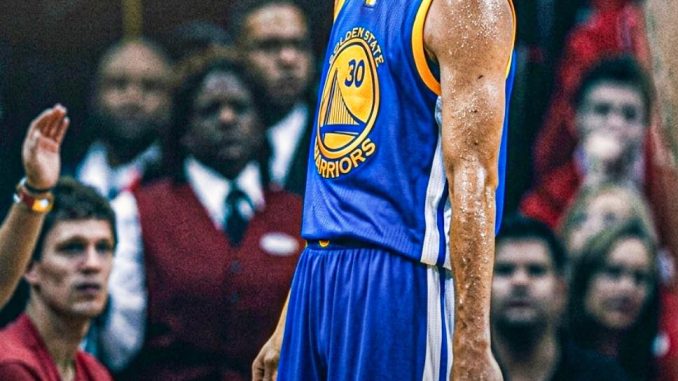
Eleven years ago, the basketball world witnessed the moment when Stephen Curry officially transformed from an emerging superstar into the face of a dynasty. Under the bright lights of the Western Conference Finals, with the pressure of an entire franchise resting on his shoulders, Curry delivered one of the defining playoff performances of his career — a dazzling 40-point masterpiece that sent the Golden State Warriors roaring past the Houston Rockets in a Game 3 blowout and firmly established Golden State as basketball’s newest powerhouse.
At the time, the Warriors were still trying to convince the world they were more than just a regular-season phenomenon. The 2014-15 campaign had been spectacular from start to finish. Golden State had won 67 games, dominated opponents with breathtaking pace and spacing, and revolutionized modern offense with a barrage of three-point shooting that left defenses scrambling. Yet despite all the brilliance, skepticism remained. Critics questioned whether a jump-shooting team could truly survive the brutality of playoff basketball. Others wondered whether Curry, despite his MVP season, could impose himself deep into the postseason against elite defenses determined to trap, bump, and exhaust him.
Game 3 against Houston became the answer to every doubt.
The series had already tilted in Golden State’s favor after the Warriors protected home court in the first two games at Oracle Arena. Houston, led by MVP finalist James Harden, returned home desperate to avoid falling into a virtually impossible 3-0 hole. The Rockets believed the energy inside Toyota Center would fuel a turnaround. Instead, the night became Curry’s personal showcase.
From the opening tip, Curry played with the calm confidence of a superstar who understood the stage belonged to him. Houston tried every defensive adjustment imaginable. They trapped him beyond the arc, switched longer defenders onto him, and attempted to force the ball out of his hands. None of it mattered. Curry sliced through the Rockets with an offensive rhythm that felt almost unfair, blending impossible shooting with dazzling ball-handling and relentless movement.
Every possession seemed to increase the pressure on Houston’s defense. One moment Curry was launching a deep three several feet behind the line. The next, he was weaving through traffic for a high-arcing layup before sprinting back downcourt with the swagger that would soon become iconic throughout the league.
What made the performance even more devastating for the Rockets was how effortless Curry made it all appear. He never looked rushed. He never looked overwhelmed. The Warriors’ offense flowed entirely through his energy, and every made shot seemed to ignite Golden State further while simultaneously draining Houston’s confidence.
By halftime, the Warriors already looked firmly in control. Curry had torched the Rockets from every angle, and Golden State’s ball movement turned the game into a showcase of modern basketball artistry. Houston entered the night hoping to slow the pace and make the game physical. Instead, the Warriors accelerated everything, turning defensive rebounds into transition opportunities and exploiting every defensive mistake.
Curry’s brilliance extended beyond scoring. His mere presence warped Houston’s entire defensive structure. Every time he crossed half court, multiple defenders shaded toward him, leaving shooters and cutters free to attack open space. That gravity became the foundation of the Warriors’ dynasty. Long before analytics fully reshaped the NBA, Golden State understood the value of spacing and movement better than anyone else in basketball, and Curry was the engine powering it all.
As the second half unfolded, the game turned from competitive battle into full-scale demolition. The Rockets simply had no answer. Harden fought to keep Houston alive offensively, but every small run was immediately crushed by another Curry explosion. Whenever Houston threatened momentum, Curry responded with a dagger jumper that silenced the crowd and restored Golden State’s command.
One of the most unforgettable sequences came late in the third quarter when Curry buried back-to-back three-pointers in rapid succession, each more difficult than the last. The first came off a quick screen near the wing, where he barely needed daylight to fire. The second arrived moments later in transition, pulling up from well beyond the arc with the fearless confidence that would redefine acceptable shooting range in the NBA.
The Rockets looked stunned. Fans inside the arena could only shake their heads as Curry continued raining shots from distances once considered reckless. Yet for Curry, those shots were routine. That season marked the beginning of basketball’s long-range revolution, and Game 3 served as one of its loudest announcements.
While Curry’s scoring dominated headlines, the Warriors’ collective dominance also reflected the brilliance of head coach Steve Kerr. In his first season leading Golden State, Kerr had transformed a talented roster into a historically efficient machine. He empowered Curry to play freely, emphasized relentless ball movement, and encouraged a defensive intensity that complemented the team’s offensive firepower.
Golden State’s defense suffocated Houston throughout the night. Klay Thompson chased shooters across the perimeter, Draymond Green anchored the defense with unmatched versatility, and Andrew Bogut protected the rim while setting crushing screens that freed Curry for open looks. Every piece fit perfectly.
The Warriors were not merely winning games during that playoff run — they were reshaping the identity of championship basketball.
For years, NBA champions had typically relied on dominant interior scoring, isolation-heavy offense, or physically overwhelming frontcourts. Golden State shattered those conventions. The Warriors played with pace, joy, and spacing unlike anything the league had fully embraced before. Their style forced opponents into impossible decisions. Help too aggressively on Curry, and Thompson would bury open threes. Collapse into the paint, and Green would orchestrate from the top of the floor. Switch everything, and Curry’s handle would expose mismatches instantly.
Game 3 against Houston represented the perfect storm of all those elements working together.
Curry finished with 40 points, delivering one spectacular moment after another while controlling the game from start to finish. More importantly, he did it on the road, in a hostile playoff environment, against a desperate opponent fighting to save its season. Superstars are often defined not by regular-season brilliance but by postseason moments when pressure reaches its peak. Curry’s performance that night permanently elevated his reputation among the league’s elite.
At the time, comparisons between Curry and Harden dominated NBA discussions. Harden had enjoyed a sensational MVP-caliber season himself and had carried Houston to the conference finals despite significant roster instability. Many believed Harden deserved the MVP award over Curry because of his individual offensive burden. But Game 3 showcased the difference between great production and transformative impact.
Curry controlled every aspect of the game without monopolizing the basketball. He moved constantly, stretched the floor beyond imagination, and inspired a style of play that made teammates better. Golden State’s offense became almost impossible to guard because Curry’s shooting range broke traditional defensive concepts.
The victory gave the Warriors a commanding 3-0 series lead, placing them one step away from the NBA Finals. More importantly, it sent a message to the entire league that Golden State was no fluke. The Warriors were fast, fearless, and fully capable of dominating on the biggest stage.
Houston never truly recovered from the emotional blow of Game 3. Although the Rockets avoided a sweep by winning Game 4 behind Harden’s brilliance, Golden State eventually closed out the series in five games to capture the Western Conference crown.
That postseason journey culminated weeks later when the Warriors defeated the Cleveland Cavaliers in the NBA Finals, securing the franchise’s first championship in 40 years and the first title of Curry’s legendary career. The championship became the launching point for one of the greatest dynasties basketball has ever seen.
Looking back now, Game 3 against Houston feels like a turning point not just for Golden State, but for the NBA itself.
Before Curry’s rise, deep three-point shooting was often treated as a situational weapon. After Curry, it became the foundation of modern offense. Young players around the world suddenly practiced pull-up threes from 30 feet. Teams prioritized spacing and perimeter versatility more aggressively than ever before. Front offices began constructing rosters designed specifically to survive in a faster, more perimeter-oriented era.
Curry changed basketball strategy forever, and performances like the one he delivered against Houston helped convince the basketball world that the transformation was real.
What also made the moment so memorable was Curry’s personality. Unlike many superstars before him, Curry played with visible joy. He celebrated big shots with emotion, energized teammates constantly, and embraced the entertainment aspect of the sport without losing his competitive edge. Fans gravitated toward him because he made greatness feel fun and accessible.
That charisma turned the Warriors into a global phenomenon. Children mimicked Curry’s shooting form on playgrounds everywhere. NBA ratings surged as audiences tuned in to watch Golden State’s breathtaking style. The Warriors became appointment television, and Curry stood at the center of it all.
Eleven years later, the impact of that playoff run remains impossible to ignore. Curry has since added multiple championships, MVP trophies, Finals records, and unforgettable performances to his résumé. He is now universally recognized as the greatest shooter in basketball history and one of the most influential athletes the sport has ever produced.
Yet even among all his accomplishments, that Western Conference Finals performance against Houston remains deeply significant because it represented the arrival of a new basketball era.
It was the night Curry announced that the league belonged to him and the Warriors.
It was the night Golden State’s revolutionary style officially overwhelmed one of the NBA’s best teams on the conference finals stage.
And it was the night the path toward a dynasty truly became undeniable.
For longtime Warriors fans, the memory still carries emotional weight. After decades of frustration, heartbreak, and irrelevance, Golden State finally possessed a transcendent superstar capable of carrying the franchise to the summit of the basketball world. Curry was not simply winning games — he was changing the culture of the organization and elevating expectations permanently.
The Warriors’ dominance over the following years would include record-breaking seasons, unforgettable playoff battles, and multiple championships. But every dynasty has a defining early statement, a moment when belief transforms into certainty.
For Golden State, that statement came in Houston.
Forty points. A road playoff blowout. A conference finals takeover.
And the beginning of a championship legacy that would reshape basketball history forever.
Be the first to comment