The roar inside Frost Bank Center felt more like a celebration than a warning during the opening minutes Thursday night as the San Antonio Spurs came flying out of the gates with the energy of a team determined to protect home court and regain control of the Western Conference Finals. The crowd rose with every defensive stop, every transition bucket, and every moment of brilliance from the young Spurs core. For a brief stretch, it looked as though San Antonio was on the verge of overwhelming the youngest No. 1 seed the NBA had seen in years.
Then Shai Gilgeous-Alexander reminded everyone why the Oklahoma City Thunder have spent the entire season proving they belong among basketball’s elite.
Calm amid the chaos, composed while the Spurs surged, Gilgeous-Alexander slowly dismantled San Antonio’s early momentum before orchestrating a breathtaking Thunder comeback that completely changed the trajectory of the series. Oklahoma City erased a 15-point first-half deficit and stormed to a commanding 123-108 victory in Game 3, reclaiming home-court advantage and grabbing a critical 2-1 lead in the Western Conference Finals.
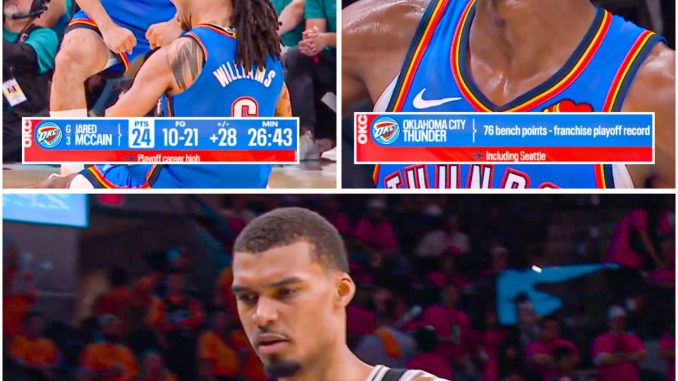
While Gilgeous-Alexander’s stat line of 26 points and 12 assists underscored his brilliance, the defining story of the night became Oklahoma City’s remarkable depth. The Thunder bench erupted for a franchise playoff-record 76 points, overwhelming San Antonio’s second unit and turning what once looked like a Spurs statement game into a showcase of Oklahoma City’s resilience, versatility, and championship-level poise.
It was the kind of victory contenders remember.
For much of the first quarter, however, Oklahoma City appeared vulnerable. San Antonio entered the night energized after splitting the first two games on the road and carried that confidence into a blistering start. The Spurs attacked the paint relentlessly, moved the ball with pace, and forced the Thunder into uncomfortable possessions early.
Victor Wembanyama once again established himself as the focal point of San Antonio’s offense, altering shots defensively while stretching Oklahoma City’s defense with his perimeter shooting and interior presence. The Spurs pushed the tempo aggressively, and when Devin Vassell drilled a transition three midway through the opening quarter, San Antonio suddenly held a double-digit advantage that electrified the arena.
Moments later, the lead ballooned to 15.
The Thunder looked rattled. Their normally fluid offense stalled under San Antonio’s pressure, and several careless turnovers fueled easy Spurs baskets the other way. Oklahoma City’s starters struggled to find rhythm, while the Spurs played with the confidence and swagger of a team sensing an opportunity to seize control of the series.
But Gilgeous-Alexander never panicked.
That has become one of the defining traits of the MVP finalist throughout Oklahoma City’s remarkable postseason run. No matter how chaotic the moment becomes, the All-NBA guard operates at his own pace, dissecting defenses possession by possession until the game gradually bends in Oklahoma City’s favor.
Instead of forcing difficult shots or trying to erase the deficit in one sequence, Gilgeous-Alexander methodically settled the Thunder offense. He attacked mismatches, collapsed San Antonio’s defense with his drives, and consistently found open teammates when the Spurs sent extra defenders his way.
The shift began late in the second quarter.
Oklahoma City’s bench unit injected life into the game with relentless energy on both ends of the floor. Rookie guard Jared McCain delivered perhaps the most important stretch of his young playoff career, knocking down timely perimeter shots while playing with fearlessness against San Antonio’s aggressive defense. Every time the Spurs threatened to rebuild momentum, McCain answered with another clutch basket or hustle play.
Jalen Williams soon joined the surge.
The versatile forward attacked the rim with force, punished smaller defenders in transition, and gave Oklahoma City another reliable shot creator alongside Gilgeous-Alexander. Williams played with remarkable composure for a player still early in his postseason career, finishing through contact and making smart reads whenever the Spurs attempted to trap Oklahoma City’s ball handlers.
By halftime, the Thunder had stabilized the game.
The deficit that once stood at 15 had nearly disappeared, and the energy inside the building had noticeably shifted. What began as a San Antonio celebration slowly transformed into growing anxiety as Oklahoma City’s confidence mounted with each possession.
Then came the knockout punch.
The Thunder dominated the third quarter with the precision and intensity of a veteran contender. Oklahoma City’s defense tightened dramatically, cutting off driving lanes and forcing San Antonio into difficult half-court possessions. The Spurs, who looked unstoppable early, suddenly struggled to generate clean looks as the Thunder switched seamlessly across the perimeter and contested nearly every shot.
Gilgeous-Alexander controlled the pace masterfully during the stretch, repeatedly manipulating defenders in the pick-and-roll before finding open shooters or creating midrange opportunities for himself. His patience became devastating. Every possession seemed designed to exploit exactly where San Antonio’s defense was weakest.
Meanwhile, Oklahoma City’s bench continued pouring in points at a historic pace.
McCain caught fire from beyond the arc, bringing the Thunder bench to its feet after consecutive three-pointers that pushed Oklahoma City firmly ahead. Williams added several acrobatic finishes in traffic, while the Thunder reserves consistently outran and outworked San Antonio’s second unit.
By the end of the third quarter, the entire complexion of the game had changed.
The Spurs no longer looked like the aggressor. Oklahoma City had seized complete control.
The Thunder’s ability to overwhelm opponents with depth has been one of the defining themes of their postseason run, but Thursday night elevated that strength to another level. Oklahoma City’s reserves produced 76 points, the highest playoff bench total in franchise history, and the impact extended far beyond scoring.
The bench brought defensive intensity, pace, rebounding, and relentless pressure that gradually exhausted San Antonio over the course of the game. Every time Spurs coach Gregg Popovich searched for answers with lineup adjustments, Oklahoma City responded with another wave of energy and production.
That depth has become one of the greatest advantages for Thunder coach Mark Daigneault throughout the playoffs.
Unlike many postseason teams that shorten rotations dramatically, Oklahoma City continues to trust its young supporting cast in critical moments. That confidence paid enormous dividends in Game 3, particularly with McCain and Williams delivering the best playoff performances of their careers.
McCain, whose fearless mentality has quickly made him a fan favorite, looked completely unfazed by the magnitude of the moment. The rookie played with remarkable confidence, spacing the floor offensively while competing aggressively on defense. Each shot he made seemed to further drain San Antonio’s momentum.
Williams, meanwhile, continued evolving into one of Oklahoma City’s most dependable two-way stars. His versatility created matchup nightmares for the Spurs throughout the second half. Whether attacking downhill, facilitating offense, or defending multiple positions, Williams consistently impacted winning possessions.
And through it all, Gilgeous-Alexander orchestrated everything.
What separates the Thunder superstar from many elite scorers is his ability to completely control a game without dominating every shot attempt. Even while facing constant defensive attention, Gilgeous-Alexander dictated tempo, created opportunities for teammates, and made every critical decision with precision.
His 12 assists reflected not only his vision but also the trust Oklahoma City has developed offensively. The Thunder move with confidence because their leader consistently puts teammates in positions to succeed.
Late in the fourth quarter, with Oklahoma City comfortably ahead, Gilgeous-Alexander delivered the sequence that effectively sealed the game and silenced the crowd. After drawing two defenders near the top of the key, he threaded a perfect pass to a cutting Williams for a thunderous dunk that pushed the lead beyond reach.
The Thunder bench erupted.
Moments later, Gilgeous-Alexander calmly walked back on defense with the expression of a player fully aware that Oklahoma City had just delivered a potentially series-defining performance.
For San Antonio, the loss represented a painful missed opportunity.
The Spurs played with tremendous energy early and once again showed flashes of the immense potential surrounding their young core. Wembanyama continued producing highlight moments on both ends of the floor, while San Antonio’s ball movement and pace created significant problems for Oklahoma City during the opening quarter.
But as the game progressed, the Spurs struggled to maintain offensive consistency against Oklahoma City’s defensive adjustments. Turnovers became increasingly costly, transition opportunities disappeared, and the Thunder’s physicality gradually wore down San Antonio’s rotation.
The Spurs also struggled to contain Oklahoma City’s secondary scoring options once Gilgeous-Alexander began collapsing the defense. Too often, San Antonio found itself scrambling in rotations, leading to open perimeter shots and driving lanes that Oklahoma City exploited repeatedly.
Despite the disappointing finish, the series remains far from over.
San Antonio has already proven capable of competing with Oklahoma City’s speed, athleticism, and versatility. The Spurs stole Game 1 on the road behind a historic performance from Wembanyama, and their explosive first quarter in Game 3 showed they can still pressure the Thunder when playing aggressively.
But Game 3 may have revealed the growing maturity of this Oklahoma City roster.
Young teams often struggle after falling behind on the road in hostile playoff environments. Instead of collapsing under pressure, the Thunder responded with poise, discipline, and relentless execution. They trusted their system, relied on their depth, and followed the steady leadership of Gilgeous-Alexander until the game completely shifted in their favor.
That composure could prove critical as the series continues.
Oklahoma City now enters Game 4 carrying both momentum and renewed confidence after reclaiming home-court advantage. More importantly, the Thunder demonstrated they can survive difficult stretches against San Antonio without abandoning their identity.
The performance also reinforced why many around the league increasingly view Oklahoma City as a legitimate championship threat rather than merely an exciting young team ahead of schedule.
Championship contenders win in different ways.
Sometimes it requires superstar brilliance. Sometimes it demands defensive toughness. Sometimes it comes from role players delivering unexpected performances under pressure.
On Thursday night, Oklahoma City showcased all of it.
They survived an early avalanche from a desperate Spurs team. They adjusted defensively. They received career playoff performances from young contributors. And when the game reached its most important moments, Gilgeous-Alexander completely controlled the floor like one of basketball’s premier postseason stars.
The Thunder walked into San Antonio facing adversity, noise, and mounting pressure.
They walked out with a 2-1 series lead and a statement victory that may ultimately define this Western Conference Finals battle.
If Oklahoma City continues receiving this level of production from its bench while Gilgeous-Alexander operates at the center of everything, the Thunder may be far more than a rising young contender.
They may be a team on the verge of reaching basketball’s biggest stage.
Be the first to comment