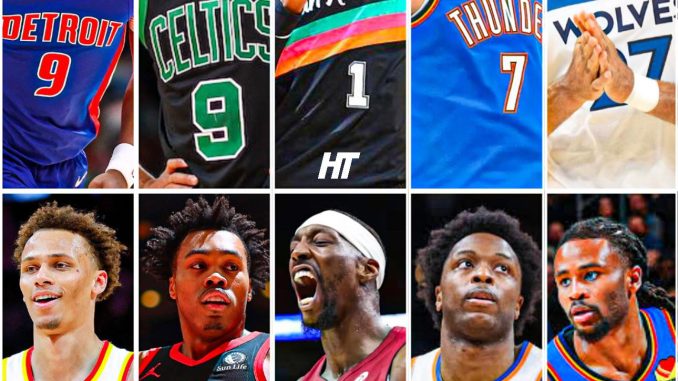
The NBA’s defensive landscape has officially entered a new era, and the 2025-26 Kia NBA All-Defensive First Team announcement confirmed what fans around the league have been witnessing all season: the next generation of elite stoppers has arrived. Led by Victor Wembanyama and Rudy Gobert, the newly unveiled First Team represents a fascinating blend of established dominance and emerging superstardom, signaling a dramatic shift in how defense is shaping the modern NBA.
Joining Wembanyama and Gobert on the First Team were Chet Holmgren, Derrick White, and Ausar Thompson, a group that perfectly captures the league’s changing identity. Length, versatility, rim protection, switchability, and relentless perimeter pressure have become the defining traits of elite defenses, and no collection of players embodied that more than this year’s honorees. (NBA)
For years, the NBA was dominated by offensive explosions, pace-and-space systems, and historic scoring outputs. But the 2025-26 season became a reminder that championship aspirations are still rooted in defensive excellence. Teams with elite defenders controlled the standings, dictated playoff series, and imposed physicality in a league increasingly built around spacing and skill. This year’s All-Defensive selections reflected that reality.
At the center of it all stood Wembanyama, the generational defensive force who has rapidly transformed from promising prospect into arguably the most terrifying defender basketball has seen in decades. The San Antonio Spurs superstar was not only named Defensive Player of the Year earlier this month, but he also became the only unanimous First Team selection, earning all 100 First Team votes from the global media panel. (FOX Sports)
Wembanyama’s rise has been nothing short of historic. At just 22 years old, the French phenom already controls games defensively in ways rarely seen in NBA history. Opponents altered offensive schemes simply to avoid him. Guards refused to attack the rim. Coaches redesigned late-game possessions because of his reach and anticipation. His defensive influence went beyond blocks and steals; it reshaped the geometry of the court.
The Spurs’ franchise centerpiece finished the season averaging an NBA-leading 3.1 blocks per game while anchoring one of the league’s fastest-rising defenses. He combined elite timing with unprecedented mobility for a player standing over seven feet tall. Unlike traditional rim protectors, Wembanyama comfortably switched onto guards, disrupted passing lanes, and erased transition opportunities before they developed. (Reuters)
His defensive instincts have become so advanced that many around the league now view him as the defining defender of the next decade. Several analysts have already begun comparing his impact to legends such as Hakeem Olajuwon, Kevin Garnett, and Tim Duncan, but Wembanyama’s combination of size and mobility arguably creates an entirely different archetype.
What made this All-Defensive announcement even more compelling was the inclusion of Holmgren, whose emergence alongside Wembanyama has quickly become one of the NBA’s defining rivalries. The Oklahoma City Thunder big man earned First Team honors after a season in which he established himself as one of basketball’s premier two-way players. (The Slipper Still Fits)
Holmgren’s defensive evolution was instrumental to Oklahoma City’s rise into a Western Conference powerhouse. While much attention focused on the Thunder’s offensive brilliance, Holmgren’s rim protection and positional awareness gave the team its true identity. He averaged nearly two blocks per game, contested shots at an elite rate, and consistently shut down pick-and-roll actions with his length and anticipation.
What separates Holmgren from many traditional centers is his fluidity. He moves like a wing while protecting the rim like an elite center. That versatility has become invaluable in postseason basketball, where defensive adaptability often determines playoff success. Holmgren’s presence allowed Oklahoma City to switch schemes seamlessly without sacrificing interior protection.
The timing of the announcement added even more intrigue because Holmgren and Wembanyama are currently battling in the Western Conference Finals, a matchup many believe could define the NBA’s future. Their duel represents more than a playoff series; it symbolizes a new generation of dominant two-way stars redefining what modern big men can accomplish. (Yahoo Sports)
While Wembanyama and Holmgren represent the league’s future, Gobert’s inclusion reminded everyone that defensive greatness still demands respect regardless of age or narrative fatigue. The veteran center from the Minnesota Timberwolves earned yet another First Team nod, further cementing his Hall of Fame legacy as one of the greatest defenders the league has ever seen. (Hoops Rumors)
Gobert’s career has often been polarizing among fans, especially in an era obsessed with offensive versatility. Yet season after season, the numbers continue validating his impact. Minnesota once again finished among the NBA’s elite defensive teams largely because Gobert controlled the paint with unmatched discipline and positioning.
Even as younger stars dominate headlines, Gobert remains the standard for interior defense. His ability to organize defensive coverages, deter drives, and dominate the glass still separates him from most centers in basketball. This latest selection marked another milestone in a résumé already featuring multiple Defensive Player of the Year awards and a long list of All-Defensive honors. (Hoops Rumors)
Then there was Derrick White, perhaps the most underappreciated elite defender in basketball. The Boston Celtics guard finally broke through to earn his first All-Defensive First Team selection after years of being considered one of the league’s most impactful perimeter defenders. (CelticsBlog)
White’s brilliance lies in the subtle details. He may not possess the overwhelming physical gifts of Wembanyama or Holmgren, but his anticipation, effort, and timing make him a nightmare for opposing guards. He consistently blows up offensive actions before they fully develop, rotates flawlessly, and contests shots with remarkable discipline.
This season, White elevated his game even further. He led all NBA guards in blocks, an astonishing statistic considering the size disadvantage he faces nightly. His rim contests, chase-down recoveries, and ability to defend multiple positions became essential to Boston’s defensive identity. (CelticsBlog)
In many ways, White symbolizes the evolution of modern guard defense. Today’s elite perimeter defenders must navigate endless screens, switch onto bigger players, defend in space, and still generate turnovers. White mastered all of it.
Perhaps the most exciting story among the First Team selections belonged to Ausar Thompson of the Detroit Pistons. Thompson’s inclusion signaled the official arrival of one of basketball’s brightest young defensive stars. (Bleacher Report)
From the opening weeks of the season, Thompson established himself as a relentless defensive disruptor. His athleticism, wingspan, and motor allowed him to guard virtually every position on the floor. He pressured ball handlers, jumped passing lanes, chased down loose balls, and consistently shifted momentum through defensive energy alone.
What makes Thompson especially dangerous is his versatility. Few young players possess his combination of physical tools and defensive instincts. He can defend point guards on the perimeter one possession and battle power forwards in the paint the next. That flexibility has become incredibly valuable in today’s NBA, where offenses constantly hunt mismatches.
Detroit’s resurgence this season owed much to Thompson’s defensive transformation. The Pistons developed a tougher identity, and Thompson quickly became the emotional engine behind it. Coaches around the league repeatedly praised his competitiveness and willingness to embrace difficult defensive assignments nightly.
The Second Team selections were equally impressive and reinforced just how deep the NBA’s defensive talent pool has become. Bam Adebayo, Scottie Barnes, Dyson Daniels, OG Anunoby, and Cason Wallace all earned recognition for exceptional defensive campaigns. (Reuters)
Adebayo continued proving why he remains one of the league’s most versatile defenders. The Miami Heat star can switch onto guards, defend centers, and quarterback an entire defense simultaneously. Barnes evolved into Toronto’s defensive anchor, while Daniels emerged as one of the NBA’s premier perimeter pests with the Atlanta Hawks.
Anunoby’s inclusion highlighted his continued excellence for the New York Knicks. Widely regarded as one of basketball’s most physically imposing wing defenders, he consistently neutralized elite scorers throughout the season. Meanwhile, Wallace’s emergence with Oklahoma City further emphasized the Thunder’s defensive dominance, giving the franchise multiple All-Defensive representatives. (Posting and Toasting)
What stood out most from this year’s selections was the overwhelming presence of youth. Wembanyama, Holmgren, Thompson, Barnes, Wallace, and Daniels all represent a rapidly evolving defensive generation. They are longer, faster, more versatile, and more comfortable defending in space than previous eras.
The NBA’s transition toward positionless basketball has forced defenders to adapt. Gone are the days when centers only protected the paint and guards only chased shooters. Today’s elite defenders must do everything. They must protect the rim, defend the perimeter, communicate rotations, and survive endless switching schemes.
This year’s All-Defensive teams reflected that transformation perfectly.
At the same time, veterans like Gobert, White, Adebayo, and Anunoby demonstrated that experience still matters immensely on the defensive end. Communication, discipline, and understanding tendencies remain critical components of elite team defense.
Another fascinating element of the voting was the growing emphasis on postseason impact. Several players elevated their reputations during deep playoff runs, reinforcing the idea that defensive excellence becomes even more valuable when games slow down in May and June.
The Western Conference Finals matchup between the Spurs and Thunder has especially amplified the spotlight on Wembanyama and Holmgren. Their defensive battles have already become must-watch television, with each possession showcasing elite shot contests, recovery speed, and rim deterrence rarely seen from players their age.
Around the league, executives increasingly believe the future of championship basketball will revolve around these versatile defensive giants. Offensive skill remains essential, but teams capable of controlling the paint while still switching defensively possess a massive advantage in the modern game.
That reality has changed roster construction across the NBA. Franchises are prioritizing length, versatility, and defensive IQ more than ever before. Players like Wembanyama and Holmgren have accelerated that shift by proving that elite rim protection no longer requires sacrificing perimeter mobility.
The 2025-26 All-Defensive Teams ultimately represented more than individual recognition. They offered a glimpse into the NBA’s evolving future. Defense is no longer simply about physicality or shot blocking; it is about versatility, anticipation, adaptability, and the ability to disrupt offenses across all areas of the floor.
And at the center of this revolution stands Wembanyama, the league’s newest defensive superstar, already redefining what basketball’s highest level can look like.
But he is not alone.
Holmgren is rising. Thompson is emerging. Wallace is developing. Barnes continues improving. Daniels is becoming elite. The next wave has arrived, and they are transforming defense into the NBA’s newest art form.
For years, fans questioned whether defense still mattered in an offense-driven era. The 2025-26 All-Defensive Teams provided a powerful answer.
Defense is alive, thriving, and being reinvented by a fearless new generation of stars. (NBA)
Be the first to comment