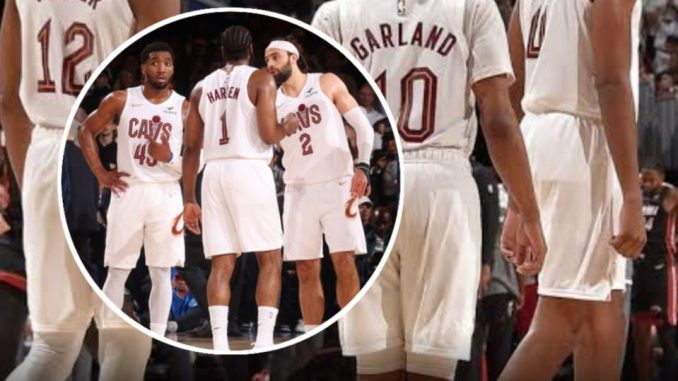
The mood inside the Cleveland Cavaliers’ locker room has shifted quickly from frustration to resolve, and now to a carefully controlled belief that the series is still very much alive.
After a tough Game 2 defeat on the road that saw the Cavaliers fall short against the New York Knicks, the message from the top of the organization was unmistakable. The team’s governor, often referred to within the franchise circle simply as “Cavs Gov,” delivered a rallying cry aimed at steadying the locker room, calming the noise outside, and refocusing attention on what lies ahead: a pivotal Game 3 at home in Cleveland.
For a franchise that has spent the past several seasons trying to re-establish itself as a consistent Eastern Conference contender, the stakes are familiar but no less intense. The Cavaliers now trail in the series after back-to-back losses in New York, including a decisive Game 2 defeat that exposed both tactical gaps and emotional fatigue in a young roster still learning how to navigate the unforgiving rhythm of playoff basketball.
The most recent loss, a 109–93 defeat to the Knicks, was not just another mark in the loss column. It was a performance that raised questions about Cleveland’s offensive identity under pressure, their ability to generate clean looks against a disciplined defense, and their capacity to respond when a home crowd begins to sense control slipping away.
The Knicks, led by their physical defensive schemes and the steady orchestration of their backcourt leadership, have imposed a tempo that has clearly disrupted Cleveland’s flow. In both Games 1 and 2, the Cavaliers struggled to establish consistent half-court execution, often settling for contested mid-range shots or rushed perimeter attempts as possessions broke down late in the clock.
But if the scoreboard told one story, the response from inside the Cavaliers’ leadership structure told another.
“Cavs Gov,” speaking through a team message circulated internally and echoed by leadership voices within the organization, emphasized resilience over reaction. The message was not about panic or blame, but about control, composure, and home-court recalibration.
“This is exactly where we said we wanted to be when the season started,” the message reportedly conveyed in tone rather than direct quotation. “You don’t get to the Eastern Conference Finals without facing adversity. Now we respond where it matters most—at home, together.”
That sentiment has resonated within a locker room that still carries the imprint of a rebuilding phase, even as expectations have rapidly escalated following their deep playoff run. The Cavaliers are no longer simply a developing team; they are now measured against the standard of contenders, where adjustments are immediate and excuses are nonexistent.
The challenge ahead is clear. Game 3 shifts to Cleveland, where the Cavaliers have traditionally played with more energy, sharper execution, and a noticeably improved defensive identity. The home crowd at Rocket Mortgage FieldHouse is expected to play a significant role in resetting momentum, especially for a team that thrives on transition bursts and emotional rhythm.
But the Knicks are not an opponent that easily allows momentum swings.
Under pressure, New York has consistently leaned into its physicality, rebounding discipline, and structured offensive sets that slow games into calculated possessions. Their ability to absorb runs and respond with timely scoring has been a defining feature of this series so far. In both wins, they have neutralized Cleveland’s attempts to speed up the pace, forcing the Cavaliers into a half-court grind that exposes their inexperience in late-clock decision-making.
For Cleveland, the focus now turns to adjustments that go beyond X’s and O’s. The Cavaliers need more than tactical tweaks—they need emotional stability across four quarters.
Star players must find cleaner entry points into their offense, particularly when primary actions are denied. Ball movement must improve against switching schemes that have consistently forced isolation-heavy possessions. And perhaps most importantly, defensive communication must tighten, as breakdowns in rotation have repeatedly given the Knicks easy looks at critical moments.
The Cavaliers’ frontcourt, which has battled physical interior defense throughout the series, will be central to Game 3’s outcome. Establishing paint presence early will not only open perimeter opportunities but also prevent New York from loading up aggressively on perimeter creators.
There is also the matter of pacing. Cleveland has oscillated between pushing transition opportunities and slowing down into structured sets, but inconsistency in tempo has played directly into New York’s hands. Game 3 demands a more deliberate identity: either fully commit to pushing pace before the defense sets, or embrace controlled execution with purposeful spacing. The in-between has proven costly.
Still, despite the concerns, belief remains intact within the organization.
League sources around the Cavaliers describe the locker room environment as “focused, not fractured.” The message from leadership has not been one of overhaul but of refinement. Small corrections, sharper execution, and emotional consistency are the pillars being emphasized heading into the first home game of the series.
The Cavaliers know the stakes are not just about avoiding a deeper deficit—they are about reclaiming narrative control. A 3–0 series hole would place them on the brink of elimination against a Knicks team that has shown no signs of loosening its grip once it establishes control. A Game 3 win, however, changes the entire tone of the series and restores belief that Cleveland’s core can withstand playoff pressure at the highest level.
On the other side, the Knicks are expected to arrive in Cleveland with confidence but not complacency. Their Game 2 performance was one of controlled dominance rather than explosive separation, a sign that their system is functioning exactly as intended. They have dictated physical matchups, controlled rebounding margins, and forced Cleveland into uncomfortable offensive patterns.
Yet playoff series often pivot not on dominance, but on response.
The Cavaliers’ opportunity in Game 3 is not simply to win—it is to disrupt rhythm. To force the Knicks into adjustments they have not yet had to make. To introduce variables into a series that has, so far, followed New York’s preferred script.
For Cleveland’s coaching staff, film sessions leading into Game 3 have reportedly centered on offensive spacing clarity and defensive recovery speed. Miscommunications that led to open corner threes and second-chance opportunities in Game 2 have been highlighted repeatedly. The margin for error now is minimal.
The Cavaliers also face the psychological challenge of avoiding overcorrection. In high-pressure playoff environments, teams often swing too far in response to losses—abandoning core principles in favor of reactive adjustments. Cleveland’s internal message has been to avoid that trap. Stick to identity, refine execution, and trust home energy.
The return to Cleveland is expected to bring a different atmosphere entirely. Playoff crowds in the city have historically elevated the Cavaliers’ defensive intensity, and Game 3 will likely require that edge. Every possession will carry added weight, every defensive stop will be amplified, and every run will have the potential to swing series momentum.
For the Knicks, the challenge will be to withstand that surge and reassert control early. If they can weather the opening emotional wave, their structured style gives them a strong chance to extend their series lead. But if Cleveland finds rhythm early, the entire complexion of the matchup shifts.
This is where playoff narratives are often rewritten—not in sweeping declarations, but in the subtle swing of a single game that restores belief or deepens doubt.
The Cavaliers know this better than most. They have lived through series where momentum vanished in a single quarter and others where resilience turned pressure into opportunity. Game 3 now sits at that exact intersection.
For “Cavs Gov,” the message has already been delivered. For the players, the response will need to be delivered on the court.
The series is no longer about what has happened in New York. It is about what Cleveland chooses to make of its return home.
Be the first to comment