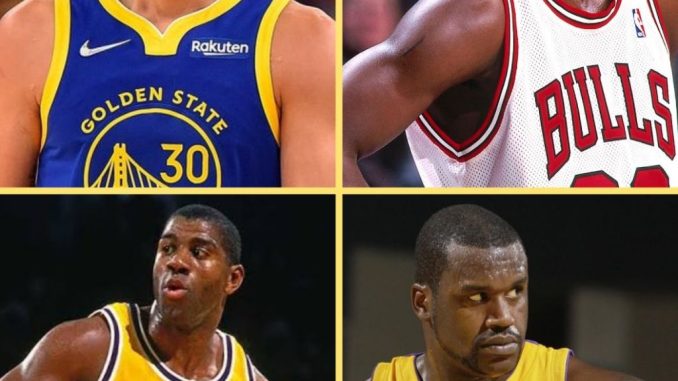
For decades, the NBA’s greatest-of-all-time debate seemed permanently carved in stone. Six championships. Six Finals MVPs. Global superstardom. Ruthless competitiveness. The aura. The mythology. The legend of Michael Jordan stood untouched atop basketball’s mountain, with every generation measuring greatness against the standard he created during the 1990s dynasty run with the Chicago Bulls. But basketball has evolved, and with evolution comes a new wave of voices challenging the traditional hierarchy. At the center of that modern argument is Stephen Curry, the revolutionary superstar whose shooting brilliance transformed not only how basketball is played, but also how greatness itself is discussed.
Now, the debate consuming fans across sports television, podcasts, social media, and barbershops has taken on a fresh identity: “MJ’s Rings or Steph’s Range?” It is no longer simply about championships versus statistics. It is about influence versus dominance, revolution versus perfection, artistry versus intimidation. NBA fans everywhere are sounding off on whether Curry’s unprecedented offensive impact deserves to elevate him into the same mythical territory long occupied by Jordan alone.
The conversation intensified following another postseason run that reminded fans just how deeply Curry’s fingerprints remain embedded in the modern NBA. Even as younger stars dominate headlines and the league transitions into a new era led by talents such as Victor Wembanyama, Shai Gilgeous-Alexander, and Jalen Brunson, Curry’s legacy continues to grow. Every deep three-pointer from a rising high school prospect, every offense built around spacing, every center learning to shoot from the perimeter traces back to the cultural and tactical earthquake Curry unleashed with the Golden State Warriors.
Still, Jordan supporters remain unmoved.
To many basketball purists, the GOAT debate starts and ends with championships and Finals perfection. Jordan’s six titles in six Finals appearances represent the sport’s gold standard. His scoring dominance, defensive excellence, MVP trophies, and unmatched competitive fury built a résumé that generations of players have struggled to approach. Fans who grew up during the Bulls dynasty often describe Jordan less as an athlete and more as an experience — a player whose mere presence could psychologically dismantle opponents before games even began.
Supporters of Jordan frequently point toward the totality of his dominance. He was not only the best scorer in basketball but also an elite defender, winning Defensive Player of the Year while capturing scoring titles. He elevated the NBA into a global phenomenon, becoming perhaps the most recognizable athlete on Earth during the 1990s. From signature moments like “The Shot” over Craig Ehlo to the Flu Game and his iconic final jumper against the Utah Jazz, Jordan’s career became a collection of basketball mythology.
For Jordan loyalists, Curry’s brilliance still falls short because the Warriors superstar lacks the complete two-way dominance and undefeated Finals résumé that define MJ’s legacy. Many fans argue that influence alone cannot outweigh ultimate accomplishment. They see Jordan’s era as more physical, more punishing, and less dependent on offensive freedom than today’s perimeter-oriented game.
Yet Curry supporters counter with a powerful argument of their own: no player in basketball history has bent the geometry of the sport the way Curry has.
The numbers behind Curry’s shooting revolution are staggering. Defenses now routinely pick him up near half court. Entire game plans revolve around preventing him from touching the basketball. Coaches have redesigned offensive philosophies across every level of basketball because of the gravity he creates simply by existing on the floor. Before Curry, shooting from 30 feet was viewed as reckless. After Curry, it became a weapon.
Fans defending Curry’s GOAT candidacy often emphasize that his impact extends beyond statistics or rings. They believe basketball history can be divided into two eras: before Curry and after Curry. That type of transformational influence, they argue, deserves unprecedented recognition.
Former players have joined the discussion as well. Some older legends remain loyal to Jordan’s traditional dominance, while younger players openly acknowledge Curry as the athlete who most inspired their generation. Children in driveways no longer yell “Jordan!” after fadeaway jumpers as often as previous generations did. Instead, they launch deep threes while shouting “Curry!” — a reflection of how thoroughly he changed basketball culture.
The debate also reveals a broader generational divide in how greatness is measured. Older fans tend to prioritize championships, physical dominance, killer instinct, and individual accolades. Younger fans increasingly value offensive innovation, efficiency, skill versatility, and transformational impact. Jordan symbolizes basketball excellence in its most ruthless form. Curry represents basketball creativity at its highest level.
Social media has amplified every side of the argument. Highlight clips comparing Jordan’s acrobatic finishes to Curry’s impossible three-pointers circulate daily. Statistical threads analyze efficiency, spacing, playoff performances, and advanced metrics. Some fans insist Curry would struggle against the hand-checking defenses of Jordan’s era, while others argue Jordan would thrive even more in today’s spacing-heavy NBA.
The beauty of the debate lies partly in its impossibility. Jordan and Curry are not merely different players; they are different basketball philosophies.
Jordan overwhelmed opponents through relentless physical and mental dominance. He attacked the rim with violence, controlled the mid-range game with surgical precision, and treated every challenge like a personal insult. Curry, meanwhile, dismantles defenses with movement, rhythm, anticipation, and range that appears almost supernatural. Jordan often inspired fear. Curry inspires disbelief.
One argument frequently raised in Curry’s favor centers around team construction and competitive balance. Critics of Jordan point out that he spent the prime of his career alongside Scottie Pippen under the guidance of legendary coach Phil Jackson. Curry supporters argue that while the Warriors dynasty was undeniably stacked, modern NBA competition is also significantly deeper and more globally talented than during the 1990s.
Jordan fans immediately push back on that notion by highlighting the psychological dominance the Bulls carried throughout the league. Opponents entered playoff series already expecting defeat. That intimidation factor became part of Jordan’s legend. The moment he sensed weakness, games often felt over before the final buzzer.
The GOAT conversation has also become intertwined with another basketball titan: LeBron James. For years, LeBron represented the primary challenger to Jordan’s throne. His longevity, all-around brilliance, and statistical dominance created perhaps the strongest résumé the league had ever seen outside of MJ. But Curry’s sustained excellence and cultural influence have now complicated the hierarchy even further.
Interestingly, Curry’s supporters often frame his case differently from LeBron’s. LeBron arguments usually center on total career production and versatility. Curry’s case is more philosophical. It asks whether changing basketball itself can outweigh traditional markers of greatness.
There is also the matter of aesthetics. Basketball fans are naturally drawn to beauty and imagination, and Curry’s game embodies both. His off-ball movement resembles choreography. His release is lightning quick. His ability to shoot accurately from impossible distances creates moments that feel more like magic tricks than athletic feats. In an entertainment-driven sports culture, Curry’s style resonates profoundly with modern audiences.
Jordan, however, possessed an artistry of his own. His fadeaway jumper became a symbol of perfection. His hang time at the rim appeared almost supernatural during his athletic peak. Every movement carried intensity and purpose. To many fans, Jordan was not simply dominant — he was cinematic.
The NBA itself has benefited enormously from the debate. Greatness arguments fuel engagement across generations and keep legends relevant long after retirement. Young fans discovering Jordan through documentaries and archival footage gain appreciation for the history of the game, while older fans watching Curry reshape basketball are forced to reconsider long-held beliefs about what greatness looks like.
Even analysts remain divided.
Some believe Jordan’s flawless Finals résumé ends all discussion. Others argue that basketball greatness cannot be reduced to championship counting alone, especially in a team sport shaped heavily by organizational structure, coaching, injuries, and era-specific circumstances. Advanced analytics have further complicated comparisons across generations, creating endless debates about pace, efficiency, spacing, and defensive rules.
One particularly compelling aspect of Curry’s rise in GOAT conversations is how unlikely it once seemed. Early in his career, questions surrounded his durability and physical profile. Scouts doubted whether his slight frame could withstand NBA punishment. Few imagined he would become the face of a basketball revolution. Jordan, by contrast, entered the league carrying superstar expectations almost immediately.
That underdog narrative strengthens Curry’s connection with fans. He feels accessible in ways Jordan never did. While almost nobody could replicate Jordan’s gravity-defying athleticism, millions of young players believe they can imitate Curry by practicing shooting. Whether realistic or not, that relatability matters culturally.
At the same time, Jordan’s mystique remains unmatched. Stories from former teammates and opponents continue to reinforce his almost mythical competitiveness. Tales of trash talk, practice battles, and psychological warfare have become legendary throughout basketball circles. For many fans, greatness is inseparable from that aura.
Perhaps the most fascinating truth within the debate is that both players fundamentally changed what future generations aspire to become.
Jordan inspired athletes to pursue total dominance. Curry inspired athletes to reimagine possibility.
Jordan made players want to conquer opponents. Curry made players want to expand the game itself.
As NBA history continues unfolding, the conversation may only become more complicated. New stars are already redefining basketball in their own ways. Wembanyama’s unprecedented combination of size and skill has some executives calling him the future blueprint of the sport. International talent continues reshaping the league’s identity. Positionless basketball evolves further each season.
Yet even amid the league’s constant transformation, Jordan and Curry remain central reference points in basketball culture. One represents the ultimate standard of winning excellence. The other represents the ultimate expression of basketball evolution.
In many ways, the debate says as much about fans as it does about the players themselves. People tend to gravitate toward the version of greatness that reflects what they value most. Those who admire ruthless competitiveness, flawless execution, and championship supremacy lean toward Jordan. Those captivated by innovation, joy, creativity, and transformative influence often side with Curry.
Neither side appears willing to surrender ground anytime soon.
Across arenas, social platforms, television panels, and podcasts, the argument continues growing louder. Every Curry three-pointer from near half court sparks another wave of comparisons. Every Jordan documentary clip reignites appreciation for his impossible dominance. Fans dissect eras, teammates, rules, statistics, and intangible qualities with near-religious passion.
And perhaps that enduring passion is the clearest sign of both players’ greatness.
Because the truth is that very few athletes transcend sports strongly enough to become symbols of entirely different basketball ideals. Jordan did it through competitive perfection. Curry did it through revolutionary imagination.
So when fans ask, “MJ’s Rings or Steph’s Range?” they are really asking a deeper question about how greatness should be remembered.
Is the greatest player the one who ruled basketball most completely?
Or the one who changed basketball forever?
For now, the answer depends entirely on who you ask.
Be the first to comment