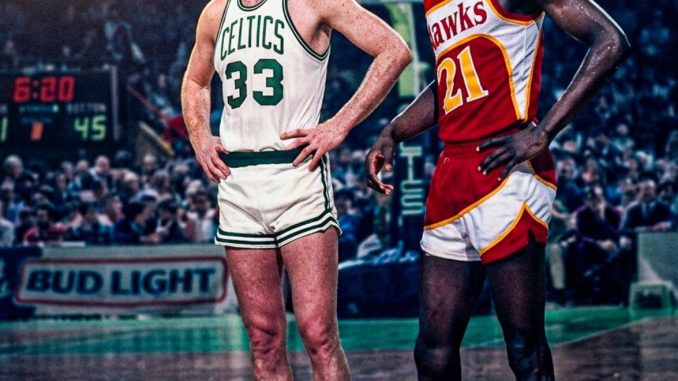
The spring of 1988 produced one of the most unforgettable postseason duels in NBA history, a Game 7 masterpiece that still echoes through basketball lore nearly four decades later. Inside the old Boston Garden, under suffocating heat and relentless pressure, two of the game’s greatest scorers delivered performances that transcended the stakes of the moment. Larry Bird and Dominique Wilkins transformed an Eastern Conference semifinal into something far greater than a playoff game. It became a heavyweight fight between legends, a display of brilliance so breathtaking that even those on the floor understood they were witnessing basketball immortality unfold in real time.
The series between the Boston Celtics and the Atlanta Hawks had already been emotionally draining before Game 7 ever tipped off. Boston entered the postseason carrying championship expectations after years of dominance in the Eastern Conference. Atlanta, meanwhile, was desperate to prove it belonged among the NBA elite. The Hawks possessed one of the league’s most electrifying stars in Wilkins, whose aerial artistry and fearless scoring had made him a sensation throughout the decade. Yet critics still questioned whether his greatness could truly translate into playoff glory.
Boston had championship pedigree. Atlanta had hunger. What followed was seven games of escalating tension that culminated in one of the greatest individual battles ever staged on a basketball court.
By the time the decisive seventh game arrived on May 22, 1988, exhaustion had already settled into both teams. The Celtics were aging but proud, anchored by Bird’s genius and the bruising interior play of Kevin McHale and Robert Parish. The Hawks countered with speed, athleticism, and Wilkins’ relentless scoring machine. The tension inside Boston Garden was suffocating before the opening tip even arrived. Fans understood the magnitude of the occasion. Game 7s already carried mythic weight in basketball history, but this one somehow felt even larger.
From the opening minutes, Bird and Wilkins established that the night would belong to them.
Wilkins attacked first. Explosive, fearless, and impossible to contain in transition, he carved through the Celtics’ defense with an aggression that immediately silenced parts of the Garden crowd. Pull-up jumpers, soaring drives, impossible finishes through contact — Wilkins looked determined to drag Atlanta into the Eastern Conference Finals by sheer force of will. Every basket seemed to carry extra venom, as though years of criticism had fueled his performance.
Bird responded the way only Bird could.
There was no wasted movement, no dramatic flair. Bird simply dissected the game with ruthless efficiency. He buried contested jumpers, threaded impossible passes, and manipulated every inch of the floor like a grandmaster controlling a chessboard. While Wilkins overwhelmed opponents with athletic brilliance, Bird dismantled defenses with intellect and precision.
The contrast between the two superstars made the showdown even more captivating. Wilkins soared. Bird calculated. One attacked with thunder, the other with cold-blooded execution.
Neither could be stopped.
The game itself swung wildly. Boston’s experience appeared ready to seize control one moment, only for Atlanta’s energy to surge back the next. Every possession carried enormous weight, and every basket from Bird or Wilkins sent another shockwave through the arena.
Wilkins was magnificent throughout the first three quarters, but the fourth quarter elevated the contest into basketball mythology.
With the season hanging in the balance, Wilkins erupted into one of the greatest scoring stretches the playoffs had ever seen. He attacked the Celtics from every angle imaginable, draining jumper after jumper while repeatedly shredding defenders off the dribble. Boston threw multiple defenders at him. Nothing mattered. Wilkins was operating at a level where even perfect defense became irrelevant.
The Garden crowd, notoriously hostile to opponents, found itself stunned into silence during portions of Wilkins’ rampage. The Hawks star scored 16 points in the fourth quarter alone, each basket escalating the tension further. Every time Boston seemed ready to gain breathing room, Wilkins answered with another impossible shot.
Yet Bird somehow matched him.
That remains the enduring image of Game 7: two transcendent players refusing to blink. Bird repeatedly answered Wilkins’ explosions with daggers of his own. Mid-range jumpers, turnaround fadeaways, deep outside shots — Bird unleashed every weapon in his arsenal at precisely the moment Boston needed him most.
The fourth quarter became less about team basketball and more about two legends trading blows in front of a horrified and mesmerized audience.
Wilkins would score. Bird would answer.
Bird would hit a jumper. Wilkins would respond with something even tougher.
Possession after possession, the intensity rose. Players on both sides later admitted they felt as though they were merely spectators watching history unfold between two unstoppable forces.
Bird’s greatness had always extended beyond statistics. What separated him from nearly everyone else in basketball history was his complete fearlessness in the game’s biggest moments. He wanted the pressure. He embraced it. In Game 7 against Atlanta, that mentality surfaced once again.
Late in the fourth quarter, with Boston desperately trying to avoid elimination on its home floor, Bird delivered the sequence that permanently cemented the game’s legendary status. He erupted for 20 fourth-quarter points, many coming on brutally difficult shots under immense defensive pressure. Time and again, Bird hunted the decisive moment instead of avoiding it.
One jumper from the left side gave Boston momentum. Another from the baseline pushed the Celtics ahead. Then came a devastating three-pointer that ignited the Garden into chaos.
Wilkins never backed down.
The Hawks superstar continued attacking until the final minutes, ultimately finishing with an astonishing 47 points. It remains one of the greatest Game 7 performances ever produced by a losing player. Wilkins shot with supreme confidence, elevating over defenders and absorbing physical punishment without hesitation. For stretches, it genuinely appeared he might single-handedly eliminate the defending Eastern Conference powerhouse.
But Bird was simply transcendent.
He matched Wilkins with 34 points of his own while controlling every facet of the game. Beyond scoring, Bird rebounded, facilitated offense, and orchestrated Boston’s composure under crushing pressure. His leadership steadied the Celtics whenever chaos threatened to consume them.
Most importantly, Bird delivered when the stakes peaked highest.
As the final minutes ticked away, Boston gradually wrestled control of the contest through execution and experience. The Celtics understood how to survive these moments because they had lived them repeatedly throughout the decade. Atlanta fought brilliantly, but championship DNA eventually tilted the game.
Boston escaped with a 118-116 victory, though the final score hardly captured the emotional exhaustion left behind. Players collapsed into embraces as the Garden erupted in relief more than celebration. The Celtics had survived, barely.
Yet the aftermath of the game centered less on Boston advancing and more on the astonishing brilliance displayed by Bird and Wilkins.
Even among the countless legendary playoff performances scattered throughout NBA history, this duel occupies rare territory. Fans have witnessed iconic scoring explosions before. They have seen Game 7 classics and superstar showdowns. But few contests combined the pressure, talent, atmosphere, and sustained excellence quite like Boston versus Atlanta in 1988.
Bird himself later acknowledged the extraordinary nature of Wilkins’ performance. That respect mattered because Bird rarely handed out compliments lightly. He understood greatness when he saw it, and Wilkins had produced basketball greatness on the grandest possible stage.
For Wilkins, the game became both heartbreaking and defining.
Despite the loss, his legacy emerged strengthened rather than diminished. For years, critics unfairly portrayed him as merely a spectacular dunker or regular-season entertainer. Game 7 destroyed those narratives. Against one of the greatest dynasties in NBA history, under suffocating pressure, Wilkins proved he possessed the heart and scoring brilliance necessary for playoff warfare.
His 47-point masterpiece became immortal precisely because it came against Bird and the Celtics inside Boston Garden. There was no easy stage, no weakened opponent, no reduced stakes. Wilkins delivered his career-defining playoff performance in the most hostile environment imaginable.
Bird’s legacy, meanwhile, only grew larger.
By 1988, Bird had already established himself as one of basketball’s all-time greats. Multiple championships, MVP awards, and countless clutch moments had elevated him into rare company. Yet Game 7 against Atlanta reinforced why so many players from that era still describe Bird with near-mythological reverence.
He consistently rose to the occasion when pressure became unbearable.
There was something psychologically devastating about Bird for opponents. Even when teams defended him perfectly, he remained utterly convinced he would win. That confidence permeated the Celtics throughout the 1980s and helped fuel one of basketball’s greatest dynasties.
The battle with Wilkins showcased another essential truth about Bird: he thrived against greatness. Rather than shrinking when another superstar caught fire, Bird elevated himself further. Wilkins forced Bird into one of the greatest fourth quarters of his career because Bird refused to surrender the stage.
The game also symbolized a changing NBA landscape.
The Celtics represented the hardened, physical, fundamentally dominant basketball that had ruled much of the decade. The Hawks, led by Wilkins, embodied the league’s growing emphasis on athleticism and explosive individual scoring. Their clash felt like a collision between eras, styles, and philosophies.
For younger generations who never witnessed the game live, highlights alone cannot fully capture the atmosphere inside Boston Garden that afternoon. The crowd noise, the physicality, the visible fatigue on players’ faces, and the raw emotional stakes combined to create something uniquely unforgettable.
Modern playoff basketball often emphasizes spacing and pace. Game 7 in 1988 felt more primal. Every possession resembled combat. Every shot carried emotional consequences. Players fought through contact that would routinely draw fouls today, and stars routinely played massive minutes without relief.
Bird and Wilkins embraced that brutality.
Neither sought escape from responsibility. Instead, both demanded the ball repeatedly as exhaustion mounted. Their willingness to continue attacking under immense physical and mental strain remains one of the game’s defining characteristics.
The duel has since become a treasured chapter in NBA history, replayed endlessly whenever conversations arise about the greatest playoff performances ever witnessed. Historians, former players, and fans still reference it as the gold standard for superstar battles under pressure.
What makes the game timeless is not simply the scoring totals. It is the emotional intensity attached to every basket. Statistics alone cannot explain why the contest continues resonating nearly 40 years later. Countless players have scored huge numbers in playoff games. Very few have done so while trading punches with another all-time legend in a winner-take-all environment.
Bird versus Wilkins represented basketball at its purest competitive level.
There were no shortcuts, no superteams engineered through free agency, and no manufactured narratives. Just two extraordinary players dragging everything they possessed onto the floor with a season at stake.
The Celtics eventually advanced to the Eastern Conference Finals before falling to the eventual champion Detroit Pistons in another grueling series. Atlanta’s season ended in heartbreak. But history ultimately remembered both teams because of Game 7.
Years later, Bird and Wilkins remain forever linked because of that afternoon in Boston.
For Bird, it became another jewel in a career overflowing with legendary moments. For Wilkins, it became proof that greatness is not always measured by championships alone. Sometimes greatness emerges through courage, brilliance, and the refusal to surrender even in defeat.
That is why Game 7 in 1988 still occupies sacred ground within basketball history.
It was more than a playoff game. It was artistry under pressure. It was competitive fire at its absolute peak. It was two Hall of Famers pushing each other toward basketball immortality possession after possession.
And when it finally ended, exhausted players and stunned fans understood they had witnessed something extraordinarily rare: a game where both sides left the floor larger than when they entered it, where defeat could not diminish greatness, and where two legends combined to create one of the NBA’s most unforgettable masterpieces.
Be the first to comment