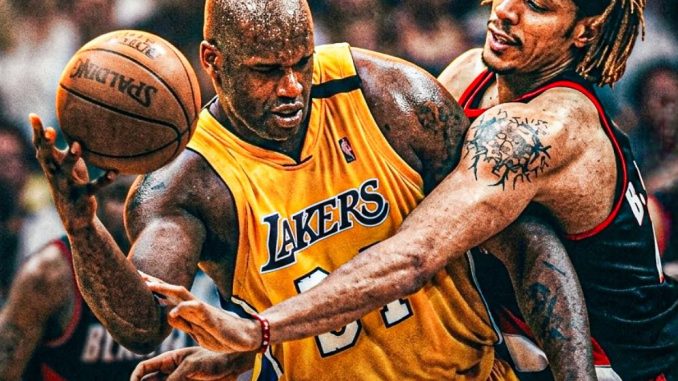
Twenty-six years ago, the bright lights of the Western Conference Finals belonged entirely to one man. On a roaring night inside the Great Western Forum, Shaquille O’Neal delivered one of the most physically dominant playoff performances of his legendary career, overpowering the Portland Trail Blazers with a historic free-throw barrage as the Los Angeles Lakers captured Game 1 of the 2000 Western Conference Finals and announced themselves as a championship force ready to take over the league.
The matchup itself already carried enormous anticipation. The Lakers had stormed through the regular season under first-year head coach Phil Jackson, winning 67 games and entering the postseason as favorites to reach the NBA Finals. Across from them stood a rugged Portland team loaded with veterans, toughness, and defensive versatility. The Blazers featured stars like Scottie Pippen, Rasheed Wallace, Steve Smith, and Arvydas Sabonis, a deep and battle-tested group that many believed had the size and experience necessary to challenge Los Angeles.
Yet from the opening tip, everything revolved around Shaq.
At the height of his powers during the 1999–2000 season, O’Neal was already the most unstoppable interior force basketball had seen since the days of Wilt Chamberlain. He had bulldozed opponents throughout the year with a rare combination of size, agility, touch, and raw violence around the rim. Defenses routinely collapsed on him with double teams and triple teams, but very few could survive the punishment for four quarters.
Portland attempted every strategy imaginable in Game 1. The Blazers threw Sabonis at him. They sent Wallace to help. They crowded the paint and hacked relentlessly whenever O’Neal caught the ball near the basket. Nothing worked.
Instead, the fouling only became part of Shaq’s masterpiece.
The Lakers center lived at the free-throw line all night long, relentlessly attacking Portland’s frontcourt and forcing the Blazers into desperation mode. While teams often embraced the so-called “Hack-a-Shaq” strategy because of O’Neal’s inconsistency at the line, this night became one of the great playoff exceptions. Shaq responded to every foul with aggression, confidence, and surprising composure, turning a traditional weakness into the defining story of the game.
Each trip to the stripe seemed to energize him more.
The Forum crowd erupted every time he converted. Portland defenders grew increasingly frustrated. The physicality escalated possession after possession, but O’Neal refused to back down. He powered through contact for thunderous dunks, muscled defenders under the basket for second-chance points, and repeatedly forced the Blazers into foul trouble that completely altered the flow of the game.
By the end of the night, Shaq had delivered a stunning performance that combined brute force with playoff poise. His scoring explosion, fueled heavily by a massive free-throw total, powered the Lakers to a crucial Game 1 victory and immediately shifted momentum in the series toward Los Angeles.
What made the performance even more memorable was the context surrounding the Lakers at the time.
For years, critics questioned whether the Shaq-and-Kobe Bryant partnership could truly lead Los Angeles back to championship glory. Despite enormous talent, the Lakers had repeatedly fallen short in previous postseasons. Playoff collapses, chemistry questions, and coaching instability had prevented them from reaching the Finals during the late 1990s.
But the arrival of Phil Jackson changed the atmosphere entirely.
Jackson brought the championship pedigree he had established with the Chicago Bulls dynasty, along with the triangle offense that demanded trust, spacing, and discipline. More importantly, he empowered Shaq to fully embrace his dominance as the centerpiece of the franchise. The 2000 postseason became the ultimate payoff.
Against Portland, O’Neal looked less like a star and more like an unstoppable natural disaster.
Every possession carried a sense of inevitability. The deeper position he established in the paint, the more helpless the Blazers appeared. Sabonis, though highly skilled and enormously respected, struggled with Shaq’s strength and explosiveness. Wallace battled fiercely but found himself dragged into constant physical collisions. Portland’s rotating defenders often arrived too late, and when they did manage to foul O’Neal, he still punished them by converting enough free throws to make the strategy ineffective.
That was the psychological blow that truly devastated Portland.
Normally, teams accepted fouling Shaq as a necessary gamble. But when O’Neal began cashing in repeatedly from the line, the Blazers lost their best defensive escape route. Suddenly, there was no answer. Allow him to score inside and he dominated physically. Foul him, and he still punished you on the scoreboard.
It was one of those rare playoff games where an all-time great exposed every weakness in an opponent’s game plan simultaneously.
The Lakers fed off that energy throughout the night. Bryant attacked gaps in transition and created perimeter pressure. Veterans like Glen Rice and Ron Harper stretched the defense with timely shot-making and composure. Defensively, Los Angeles used its size and athleticism to challenge Portland’s rhythm offensively, forcing difficult possessions and limiting clean looks.
Still, Game 1 belonged to Shaq.
Every major moment seemed to feature the massive Lakers center imposing his will. When Portland threatened to close the gap, Shaq answered with a power finish. When the Blazers tried to speed up the tempo, he slowed the game back down through post dominance and trips to the free-throw line. When frustration mounted physically, he responded with even greater force.
It was a performance that perfectly symbolized the Lakers’ identity during that championship run.
The 2000 Lakers were intimidating not just because they were talented, but because they wore teams down mentally and physically over the course of a series. Opponents often entered games believing they had a strategy for containing O’Neal, only to realize by halftime that survival itself had become the primary goal.
Portland, however, remained dangerous despite the Game 1 defeat.
The Blazers possessed one of the deepest rosters in basketball and carried enough veteran leadership to recover quickly. Pippen’s championship experience gave Portland confidence, while Wallace’s versatility created matchup problems on both ends. Their defensive pressure and athleticism allowed them to compete with Los Angeles better than most teams in the league.
That is what ultimately made Shaq’s Game 1 dominance even more significant historically.
This was not an average opponent. Portland was considered a legitimate title contender and arguably the toughest challenge standing between the Lakers and the NBA Finals. Yet O’Neal made an elite defensive team appear overwhelmed for long stretches of the game.
The performance also served as another defining chapter in one of the greatest individual seasons ever produced by a center.
Throughout the 1999–2000 campaign, Shaq established complete control over the league. He averaged nearly 30 points and 14 rebounds per game, captured the regular-season MVP award almost unanimously, and transformed every matchup into a test of survival for opposing big men. His combination of efficiency, power, and nightly dominance reached levels the NBA had not witnessed in decades.
By the time the Western Conference Finals arrived, O’Neal was no longer simply playing great basketball. He was imposing historical pressure on the league itself.
Analysts debated where he ranked among the greatest centers ever. Opposing coaches openly admitted they had no true answers for him. Fans packed arenas hoping to witness destruction in real time. And in Game 1 against Portland, Shaq delivered exactly that.
The image of him relentlessly marching to the free-throw line became symbolic of the entire evening. Every whistle represented Portland’s desperation. Every made free throw represented Shaq’s evolution. Every roar from the Forum crowd reflected growing belief that Los Angeles was finally destined to return to the top of the basketball world.
The series itself would eventually become one of the most dramatic conference finals in NBA history.
Portland refused to disappear quietly, pushing the Lakers to seven grueling games and nearly pulling off a stunning comeback in the decisive Game 7 at the Forum. Yet the memory of Game 1 remained important because it established the emotional tone for the battle ahead. The Lakers understood early that when Shaq dominated physically, Portland struggled to withstand the pressure for four quarters.
That realization became foundational to Los Angeles’ championship mindset.
For Kobe Bryant, the series represented another major step in his emergence into superstardom. Though still only 21 years old at the time, Bryant’s confidence and shot-making complemented Shaq perfectly. Together, they formed perhaps the most unstoppable inside-outside duo the sport had ever seen.
But during that specific Game 1, Bryant willingly played supporting star while O’Neal unleashed chaos inside.
The performance also further cemented Phil Jackson’s growing influence on the franchise. Jackson understood how to manage the personalities and egos within the Lakers locker room while simultaneously maximizing their strengths. He recognized that the road to a title began with fully unleashing Shaq’s dominance, and the Lakers followed that blueprint relentlessly throughout the postseason.
Years later, Game 1 against Portland still stands as one of the signature playoff moments from Shaq’s prime.
Fans remember the sheer violence of the dunks, the emotional intensity of the atmosphere, and most importantly, the unlikely free-throw success that stunned the basketball world. For a player whose struggles at the line were constantly criticized, seeing O’Neal weaponize free throws in a conference finals game felt almost surreal.
It also reinforced an important truth about all-time greatness.
Superstars do not always dominate in conventional ways. Sometimes greatness emerges through adaptation, resilience, and sheer force of will. Shaq understood the Blazers wanted to make the game ugly and physical. Instead of resisting that strategy, he embraced it fully and turned it into the foundation of one of the most memorable playoff performances of his career.
The victory pushed Los Angeles one step closer toward ending its championship drought and launching a dynasty that would define the early 2000s. The Lakers would eventually defeat Portland, reach the NBA Finals, and overpower the Indiana Pacers to secure the franchise’s first title of the Shaq-Kobe era.
From there, the dynasty exploded.
The Lakers captured three consecutive championships from 2000 through 2002, with Shaq winning Finals MVP each time and establishing himself as the most dominant player of his generation. Many unforgettable moments followed during that run, but the Western Conference Finals opener against Portland remains one of the clearest examples of peak Shaquille O’Neal.
It was raw power mixed with playoff urgency.
It was a superstar refusing to be denied.
And 26 years later, basketball fans still remember the night Shaquille O’Neal overwhelmed the Portland Trail Blazers with a historic free-throw barrage, carrying the Los Angeles Lakers to a massive Game 1 victory and reminding the entire NBA that when Shaq reached that level of dominance, there was simply no stopping him.
Be the first to comment