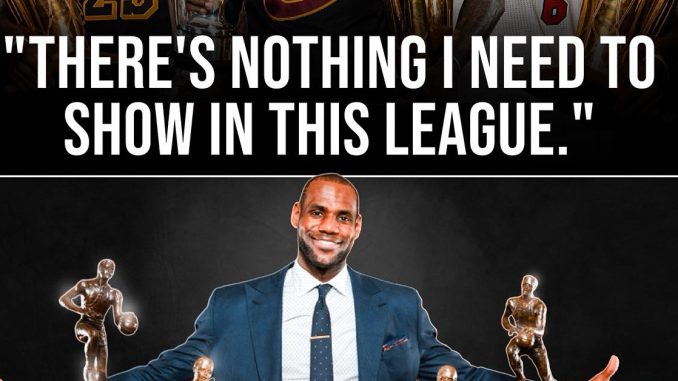
For more than two decades, the basketball world has watched LeBron James carry the weight of expectations unlike any athlete of his generation. Every season, every playoff run, every Finals appearance, every loss, and every championship has been dissected in real time under the brightest spotlight professional sports can offer. Yet somewhere along the journey, the conversations around LeBron shifted from evaluating greatness to demanding more greatness, as if the standard he created for himself became so absurdly high that anything short of perfection suddenly felt disappointing. That reality says more about LeBron’s unparalleled career than any stat sheet ever could, because the truth is simple: LeBron James owes basketball absolutely nothing.
Not another championship. Not another scoring milestone. Not another playoff run. Not another season carrying franchises deep into May and June while players half his age struggle to survive the physical grind of an 82-game season. His legacy was cemented long ago, and every chapter added since then has simply expanded a résumé that already belonged among the immortals of sports history.
For years, critics tried to frame LeBron’s career through impossible comparisons. Could he surpass Michael Jordan? Could he win enough titles? Could he dominate long enough? Could he evolve his game? Could he lead multiple franchises to championships? Could he succeed under overwhelming pressure? Every time basketball culture moved the goalposts, LeBron somehow found a way to meet the new standard.
When he entered the league in 2003 as an 18-year-old phenom from Akron, Ohio, the expectations were already historic. He was labeled “The Chosen One” before playing a single NBA game. Most young stars are allowed time to fail quietly while learning the league. LeBron never had that luxury. Every nationally televised game became an event. Every playoff exit became a debate show topic. Every flaw became headline material.
And still, he delivered.
He transformed the Cleveland Cavaliers from a struggling franchise into a perennial contender almost immediately. He became one of the league’s most dominant forces before he was old enough to legally drink. By his mid-20s, he was already collecting MVP awards and carrying undermanned rosters deep into the postseason against historically loaded opponents.
Yet even then, the criticism continued. Winning 60-plus games was not enough. Leading statistically in nearly every category was not enough. Reaching the NBA Finals at a young age was not enough. LeBron was judged by a different metric because everyone understood they were watching a once-in-a-lifetime player.
Then came “The Decision,” perhaps the most polarizing moment of his career. When LeBron left Cleveland for the Miami Heat in 2010, the backlash was immediate and relentless. Fans burned jerseys. Analysts questioned his mentality. Former players attacked his competitiveness. Overnight, basketball’s brightest star became its biggest villain.
But history has a funny way of reshaping narratives.
In Miami, LeBron evolved from a generational athlete into a complete basketball mastermind. Under intense scrutiny, he refined every weakness critics once highlighted. His post game improved. His shooting became more reliable. His defensive versatility reached terrifying levels. He learned how to control games mentally as much as physically.
And then the championships came.
Back-to-back titles. Back-to-back Finals MVPs. Four straight Finals appearances. The pressure that many believed would crush him instead forged one of the most dominant peaks the NBA has ever seen. LeBron silenced doubters not with words, but with basketball brilliance.
Yet perhaps the defining chapter of his legacy arrived when he returned home to Cleveland.
Athletes often talk about unfinished business, but few have ever completed a mission as emotionally significant as LeBron ending Cleveland’s 52-year professional sports championship drought. The 2016 NBA Finals against the Golden State Warriors remains one of the greatest achievements in basketball history. Down 3-1 against a 73-win team that many considered unbeatable, LeBron delivered performances that bordered on mythical.
The block on Andre Iguodala. The back-to-back 41-point games. The all-around dominance in every statistical category. The emotional release when the final buzzer sounded.
That championship changed everything.
For many fans and analysts, LeBron’s comeback victory in 2016 erased the last remaining criticism surrounding his greatness. He fulfilled the promise to his hometown. He defeated arguably the greatest regular-season team ever assembled. He delivered under maximum pressure. In that moment, his legacy no longer required validation.
Everything after that became bonus material.
And what remarkable bonus material it has been.
LeBron continued to redefine longevity after joining the Los Angeles Lakers. Most superstars decline sharply in their mid-30s. LeBron continued averaging elite numbers while carrying massive offensive responsibility. He adapted his game yet again, relying more on skill, intelligence, footwork, and precision while still unleashing flashes of the unstoppable athletic force that terrorized defenses for years.
Then came another championship in 2020 inside the Orlando bubble, one of the most mentally demanding environments the league has ever experienced. Critics attempted to diminish the accomplishment, but players across the NBA consistently acknowledged how difficult that season truly was. Isolated from families, cut off from normal routines, and forced to compete under unprecedented circumstances, LeBron once again rose above the chaos.
Four championships. Four Finals MVPs. Multiple franchises elevated to championship status. The NBA’s all-time leading scorer. Twenty-plus years of sustained excellence. Countless All-NBA selections. Historic playoff numbers. Olympic gold medals. Cultural influence that transcended basketball.
At some point, the debate shifted from whether LeBron belongs among the all-time greats to where exactly he ranks among the greatest athletes in sports history.
What makes LeBron’s story even more extraordinary is how completely he lived up to impossible expectations. That almost never happens. Hyped prospects fail constantly. Teenage phenoms crumble under pressure. Even Hall of Fame careers often fall short of the absurd projections placed on young superstars.
LeBron somehow exceeded them.
Think about how rare that truly is. A teenager entered the NBA carrying expectations comparable to the biggest sports prodigies ever seen, and instead of collapsing under the pressure, he became even greater than imagined. Two decades later, he remains one of basketball’s central figures while entire generations of stars have entered and exited the league around him.
The durability alone feels almost unreal.
Through countless playoff battles, Olympic competitions, deep postseason runs, and over 20 seasons of physical punishment, LeBron maintained a level of excellence that defied conventional sports science. His commitment to conditioning, recovery, nutrition, and preparation transformed him into a blueprint for longevity in modern athletics.
Younger stars openly study his routines. Coaches marvel at his basketball IQ. Former opponents praise his adaptability. Even longtime critics have gradually acknowledged the sheer impossibility of sustaining greatness at his level for this long.
And perhaps that is why conversations surrounding LeBron sometimes feel unfair. Fans became so accustomed to brilliance that they stopped appreciating how abnormal it all was. A 27-point triple-double became routine. Carrying teams through injuries became expected. Dominating playoff series at age 39 or 40 became normalized.
But history will remember these years differently.
Future generations will look back at LeBron’s career with disbelief, the same way modern fans examine the legends of past eras. They will study the longevity, the numbers, the versatility, the consistency, and the pressure he endured from the moment he entered the league. They will see a player who thrived in multiple basketball eras, against multiple generations of stars, while evolving his game repeatedly to stay dominant.
And beyond basketball, LeBron’s impact extended into culture, business, philanthropy, and athlete empowerment.
He became one of the most influential athlete voices of the modern era, unafraid to speak publicly on social issues and community concerns. Through the LeBron James Family Foundation, he invested heavily into education and opportunities for underserved communities in Akron. The I PROMISE School became one of the clearest examples of an athlete creating long-term impact beyond sports headlines.
That matters when discussing legacy.
Greatness is not only about trophies or statistics. It is about influence. It is about changing the shape of the sport and the culture surrounding it. LeBron did both.
He empowered athletes to think bigger about ownership and business. He helped redefine player mobility in the modern NBA. He built media ventures while still performing at an elite level on the court. He expanded the idea of what a basketball superstar could become.
Of course, debates will always exist. Basketball fans love arguing eras, championships, and individual greatness. Some will always choose Jordan. Others will point toward different legends like Kobe Bryant, Magic Johnson, or Kareem Abdul-Jabbar. That is part of sports culture.
But regardless of personal rankings, one truth has become undeniable: LeBron’s place in basketball history was secured years ago.
Every additional accomplishment now simply strengthens an already untouchable résumé.
If he never wins another championship, his legacy remains intact. If he never appears in another Finals series, nothing changes historically. If age eventually catches up and his production declines, it will not erase what he already accomplished against impossible odds for more than 20 years.
Basketball asked nearly everything from LeBron James, and he gave the game even more in return.
He gave fans unforgettable playoff moments. He gave franchises relevance and championships. He gave the NBA a global ambassador capable of carrying the league through multiple eras. He gave younger players a roadmap for professionalism and longevity. He gave the sport one of the most complete players ever seen — a scorer, passer, rebounder, leader, and basketball genius wrapped into one extraordinary career.
There may never be another player quite like him.
The combination of size, vision, athleticism, IQ, durability, and versatility was already unprecedented. Add in the pressure he faced from adolescence and the longevity he sustained into his late 30s and beyond, and the total package becomes almost impossible to replicate.
That is why the constant demand for “one more ring” often misses the larger picture. Championships matter, but they are not the sole measure of basketball greatness. Context matters. Competition matters. Longevity matters. Influence matters. Evolution matters.
LeBron mastered all of it.
He entered the NBA as the most hyped prospect in modern basketball history and somehow surpassed the impossible expectations attached to his name. He carried struggling franchises, built dynasties, won championships, shattered records, adapted through generations, and remained relevant long enough to inspire players who once idolized him as children.
That is not just greatness, that is basketball immortality and whether the final chapter arrives next season or years from now, the sport no longer needs anything else from LeBron James. The King’s legacy was cemented long ago.
Be the first to comment