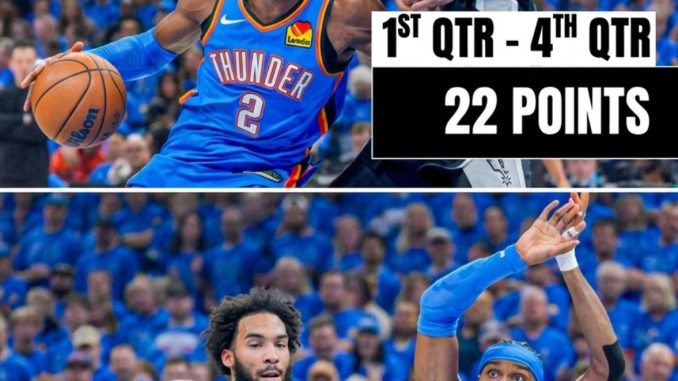
The roar inside Paycom Center faded into stunned silence long before the final buzzer officially confirmed it. The Oklahoma City Thunder had spent the entire postseason looking like an unstoppable machine, a young powerhouse fueled by the brilliance of newly crowned MVP Shai Gilgeous-Alexander and the confidence of a team that believed its moment had finally arrived. But in a Western Conference Finals opener that instantly became one of the most unforgettable playoff battles of the year, it was Victor Wembanyama and the San Antonio Spurs who walked out with the statement victory, silencing Oklahoma City and raising a question nobody expected to ask after the MVP ceremony: where did Shai disappear when the game mattered most?
For three quarters, the night felt destined to become another coronation moment for Gilgeous-Alexander. The Thunder crowd celebrated their superstar before tipoff as he officially received the NBA MVP trophy, and the energy in the arena carried the emotion of a franchise on the verge of something historic. Fans waved signs, teammates embraced him during introductions, and the building shook with chants of “MVP” every time he touched the ball.
Gilgeous-Alexander initially responded like the league’s best player. He controlled the pace, got to his favorite midrange spots, and repeatedly attacked the Spurs’ defense with the smooth patience that made him nearly impossible to guard all season. Oklahoma City looked poised to continue its playoff dominance after sweeping the Los Angeles Lakers in the previous round, and by halftime the Thunder appeared fully in control of the series opener.
But playoff basketball has a cruel way of rewriting narratives in real time.
As the game tightened in the fourth quarter, the Spurs slowly turned the matchup into a grind. Every possession became more physical. Every shot carried more pressure. Every mistake suddenly felt enormous. That shift favored San Antonio, especially with Wembanyama anchoring the defense and altering nearly everything near the rim.
The 7-foot-4 phenom was magnificent from the opening tip, showcasing why many around the league already believe he is the future face of basketball. Wembanyama dominated defensively with his length and timing, contesting jumpers that most defenders could never reach while also recovering fast enough to protect the paint. Offensively, he punished Oklahoma City with a combination of perimeter shooting, post play, and transition dominance that left the Thunder scrambling for answers.
Yet the defining story of the night became the dramatic contrast between the two superstars once overtime arrived.
After putting together a solid scoring performance during regulation, Gilgeous-Alexander suddenly vanished offensively in the extra periods. In the first overtime, he managed only two points. In the second overtime, he failed to score entirely. Possession after possession ended with forced jumpers, difficult drives into traffic, or the ball leaving his hands as San Antonio’s defense tightened around him like a vice.
Meanwhile, Wembanyama grew even stronger as the pressure intensified.
The Spurs star played with remarkable composure for someone still so early in his career. He buried contested shots, erased defensive breakdowns with spectacular blocks, and controlled the pace of overtime with the poise of a veteran champion. Every time Oklahoma City threatened to regain momentum, Wembanyama answered with another massive play.
One sequence late in the second overtime perfectly captured the entire game. Gilgeous-Alexander isolated near the top of the key, hoping to create one of the signature moments that defined his MVP season. Wembanyama switched onto him defensively, stretched his endless wingspan into the air, and forced an awkward miss that sent the crowd into disbelief. Seconds later, the Spurs raced the other direction and converted a critical basket that effectively sealed the game.
The contrast could not have been sharper.
One superstar elevated under the brightest lights. The other faded just as the game reached its most important possessions.
To be fair, Gilgeous-Alexander was far from terrible overall. He still finished with respectable numbers and spent much of regulation carrying Oklahoma City offensively. But MVPs are judged differently, especially in the postseason. Fair or unfair, the final moments tend to shape public memory more than the first three quarters. And in those moments, Gilgeous-Alexander struggled badly.
San Antonio deserves enormous credit for making life difficult on him. The Spurs mixed defensive coverages throughout the night, frequently trapping him on drives and forcing the ball out of his hands late in the clock. They crowded his midrange spots and used Wembanyama’s length to erase the space Gilgeous-Alexander usually relies on to operate comfortably.
The Thunder star looked increasingly exhausted as the game stretched deeper into overtime. Oklahoma City leaned heavily on him to create offense, and the Spurs exploited that burden by turning every possession into a physical battle. By the second overtime, Gilgeous-Alexander appeared hesitant at times, settling for contested shots rather than attacking with the aggression that made him nearly unstoppable during the regular season.
For the Thunder, the loss exposed vulnerabilities that had rarely appeared during their dominant playoff run. Oklahoma City entered the Western Conference Finals with swagger after dismantling the Lakers and earning the top seed in the Western Conference. The Thunder’s youth, speed, and offensive firepower overwhelmed nearly everyone they faced throughout the season.
But San Antonio is not intimidated by Oklahoma City’s rise.
The Spurs arrived in the conference finals playing their best basketball of the season after eliminating the Minnesota Timberwolves in convincing fashion. Their confidence has continued growing alongside Wembanyama’s superstardom, and Game 1 showed that they believe this series is theirs to win.
Perhaps most impressively, the Spurs never panicked despite playing in one of the loudest road environments imaginable. Oklahoma City repeatedly made runs that seemed capable of breaking the game open, yet San Antonio calmly responded every single time. Veteran leadership from players around Wembanyama steadied the team, while the young superstar himself played with an unbelievable level of maturity.
The game also reignited the growing debate about who truly owns the NBA’s future.
Gilgeous-Alexander just completed an MVP campaign and established himself among the league’s elite players. His rise transformed Oklahoma City from a rebuilding project into a legitimate championship contender. But Wembanyama’s performance on this stage reminded everyone why the basketball world has been obsessed with his ceiling since before he entered the league.
There were stretches during the game where Wembanyama looked almost unfair. He protected the rim like an all-time great center while simultaneously moving like a wing player on offense. He hit perimeter shots, attacked in transition, facilitated offense, and erased mistakes defensively with terrifying ease.
Most importantly, he delivered when the pressure peaked.
That matters in playoff basketball more than anything else.
The NBA has always been a league driven by superstar moments, and Wembanyama authored several during this thriller. His clutch shot-making, defensive dominance, and composure under pressure turned a difficult road game into a defining statement victory for San Antonio.
For Gilgeous-Alexander, the scrutiny will inevitably intensify after this performance. MVP winners are expected to dominate late-game situations, especially at home in the conference finals. Critics will focus heavily on the overtime numbers: just two total points across both extra periods. Social media exploded with reactions questioning how the league’s MVP could disappear so completely at the biggest moment of the postseason.
Some of that criticism may go too far. Basketball remains a team sport, and Oklahoma City’s supporting cast also struggled to deliver consistently in crunch time. Several Thunder role players missed key opportunities, while the team’s offense overall became stagnant late in the game.
Still, the spotlight naturally falls on the MVP.
That is the burden attached to greatness.
Thunder head coach Mark Daigneault defended his star afterward, emphasizing the defensive attention Gilgeous-Alexander faced throughout the night and praising the Spurs for their execution. But even within the organization, there is likely recognition that Oklahoma City needs more from its superstar late in games if it hopes to survive this series.
The encouraging news for the Thunder is that the series is far from over. Oklahoma City has responded well to adversity all season and still possesses one of the most talented rosters in basketball. Gilgeous-Alexander has repeatedly bounced back from disappointing performances throughout his career, and few expect him to remain quiet offensively for long.
Yet Game 1 fundamentally shifted the tone of the Western Conference Finals.
What initially looked like Oklahoma City’s moment suddenly feels far more uncertain.
San Antonio stole home-court advantage and demonstrated that the Thunder are vulnerable under postseason pressure. More importantly, the Spurs proved they have the best player on the floor when games become chaotic and emotionally overwhelming.
That sentence alone would have sounded impossible to many people just months ago considering Gilgeous-Alexander’s MVP season. But after watching Wembanyama dominate both ends of the court in one of the season’s biggest games, the conversation feels impossible to ignore.
The Spurs now carry momentum, confidence, and the psychological edge into Game 2. They know they survived Oklahoma City’s best early punches. They know they can win inside one of the NBA’s toughest arenas. And they know their franchise superstar thrives in the exact moments where championships are often decided.
As fans filed out of the arena after the marathon thriller, the emotions could not have been more different between the two sides. Spurs players celebrated a defining road victory while Thunder supporters stared in disbelief at how quickly the night had unraveled.
It began as a celebration of Oklahoma City’s MVP.
It ended as Victor Wembanyama’s masterpiece.
And now, instead of simply celebrating Shai Gilgeous-Alexander’s incredible season, the basketball world is asking a much harsher postseason question: when overtime arrived and the pressure became unbearable, did the MVP vanish?
Be the first to comment