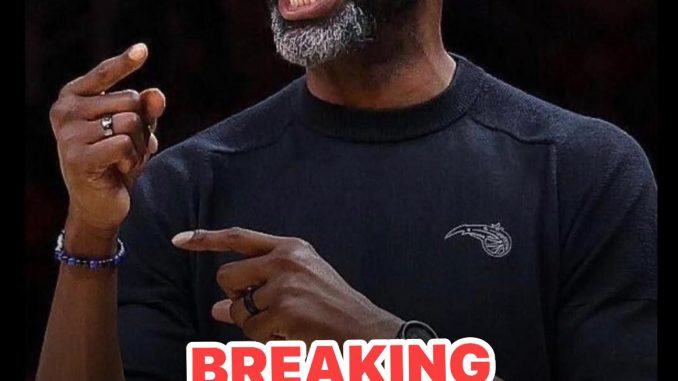
The New Orleans Pelicans have officially turned the page toward a new era, hiring Jamahl Mosley as the franchise’s new head coach in a move that signals ambition, patience, and a renewed commitment to building a sustainable winner in the Western Conference. After several impressive seasons guiding the Orlando Magic through one of the NBA’s most successful rebuilds in recent memory, Mosley now arrives in New Orleans with a growing reputation as one of basketball’s brightest coaching minds and one of the league’s most respected leaders.
For the Pelicans organization, the decision represents far more than a routine coaching change. It is a bold statement about identity, culture, and the direction of a franchise that believes it possesses the talent necessary to compete at the highest level but has struggled to find long-term consistency. Mosley’s arrival comes with the hope that he can maximize the team’s young core, stabilize a roster filled with potential, and finally guide New Orleans toward sustained postseason success.
The hire also reflects the increasing respect Mosley has earned throughout NBA circles over the past several years. After spending time as an assistant coach with the Denver Nuggets, Cleveland Cavaliers, and Dallas Mavericks, Mosley’s breakthrough came in Orlando, where he transformed a rebuilding roster into one of the Eastern Conference’s toughest and most disciplined teams. Under his leadership, the Magic developed into a playoff-caliber group known for elite defensive intensity, unselfish basketball, and relentless effort.
What stood out most during Mosley’s tenure in Orlando was not simply the playoff appearances themselves, but the way the team evolved under his guidance. When he first arrived with the Magic, expectations were modest. The roster was young, inexperienced, and lacking established stars. Many analysts viewed Orlando as a franchise years away from contention. Instead, Mosley cultivated a culture rooted in accountability, player development, and trust.
Within a remarkably short period of time, Orlando became one of the league’s most improved teams. Young players flourished under Mosley’s leadership, and the Magic earned three playoff appearances while building a foundation that many executives around the league admired. His ability to connect with players, particularly younger stars navigating the pressures of the NBA, became one of his defining strengths.
That player-first approach is expected to be crucial in New Orleans.
The Pelicans remain one of the NBA’s most fascinating teams because of the immense talent already on the roster. When healthy and fully engaged, New Orleans possesses the size, athleticism, and versatility to challenge virtually anyone in the league. Yet the franchise has repeatedly battled injuries, inconsistency, and unrealized expectations over recent seasons. Despite flashes of brilliance, the Pelicans have struggled to establish the stability necessary to become a true championship contender.
Now, the organization is betting that Mosley can unlock another level.
League sources have long described Mosley as one of the NBA’s best communicators, a coach capable of balancing demanding standards with strong personal relationships. Players throughout the league consistently praise his authenticity, energy, and ability to earn trust. Those qualities were evident during his years in Orlando, where several young players credited him for helping them mature both on and off the floor.
That emotional intelligence may prove especially valuable in New Orleans, where managing personalities, maintaining locker room chemistry, and navigating adversity have all been ongoing challenges.
Mosley inherits a roster that still carries significant expectations. The Pelicans have assembled a talented nucleus capable of competing in a loaded Western Conference, but health and consistency have repeatedly interrupted their momentum. There have been stretches where New Orleans looked like a legitimate threat near the top of the conference standings, only for injuries or uneven performances to derail progress.
Ownership and the front office clearly believe Mosley is the right leader to bring structure and continuity.
One executive around the league described the hiring as “a culture move as much as a basketball move,” noting that Mosley’s greatest strength may be his ability to create belief inside an organization. That reputation followed him throughout Orlando, where players competed with a level of effort and togetherness that became a defining characteristic of the team.
The Pelicans have shown signs of that identity in recent seasons, but not consistently enough to sustain long playoff runs. Mosley’s challenge will be to establish that standard every single night.
From a basketball standpoint, his defensive philosophy could immediately reshape New Orleans. Orlando emerged as one of the NBA’s most disruptive defensive teams under Mosley, using length, physicality, and disciplined rotations to frustrate opponents. The Magic regularly ranked among the league’s better defensive units, a reflection of both scheme and accountability.
The Pelicans already possess several versatile defenders and athletic wings capable of thriving in a similar system. Mosley’s emphasis on effort, communication, and defensive commitment could help transform New Orleans into one of the Western Conference’s more complete teams.
Offensively, Mosley also showed growth during his time in Orlando. Early in his tenure, the Magic struggled with spacing and half-court execution, common issues for young rebuilding teams. But over time, Orlando developed better offensive flow, improved ball movement, and greater confidence in late-game situations.
Those lessons will be important in New Orleans, where offensive rhythm has sometimes disappeared during critical moments. The Pelicans have often relied heavily on individual brilliance instead of sustained offensive structure. Mosley’s task will be to create a system that balances freedom with discipline while maximizing the roster’s unique strengths.
Perhaps most importantly, Mosley has proven he can develop young talent.
That ability may have been the single biggest factor that convinced New Orleans leadership to pursue him aggressively. Around the NBA, Mosley has become highly respected for his patience and commitment to player growth. Young athletes under his guidance improved not only statistically, but mentally and emotionally.
The Pelicans remain a relatively young team despite their experience in recent playoff races. Internal development remains essential if New Orleans hopes to compete with established powers across the conference. Mosley’s track record suggests he is uniquely equipped for that responsibility.
The timing of the move is also significant.
The Western Conference continues to evolve into one of the most competitive environments in professional sports. Traditional contenders remain dangerous, while younger teams are rapidly emerging as legitimate threats. In such a crowded landscape, organizational stability becomes increasingly valuable.
New Orleans believes Mosley can provide exactly that.
During his introductory meetings with team officials, sources say Mosley emphasized accountability, communication, and daily consistency as pillars of his coaching philosophy. Those themes resonate strongly with a franchise eager to move beyond unrealized potential and toward sustainable success.
The excitement surrounding Mosley’s arrival has already generated optimism among fans eager to see the franchise take the next step. Across social media and throughout the basketball community, reactions to the hire have been overwhelmingly positive. Many analysts view Mosley as one of the NBA’s rising coaching stars and believe his combination of emotional leadership and tactical discipline makes him an ideal fit for a young, talented roster.
Several former players and coaches also praised the decision shortly after the announcement became official.
One longtime NBA assistant described Mosley as “one of the most respected people in the league,” while another coach noted that his leadership style naturally inspires buy-in from players. That reputation could prove essential as the Pelicans attempt to build a stronger culture capable of surviving the inevitable adversity of an NBA season.
In today’s NBA, coaching extends far beyond drawing up plays or managing rotations. The modern head coach must act as a leader, communicator, motivator, strategist, and relationship builder simultaneously. Mosley’s rise throughout the league has been fueled largely by his ability to thrive in all of those areas.
Players who have worked with him often describe his approach as genuine and demanding at the same time. He holds athletes accountable while still maintaining strong personal connections, a balance that many organizations search years to find.
That dynamic helped Orlando evolve from a rebuilding project into a respected playoff team.
Now the Pelicans hope it can elevate them from an intriguing roster into a legitimate contender.
The pressure, however, will be immediate.
Unlike Orlando during the early stages of Mosley’s tenure, New Orleans is not entering a rebuild. Expectations already exist. Fans want playoff success, ownership wants meaningful progress, and the Western Conference offers little margin for extended adjustment periods.
Mosley will need to quickly establish his voice while also adapting to a roster with different personalities, expectations, and competitive timelines.
Still, there are strong reasons to believe the transition can succeed.
Mosley has spent years preparing for moments exactly like this. Even before becoming Orlando’s head coach, he was viewed as one of the league’s top assistant coaches and frequently interviewed for head coaching opportunities. His experience alongside respected basketball minds across multiple organizations gave him exposure to different systems, leadership styles, and organizational structures.
That diverse background helped shape the coach he eventually became.
In Dallas, Mosley worked closely with superstar talent while helping guide playoff-caliber teams. In Orlando, he learned how to build culture from the ground up. Now in New Orleans, he enters a situation somewhere between those two extremes — a talented team with playoff aspirations still searching for long-term identity.
His challenge will be finding
Be the first to comment