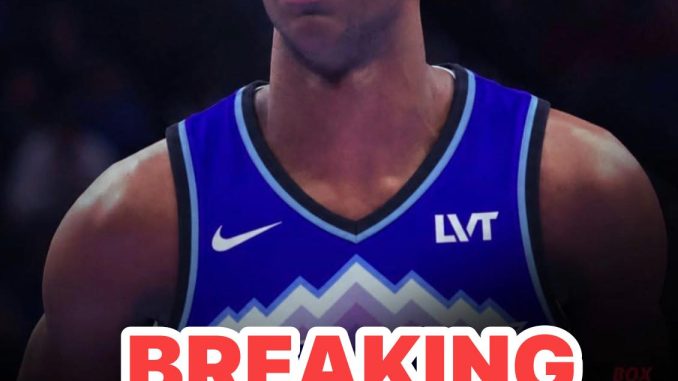
The NBA Draft landscape has taken another dramatic turn, and at the center of it all sits a franchise trying to define its future identity while resisting late pressure from an ambitious rival. According to league reports circulating ahead of draft night, the Washington Wizards are expected to retain the No. 1 overall pick and use it to select generational forward AJ Dybantsa, despite a strong and persistent push from the Utah Jazz to move up and alter the draft order at the top.
It is the kind of storyline that defines modern draft cycles: a struggling franchise armed with a franchise-altering selection, a rapidly rising prospect whose name has become synonymous with future superstardom, and a front office in Utah willing to test the limits of its asset pool in pursuit of a transformational talent. Yet, as things stand, Washington appears unmoved. The organization, long criticized for instability and inconsistent roster construction, is reportedly leaning into continuity with its evaluation process and maintaining confidence that Dybantsa is the centerpiece they have been projecting for years.
For the Wizards, the decision is not simply about selecting the best player available. It is about identity correction. After seasons of fluctuating direction, coaching changes, and incomplete rebuilds, Washington finally finds itself in position to control the most valuable asset in the NBA ecosystem: the first overall pick in a draft widely believed to feature a franchise cornerstone at the top. In league circles, Dybantsa has been described as a rare combination of physical dominance, perimeter skill, and competitive maturity that typically only emerges once every few draft cycles. For a team desperate to re-establish credibility in the Eastern Conference hierarchy, passing on that type of prospect would require overwhelming justification.
Dybantsa’s rise has been as swift as it has been emphatic. The 6-foot-9 forward has separated himself not just through highlight plays or scoring outbursts, but through the consistency of his dominance across different levels of competition. Scouts consistently point to his ability to create his own shot from multiple levels, his fluid transition game, and his defensive versatility as key markers of a modern NBA wing. In private workouts and international showcases, his poise has reportedly impressed evaluators as much as his physical tools. The consensus among many scouts is that Dybantsa does not simply fit the prototype of a No. 1 pick—he bends it toward his own profile.
That projection is exactly why Washington has remained steadfast despite external interest intensifying. League sources suggest that Utah’s front office has made multiple exploratory calls in recent weeks, attempting to gauge whether Washington would consider a trade package centered around multiple first-round picks and young rotational talent. The Jazz, who have been aggressively stockpiling assets in recent years, see Dybantsa as a potential franchise-altering wing who could accelerate their timeline and pair with their existing young core to form a long-term contender in the Western Conference.
Utah’s interest is not surprising. The organization has consistently positioned itself as one of the more opportunistic front offices in the league, willing to leverage future flexibility for present-day upside when the right player becomes available. But the cost of moving into the No. 1 slot in a draft featuring a consensus top-tier talent is typically astronomical, and Washington’s reported asking price reflects that reality. According to league chatter, the Wizards were never close to serious negotiations, as their valuation of the pick aligns directly with the belief that Dybantsa is not just the best player in the draft, but a foundational piece for the next decade.
Inside the Wizards’ front office, the decision is framed around stability and clarity. For years, Washington has cycled through rebuilding phases without ever fully committing to one identity long enough to see it through. Selecting Dybantsa represents a philosophical shift: an acknowledgment that true rebuilding requires patience, internal development, and the willingness to build around a singular star prospect rather than chase incremental upgrades through trades and short-term signings. The organization views this pick as an opportunity to reset expectations entirely.
There is also the matter of marketability and cultural impact. While front offices rarely admit it publicly, the No. 1 pick carries with it a commercial and organizational boost that extends beyond the court. Dybantsa’s growing profile as a nationally recognized prospect has already attracted attention from major brands and media outlets, and his arrival in Washington would immediately elevate the franchise’s national relevance. In a league where visibility often translates to leverage in free agency and trade negotiations, that matters.
On the court, analysts believe Dybantsa could bring immediate structure to a Wizards roster that has struggled to find a consistent offensive identity. His ability to operate as both a primary scorer and secondary facilitator makes him an ideal modern forward. He is comfortable initiating offense in transition, punishing mismatches in isolation, and reading defensive rotations well beyond his years. Perhaps most importantly, evaluators believe his game translates quickly due to its simplicity in execution—he does not rely on overly complex systems to impact games.
Defensively, Dybantsa’s length and lateral mobility give him the tools to guard multiple positions, a necessity in today’s switch-heavy NBA schemes. While he will need refinement in defensive discipline and off-ball awareness, scouts note that his instincts are already ahead of many prospects his age. That combination of immediate utility and long-term upside is precisely what makes him the kind of prospect franchises hesitate to pass on, even when trade packages become enticing.
For Utah, the frustration is understandable. The Jazz have assembled a collection of promising young players and draft capital, yet they remain without a definitive franchise face capable of elevating them into true contention. Their pursuit of the No. 1 pick underscores a recognition that elite talent acquisition is often the fastest path out of the NBA’s middle tier. In Dybantsa, they see a player who could potentially anchor both ends of the floor for years, providing the kind of two-way foundation that contending teams are built around.
Still, Washington’s stance suggests that the asking price—both financially and strategically—was too high for negotiations to gain traction. Sources around the league describe the Wizards’ internal discussions as increasingly unified, with ownership, front office leadership, and scouting departments all aligned on the belief that this pick should not be moved under any realistic circumstance. That level of organizational consensus is rare in high-stakes draft environments, and it has played a major role in solidifying their position.
As draft night approaches, anticipation continues to build around the selection itself rather than potential trade chaos. The expectation is that once Washington officially goes on the clock, there will be minimal drama at the top of the board. Instead, the focus will quickly shift to how quickly Dybantsa can adapt to the NBA stage and how his presence reshapes the Wizards’ roster construction moving forward.
Around the league, executives are already projecting ripple effects. A player of Dybantsa’s caliber entering a rebuilding environment changes timelines not just for Washington, but for multiple Eastern Conference teams that had hoped the Wizards might entertain a trade-down scenario. His arrival effectively locks Washington into a long-term developmental arc centered around a high-usage wing star, potentially influencing free agency decisions, coaching strategies, and future trade markets.
As for Dybantsa himself, the expectation of becoming the No. 1 pick brings with it a level of pressure that few players experience before ever stepping onto an NBA court. Yet those who have followed his journey closely describe him as unusually composed for a prospect of his stature. His focus, they say, remains fixed on development rather than narrative. That mindset may prove essential as he transitions into one of the most scrutinized roles in professional basketball.
If the reports hold, the moment commissioner Adam Silver announces his name as the No. 1 pick will mark the beginning of a new era in Washington. It will also serve as a reminder of how quickly the NBA hierarchy can shift when a franchise finally secures the type of talent capable of changing its trajectory. For the Wizards, the decision to hold firm despite Utah’s aggressive pursuit signals conviction. For the rest of the league, it signals that Washington believes its future is already within reach—and that future is named AJ Dybantsa.
Be the first to comment