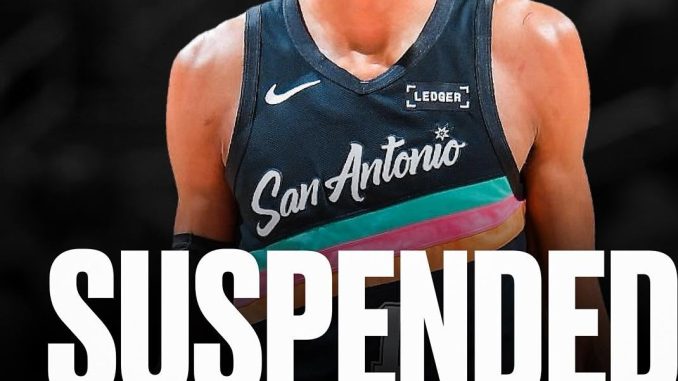
Victor Wembanyama’s march through the NBA Finals has hit an unexpected and potentially series-altering obstacle.
Just hours before Game 4 of the championship showdown between the San Antonio Spurs and the New York Knicks, the NBA announced that Wembanyama has been suspended for one game after the league office upgraded his controversial shove to Jalen Brunson’s head from a Flagrant Foul 1 to a Flagrant Foul 2. The decision gives the Spurs superstar his fourth flagrant foul point of the postseason, automatically triggering a suspension under league rules and forcing him to miss one of the most important games of San Antonio’s season.
The ruling instantly changes the complexion of the Finals.
San Antonio enters Game 4 trailing New York 2-1 in the series after clawing back into contention with a hard-fought victory at Madison Square Garden in Game 3. The Spurs appeared to have regained momentum, rediscovered their defensive identity, and placed pressure back on a Knicks team that suddenly looked vulnerable after dropping the first game on its home floor in the Finals.
Now, with Wembanyama sidelined, the challenge facing San Antonio becomes significantly steeper.
The incident that sparked the suspension occurred during a heated sequence late in Game 3. As emotions intensified and physicality escalated between the two teams, Wembanyama and Brunson became entangled during a battle for position. Following the exchange, Wembanyama delivered a forceful shove that made contact with Brunson’s head and upper body, sending the Knicks star stumbling backward.
Officials reviewed the play during the game and assessed a Flagrant Foul 1. At the time, the decision allowed Wembanyama to remain in the contest, and the Spurs ultimately secured a critical victory to avoid falling into a nearly insurmountable 3-0 deficit.
However, the NBA’s postgame review process reached a different conclusion.
After examining multiple camera angles and evaluating the severity of the contact, league officials determined that the play warranted an upgrade to a Flagrant Foul 2. The ruling not only increased scrutiny surrounding the incident but also carried immediate consequences because of Wembanyama’s accumulated flagrant foul point total throughout the playoffs.
Under NBA postseason disciplinary guidelines, players who reach four flagrant foul points are automatically suspended for one game. The upgrade pushed Wembanyama over that threshold.
For San Antonio, the timing could not be worse.
The Spurs have built much of their playoff success around the generational talent of the 7-foot-4 French phenom. Throughout the postseason, Wembanyama has been the centerpiece of everything San Antonio does on both ends of the floor. His ability to score from all three levels, protect the rim, switch defensively onto smaller guards, and impact games without even touching the basketball has transformed the Spurs into one of the league’s most dangerous teams.
His presence alone changes the geometry of the court.
Offensively, defenders are forced to account for his extraordinary length and shooting ability. Defensively, opponents frequently alter shots or avoid the paint entirely when he is on the floor. Few players in league history have combined size, skill, and versatility in the manner Wembanyama has displayed during his young career.
That influence has been evident throughout the Finals.
Even when New York successfully limited portions of his offensive game in the opening two contests, Wembanyama remained a dominant force. His rebounding, shot-blocking, and ability to create mismatches kept San Antonio competitive despite falling behind in the series.
Game 3 showcased why many observers already view him as one of the NBA’s most impactful players.
With the Spurs facing enormous pressure, Wembanyama responded with an aggressive performance that helped shift the series narrative. He controlled the paint, disrupted New York’s offensive rhythm, and delivered key plays in crucial moments as San Antonio secured a much-needed victory.
Now the Spurs must attempt to duplicate that effort without him.
The responsibility will inevitably fall on the shoulders of the rest of San Antonio’s roster.
Veteran leaders and emerging contributors alike will need to elevate their performances. The absence of Wembanyama removes not only the team’s leading star but also its emotional anchor. Players who previously benefited from the defensive attention he attracts will now face increased pressure to create offense on their own.
The frontcourt rotation becomes particularly intriguing.
Without Wembanyama’s elite rim protection, the Spurs must find alternative ways to slow Brunson and the Knicks’ attack. New York has repeatedly relied on Brunson’s ability to penetrate defenses, create scoring opportunities, and control tempo throughout the postseason. The All-NBA guard has been the engine behind the Knicks’ Finals run, delivering clutch performances and demonstrating remarkable composure under pressure.
With Wembanyama unavailable, Brunson could find additional room to operate.
That possibility is undoubtedly encouraging for New York.
The Knicks entered the Finals carrying the weight of enormous expectations and the hopes of a fan base desperate for a championship. After winning the first two games of the series, they appeared firmly in control before San Antonio’s Game 3 resurgence injected uncertainty into the matchup.
The suspension may provide New York with a golden opportunity to regain command.
Madison Square Garden is expected to be electric for Game 4, and the Knicks understand the significance of the moment. A victory would move them within one win of the championship and place overwhelming pressure on the Spurs heading into the remainder of the series.
Brunson, meanwhile, has largely avoided escalating discussion surrounding the incident itself. Throughout the postseason, the Knicks guard has consistently maintained a team-first focus, emphasizing preparation and execution over controversy.
Yet there is little doubt that the physical nature of this series has become one of its defining characteristics.
From the opening tip of Game 1, both teams have embraced an intense, hard-nosed style of basketball. Possessions have frequently resembled playoff battles from previous eras, with every rebound contested and every drive challenged.
The escalating physicality has produced dramatic moments, emotional confrontations, and heightened tensions between players.
Wembanyama’s suspension now adds another layer to that storyline.
For the NBA, the decision also underscores the league’s commitment to enforcing postseason standards regardless of circumstance. Suspending a superstar during the Finals is never a move the league takes lightly. Such decisions inevitably generate debate among fans, analysts, and former players.
Some observers will argue that the punishment is excessive given the magnitude of the stage and the importance of keeping the league’s brightest stars on the court. Others will contend that rules must be applied consistently, particularly when contact involves a player’s head.
The NBA clearly sided with the latter interpretation.
League officials determined that the nature of the contact warranted the upgrade and accepted the resulting suspension as a consequence of the established flagrant foul point system.
That system was specifically designed to discourage dangerous play and maintain accountability throughout the postseason. Once a player accumulates enough points, suspension becomes automatic, removing much of the subjective debate that often accompanies disciplinary decisions.
Nevertheless, controversy is unavoidable.
The Finals represent the league’s showcase event, and losing one of its most recognizable stars for a pivotal game instantly becomes a major talking point across the basketball world.
For Wembanyama personally, the suspension serves as a painful lesson.
At just the beginning of what many expect to be a historic career, he has consistently displayed maturity and professionalism. Yet the intensity of championship basketball can test even the most composed competitors.
The French star’s competitive fire has been one of the driving forces behind San Antonio’s success. That passion often fuels spectacular performances, but in this instance it appears to have crossed a line that resulted in significant consequences.
How he responds moving forward could be just as important as the suspension itself.
Great players frequently face adversity during their careers. Championships are often shaped not only by moments of dominance but also by moments of disappointment and resilience. Wembanyama will have an opportunity to demonstrate both if the Spurs can survive Game 4 and extend the series.
His absence may also create opportunities for other players to step into larger roles.
Championship runs are often remembered for unexpected heroes who emerge when circumstances demand it. Someone within San Antonio’s locker room must now provide that spark.
Whether it comes from a veteran seeking redemption, a young player embracing a bigger responsibility, or a collective team effort remains to be seen.
What is certain is that the Spurs can no longer rely on their superstar to solve every problem.
Head coach Gregg Popovich faces perhaps his toughest challenge of the postseason. One of the greatest coaches in basketball history, Popovich has built a reputation on adaptability, discipline, and maximizing the strengths of his roster. Those qualities will be tested once again as he prepares a game plan without the centerpiece of his team.
Expect strategic adjustments.
Expect lineup changes.
Expect an increased emphasis on ball movement, defensive rotations, and collective execution.
Because replacing Wembanyama individually is impossible.
The Spurs must instead attempt to replace him collectively.
Meanwhile, the Knicks understand that opportunity alone guarantees nothing.
Championship teams capitalize on favorable situations, but they also recognize the dangers of complacency. New York still must execute, defend, rebound, and withstand the inevitable surge from a desperate Spurs squad determined to keep its title hopes alive.
The stakes could hardly be higher.
A Knicks victory would place them on the doorstep of a championship and strengthen their grip on the series. A Spurs victory, achieved without their biggest star, would become one of the defining moments of their postseason journey and dramatically alter the psychological balance of the Finals.
As Game 4 approaches, all eyes will remain fixed on Wembanyama—even though he will not be on the floor.
His suspension has transformed a highly anticipated Finals matchup into an even more compelling drama. The NBA’s brightest young superstar will be forced to watch from the sidelines while his teammates attempt to navigate the most critical challenge of their season.
For San Antonio, the mission is clear: survive one night without the player who has carried them through so many others.
For New York, the objective is equally straightforward: seize the opportunity, protect home court, and move within touching distance of basketball immortality.
And for the Finals themselves, Wembanyama’s suspension ensures that Game 4 will be remembered as far more than just another contest. It will be a defining test of depth, resilience, discipline, and championship character—one capable of shaping not only the outcome of this series but also the legacy of everyone involved.
Be the first to comment