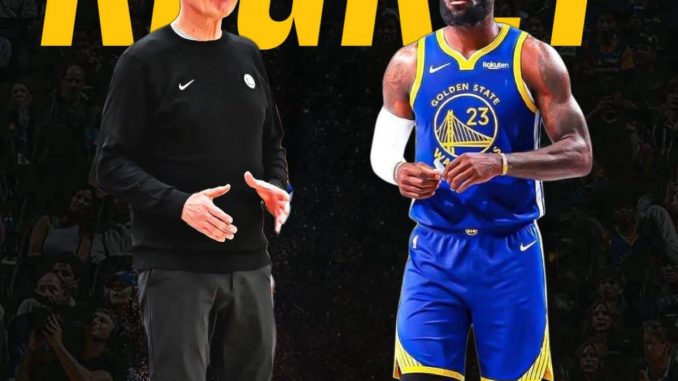
The possibility of a seismic shift in the NBA landscape is once again dominating league conversations, and this time it centers on the potential pairing of two of basketball’s most recognizable figures. Recent reports and speculation around the league suggest that Steve Kerr could eventually regret his decision to remain with the Golden State Warriors if the organization commits to pursuing LeBron James this offseason in a blockbuster move that would instantly become one of the most significant transactions in modern basketball history.
On paper, the idea sounds irresistible. James, even at this stage of his legendary career, remains one of the most productive players in the league. The four-time NBA champion continues to perform at an elite level, showcasing the versatility, basketball IQ, and leadership that have defined his two-decade reign among the sport’s greatest players. Adding a talent of his caliber to a Warriors franchise that already possesses championship pedigree would immediately elevate expectations and place Golden State squarely back into the center of the title conversation.
Yet for all the excitement such a move would generate, there is an equally compelling argument that it could create more problems than solutions. The concerns are not necessarily about James’ ability. Few executives, coaches, or players would question what he can still bring to a contender. Instead, the debate revolves around the broader implications of such a move and whether the Warriors would be sacrificing stability, chemistry, and long-term flexibility in pursuit of one final championship push.
For Kerr, the situation would be especially delicate.
The veteran coach has spent years building a culture centered on ball movement, spacing, player development, and a unique offensive identity that transformed Golden State into one of the most dominant dynasties in NBA history. His partnership with franchise cornerstone Stephen Curry helped revolutionize the modern game and delivered multiple championships to the Bay Area.
Bringing James into that environment would undoubtedly raise expectations to unprecedented levels. Every decision would be scrutinized. Every lineup combination would become a national discussion. Every loss would spark questions about whether the experiment was working.
The challenge would not simply be fitting James into the Warriors system. It would be determining whether the Warriors system could remain intact once a player of his stature arrived.
Throughout his career, James has thrived when offenses have been built around his strengths. His ability to control tempo, initiate offense, and dictate matchups has made him one of the most effective floor generals basketball has ever seen. Golden State, however, has historically operated differently. The Warriors’ offense relies heavily on constant movement, split actions, quick reads, and a willingness to surrender individual control for collective success.
That contrast creates a fascinating basketball question.
Could James seamlessly adapt to Golden State’s style, or would the Warriors gradually alter their identity to maximize his strengths?
Either scenario carries risk.
If James were asked to significantly adjust his approach, there would be concerns about diminishing the effectiveness of a player who has succeeded by playing his game for more than twenty years. On the other hand, if Golden State reshaped its offense around James, it could undermine many of the principles that made the franchise successful in the first place.
For Kerr, navigating that balance would become one of the most difficult coaching challenges of his career.
The potential complications extend beyond X’s and O’s.
Team chemistry often determines whether a championship contender reaches its full potential. History is filled with examples of talented rosters that failed to meet expectations because roles became unclear or personalities clashed. While James has demonstrated an ability to coexist with elite talent throughout his career, integrating another superstar into an established locker room is never a simple process.
Golden State already possesses a defined hierarchy and culture. Curry remains the face of the franchise and one of the most beloved athletes in basketball. Veterans understand their responsibilities. Younger players know the organizational expectations. Introducing a player as influential as James would inevitably alter those dynamics.
Even if everyone involved approached the situation with the best intentions, adjustments would be required. Rotations would change. Offensive responsibilities would shift. Media attention would multiply. Internal expectations would reach extraordinary levels.
That pressure alone could become a significant obstacle.
The NBA has repeatedly shown that assembling star power does not automatically translate into championships. Talent creates opportunity, but cohesion determines success.
Perhaps the greatest concern for Kerr and the Warriors would involve the future beyond the immediate championship window.
James remains productive, but he is approaching the later stages of an unprecedented career. Any move to acquire him would likely require substantial financial commitments and potentially significant roster changes. Golden State would need to evaluate whether sacrificing younger assets, draft capital, or long-term flexibility would be justified for what could be a relatively short championship window.
The Warriors have already experienced the challenges of balancing present ambitions with future planning. The organization spent years attempting to remain competitive while simultaneously developing younger players capable of carrying the franchise into its next era.
Pursuing James could effectively signal a complete commitment to the present.
That approach might be understandable given Curry’s age and continued excellence. The Warriors know opportunities to compete for championships are limited, and maximizing Curry’s remaining prime years is a logical organizational objective.
Still, the consequences could be substantial if the gamble fails.
Should Golden State make significant sacrifices to acquire James and fall short of a championship, the franchise could find itself facing an uncertain future with fewer resources available for rebuilding or retooling. In that scenario, Kerr would likely face questions about whether the organization should have pursued a different path.
The irony is that Kerr and James share a unique basketball history.
The two spent years competing against one another on the sport’s biggest stage. The Warriors and James’ Cleveland teams delivered some of the most memorable Finals matchups in NBA history, creating a rivalry that defined an era. Kerr witnessed firsthand both the brilliance and the challenges of preparing for James.
Now, the possibility exists that they could find themselves working together rather than opposing one another.
From a basketball perspective, the partnership is undeniably intriguing.
Imagine James orchestrating offense while Curry stretches defenses to their breaking point. Imagine opposing teams attempting to contain two of the greatest basketball minds the sport has ever produced. Imagine the matchup nightmares created by James’ size, strength, and playmaking alongside Golden State’s established shooting infrastructure.
Those possibilities explain why the rumors continue generating attention throughout the basketball world.
Few potential moves possess a higher ceiling.
At their best, James and Curry could form a combination unlike anything the league has seen in recent years. Both players possess extraordinary basketball intelligence. Both are proven champions. Both have consistently elevated teammates throughout their careers.
A successful partnership could reignite Golden State’s championship aspirations almost immediately.
However, high ceilings often come with significant risks.
Age remains a factor. Health remains a factor. Financial implications remain a factor.
Even great players are not immune to the realities of time.
The Warriors would be betting that James can continue performing at an elite level deep into his career. While he has repeatedly defied expectations regarding longevity, every organization must eventually confront the question of how long exceptional production can realistically continue.
For Kerr, that uncertainty could become especially frustrating if injuries or age-related decline begin impacting performance after major roster sacrifices have already been made.
Another challenge would involve defensive identity.
Golden State’s championship teams traditionally combined offensive firepower with defensive discipline. While James remains capable of impactful defensive stretches, maintaining elite defensive intensity throughout a long season becomes increasingly difficult as players age.
The Warriors would need to carefully manage workloads, rotations, and expectations.
That responsibility would fall largely on Kerr.
The veteran coach has earned a reputation as one of basketball’s most respected leaders, but even the most accomplished coaches face limitations. Managing superstar egos, championship expectations, and organizational priorities simultaneously is never easy.
If the Warriors acquired James and struggled early, scrutiny would arrive immediately.
Questions would emerge regarding lineup decisions. Analysts would debate usage rates. Fans would demand adjustments. National media coverage would intensify with every result.
Kerr would become the central figure responsible for ensuring the experiment succeeds.
That reality explains why some observers believe he could ultimately regret the situation.
Not because James lacks talent.
Not because the Warriors lack ambition.
But because expectations attached to such a move would be nearly impossible to satisfy.
Anything short of a championship could be viewed as failure.
That standard creates immense pressure for everyone involved.
The Warriors have spent more than a decade building one of the NBA’s most successful modern organizations. Their dynasty was not merely a product of talent; it was a product of continuity, trust, and a clearly defined basketball philosophy.
Introducing James would challenge each of those elements.
The organization would essentially be betting that extraordinary talent can overcome the natural difficulties associated with integrating another superstar into an already established environment.
Sometimes those bets pay off.
Other times they create unintended consequences that linger for years.
League executives understand this reality well. Championship windows are precious, and bold moves often determine whether franchises maximize those opportunities. Yet aggressive decisions also carry the potential for long-term repercussions.
Golden State’s front office would need to carefully evaluate every aspect of a potential pursuit.
Would James’ arrival increase championship odds enough to justify the cost?
Would the roster remain balanced after the necessary transactions?
Would the Warriors still possess enough depth to survive an 82-game season and four playoff rounds?
Would the partnership between James, Curry, and Kerr function as smoothly in practice as it appears on paper?
Those questions currently have no definitive answers.
What is clear is that the mere possibility of James joining the Warriors has already captured the imagination of the basketball world.
Fans envision championship celebrations. Critics predict chemistry issues. Analysts debate roster construction. Former players offer differing opinions about how such a partnership might unfold.
That uncertainty is precisely what makes the story so compelling.
For Kerr, the stakes would be enormous.
A successful partnership could further enhance his legacy, adding another remarkable chapter to an already distinguished coaching career. Guiding a team led by both Curry and James to championship success would represent one of the most impressive achievements of the modern NBA era.
Failure, however, would invite a different narrative.
Observers would question whether the Warriors abandoned their long-term vision. They would wonder whether the organization became too focused on star power. They would debate whether the franchise should have remained committed to its existing foundation rather than pursuing another blockbuster headline.
Those are the risks attached to every major decision in professional sports.
As the offseason approaches, speculation will continue to intensify. Rumors will grow louder. Scenarios will be examined from every possible angle. The Warriors will undoubtedly explore opportunities to strengthen their roster, while James’ future will remain one of the league’s most closely monitored storylines.
Whether the partnership ultimately materializes remains uncertain.
What is certain is that the prospect of James joining Golden State represents one of the most fascinating what-if scenarios in recent NBA memory.
It offers the promise of greatness, the possibility of another championship run, and the chance to unite some of the most influential figures the game has ever seen.
At the same time, it presents significant questions regarding fit, chemistry, identity, and long-term sustainability.
For Kerr, the decision could ultimately define the next chapter of his career. If everything clicks, the Warriors may once again find themselves at the top of the basketball world. If it does not, the move could become a cautionary tale about the dangers of chasing one more title at any cost.
That is why league observers remain so captivated by the possibility. The rewards are enormous. The risks are equally significant. And somewhere between those two extremes lies the answer to whether pursuing LeBron James would become Golden State’s next championship masterstroke—or the decision Steve Kerr wishes had never happened.
Be the first to comment